When I was born, in 1972, the Somoza dictatorship had been in power for 36 years. Nicaragua already had a history of resistance, silence and accumulated wounds. Roberto actively participated in that resistance and, by 1979, he had already been a courier, and had experienced clandestinity and exile, three of the multiple forms that the fight against the dictatorship took. He returned to Nicaragua on July 19, the day the revolution triumphed.
A few days ago I wrote about how we inhabit losses in contexts of repression and exile. Among the messages I received also appeared an inquiry into Roberto’s political past and the marks that the eighties continue to leave on many Nicaraguan families.
Far from evading that question, it moved me to a necessary reflection. If we maintain that grief is not only an intimate experience, but also a collective one, we have to be willing to look squarely at the complexities, the chiaroscuros and the accumulated memories that we carry as a society.
In Nicaragua, the pain did not start yesterday. Narratives about the past are still active and continue to shape our present. That questioning also stirred in me something that I have been discovering in the last year: that Roberto’s murder has opened a portal to memories and political murders that have marked the political life of Nicaragua, even before I was born.
Perhaps because our bodies are also historical records and because there are wounds that do not disappear: they accumulate, are inherited and reappear at different times in our collective life.
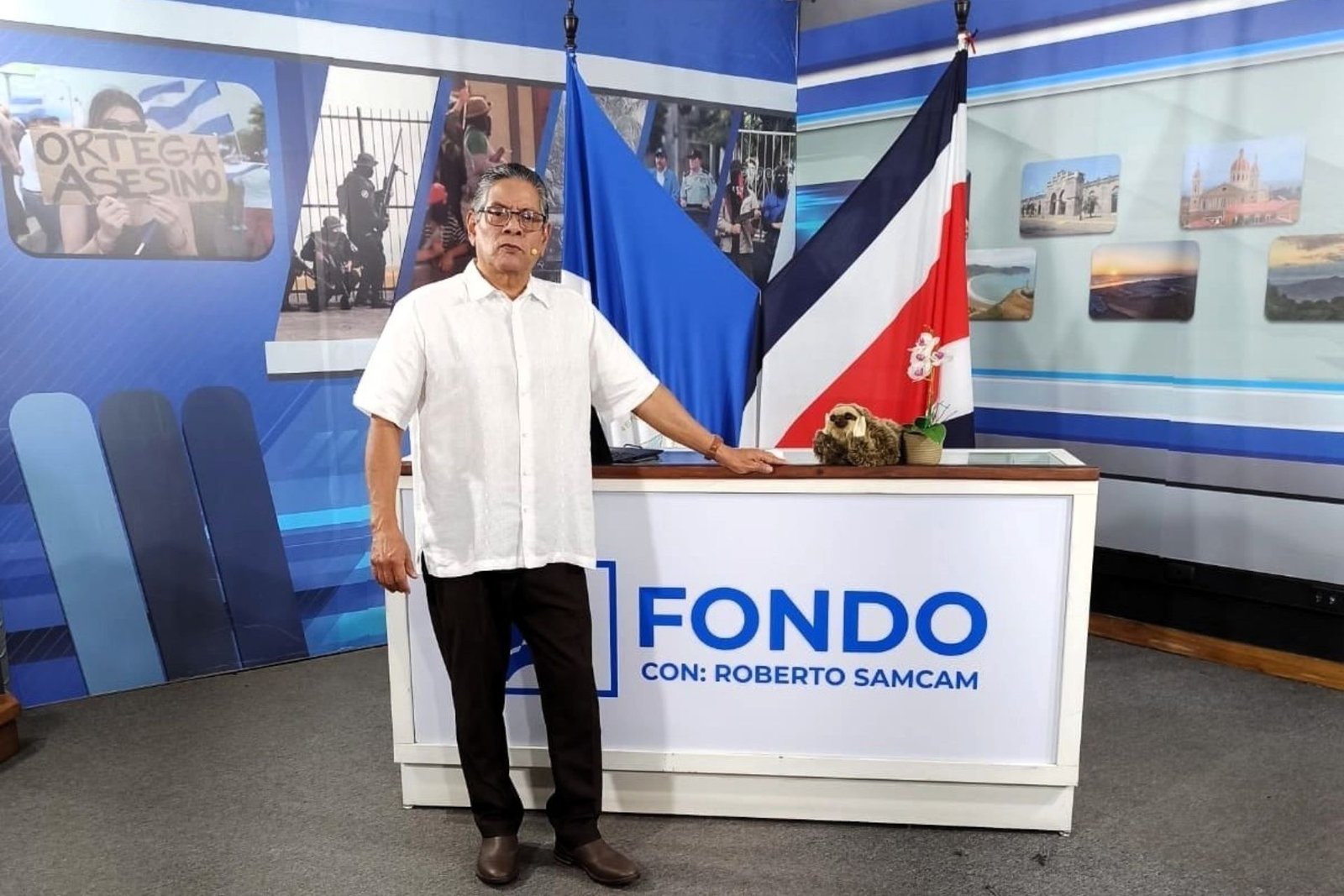
write about Roberto Samcam* from this place is, for me, an exercise in historical honesty. People who have lived intensely, have been protagonists in the processes of their time and have left traces in history cannot be reduced to simplistic analyses. To do so would be to narrow our gaze: to put a magnifying glass on the individual and forget the historical conditions, the power structures, the global disputes, the asymmetries and the multiple actors that shaped each era.
Roberto belonged to a generation that faced a Somoza dynasty. He then participated in a heartbreaking conflict, an intervention and civil war, also crossed by the logic of the global Cold War. That history cannot be read lightly or from the comfort of quick labels.
But his trajectory cannot be frozen in a single moment either. The dignity of his path did not lie in a supposed infallibility, but in his critical capacity to look at the environment, look at himself, integrate learning and break with what he no longer recognized as his own. He turned away as he anticipated that the project he once believed in no longer existed and was becoming what they once fought against. The common thread of his career is not in the places he occupied, but in the convictions he never abandoned.
The breakup was not only political. It also transformed the forms of its commitment to the country. When peace became a real possibility in 1990, he requested his retirement from the Army. Years later, when he saw that peace threatened, he would get involved again in public and party life from other spaces, convinced that convictions could be sustained without weapons. Politics, analysis, documentation, denunciation and words occupied the place that war had previously had.
Roberto became a firm opponent of today’s Ortega Murillo dictatorship. He did it with the same conviction with which in his youth he faced the Somoza dictatorship. And perhaps therein lies a fundamental part of his legacy: not having remained a prisoner of a political identity when it stopped representing his convictions, but rather having dared to review, disobey and find new ways to embody the principles he always defended.
This speaks to a conviction that I have been working on: “The exit is inwards”. We cannot build a future if we continue to reduce our history to absolutist poles. We cannot speak seriously about memory, justice or democracy if we turn political biographies into moral caricatures. Understanding is not justifying. Looking broadly does not mean erasing responsibilities, nor ignoring the asymmetries of power, nor relativizing the pain of those who were victims at different times in our history.
On the contrary. That’s what memory is for. To broaden the view. To understand the broken paths. Nicaraguan history is inhabited by multiple pasts and multiple wounds. Those who carry the wounds of the Somoza dictatorship, those who were affected by the war of the eighties and those who have experienced repression in more recent times coexist in it. Many times those stories are not separate. They inhabit the same families, the same bodies and the same biographies. Wounds do not always belong to different generations. Sometimes they accumulate, are inherited and overlap.
Acknowledging the pain of other families does not weaken our current fight; humanizes her. Politicizing collective mourning also implies taking charge of these historical legacies and accepting that shared memory is not unanimous. It is disputed territory, but it can also be a space to understand each other better.
The debate we need is not that of sterile insults on a screen. Nor that of simplification that cancels all complexity. We need a word capable of sustaining contradictions without giving up the truth.
Honoring Roberto’s memory and thinking about Nicaragua requires that maturity: accepting that a person could have been part of a painful story and, at the same time, had the lucidity, courage and honesty to break with it to defend freedom until the last of his days.
The memory we need is not a complacent memory, but a more rigorous and more human memory. A memory capable of looking at the wounds head-on without denying the humanity of those who were protagonists of this story and were also crossed by it, because we also have the right to complexity.
*Roberto Samcam was a retired military officer, political analyst and one of the most critical voices of the authoritarian drift in Nicaragua. Exiled in Costa Rica since 2018, he was murdered in San José on June 19, 2025 in a crime that today constitutes the most emblematic case of the escalation of Nicaraguan transnational repression.