
Extreme heat broke out in late May already weather records in Spain, France and the United Kingdom. Also in the Netherlands: it was the warmest May 26 since temperatures have been recorded. The mercury in De Bilt rose past 29.1 degrees Celsius around half past one in the afternoon. This officially breaks the previous record from 2005. That reports weather website Weeronline based on data from the Royal Netherlands Meteorological Institute (KNMI). The KNMI itself does not report daily records, because such records occur relatively often and the weather per day is largely determined by chance.
It is certain that it is already exceptionally warm for this time of year in May, thanks to a so-called ‘heat dome’ that hangs over Europe. Meteorologists speak of a heat dome when a high-pressure area lingers in one place for longer than normal, as a result of which heat is, as it were, trapped under a cover of downward air pressure. Because clouds remain at a distance due to the high-pressure area, sunlight can continue to contribute to further warming unhindered.
The heat dome is clearly visible on weather maps of Europe. Meteorological models showed on Tuesday how a layer of air that normally lies halfway up the atmosphere has risen to greater heights through the heat dome. In an area stretching from the United Kingdom to Hungary and from northern Germany to northern Italy, that air layer is at its highest point ever in the month of May since measurements began 75 years ago. The deviation is most extreme over large parts of the Netherlands, Belgium and Germany.
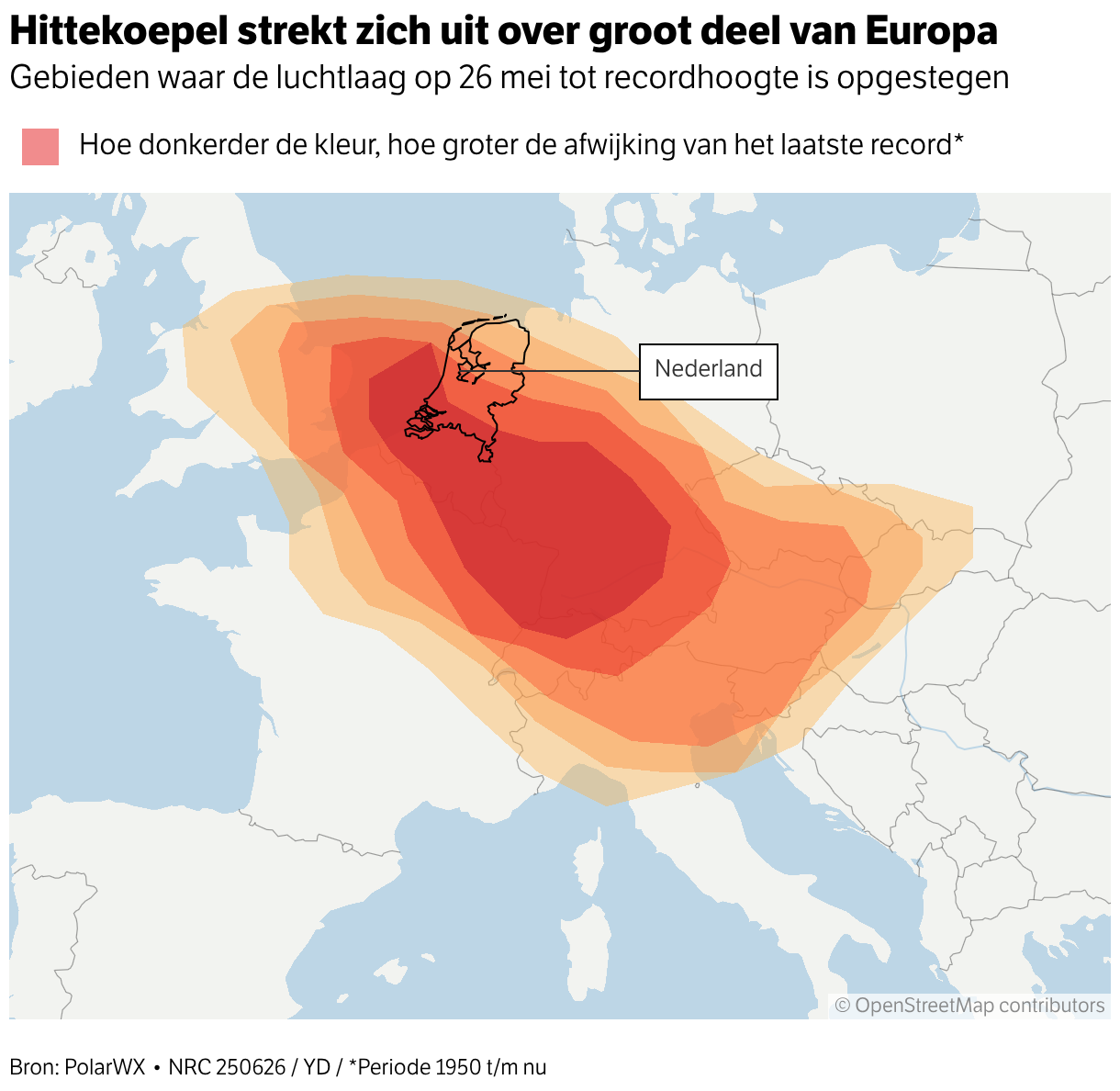
Heat domes are rare, but climate change is likely to make them more common. Various studies indicate that they can form more easily in a warmed atmosphere. This means that the weather phenomenon may be one of the ways in which the consequences of climate change reinforce themselves: climate change makes it warmer, which increases the risk of heat domes, making it even warmer.
Research must show to what extent the current heat has been exacerbated by climate change, emphasizes climate scientist Sjoukje Philip of the KNMI. According to her, it is “fairly early in the season” for a heat dome of this size. That is extra dangerous, says Philip. “You also see this, for example, if you have a heat wave earlier in the season, then people are not yet used to it and the impact is greater.” According to Philip, the number of heat deaths, which the RIVM usually calculates later in the year, often shows a clear peak at the beginning of the season.
Philip is involved in the World Weather Attribution, a collaboration of scientists who, in the event of extreme weather, calculate as quickly as possible to what extent this is a consequence of the warming climate.
In any case, the temperatures that France has experienced in recent days were very exceptional, climate scientist Christophe Cassou said on Monday against Le Monde. “This is an unprecedented event that, compared to average climates between 1979 and 2025, occurs only one in a thousand times at this time of year. In pre-industrial times it was virtually impossible.”
Philip cannot verify Cassou’s statements on Tuesday. “But I know that all heat waves worldwide have become more likely due to climate change,” she says, “and we also regularly see that the heat we are experiencing now would actually have been impossible in the past.”