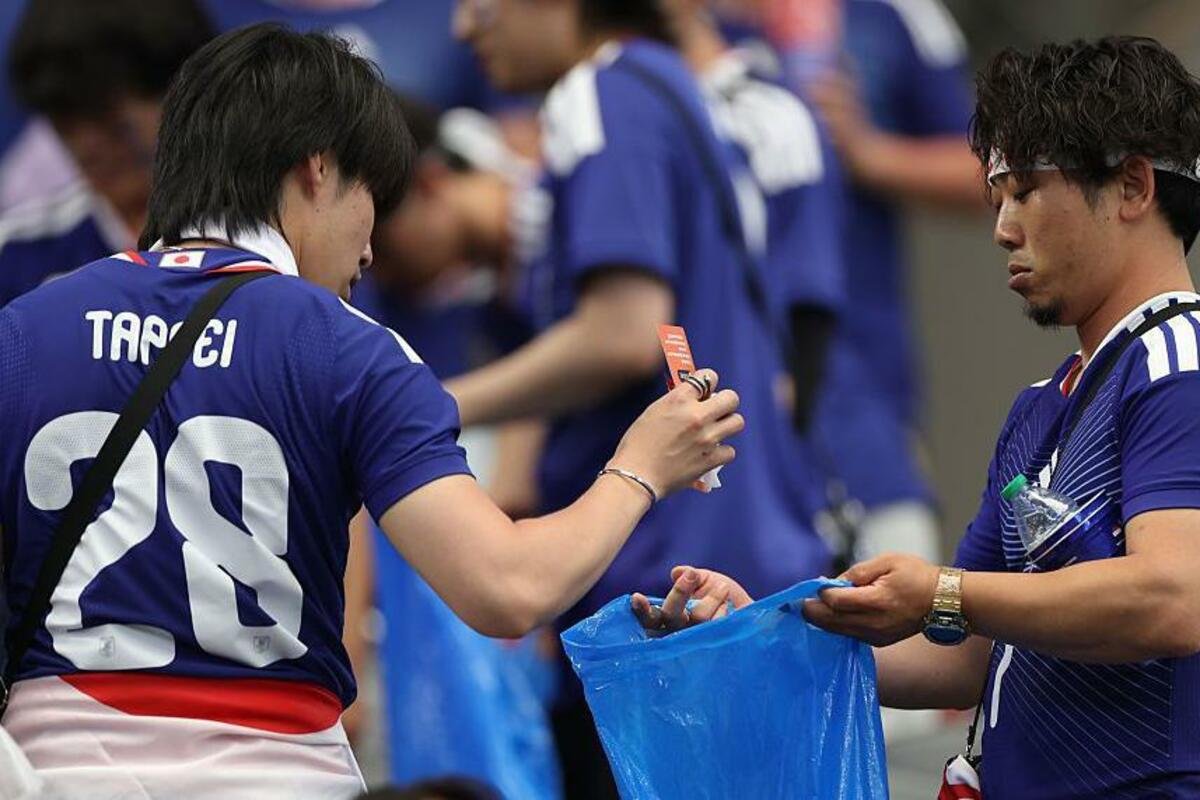
For years, Japanese soccer fans have been praised for cleaning up their stadiums after World Cup matches.
This time, however, they kicked up a dust-up at home.
When photos of Japanese fans picking up trash after the game were published in mid-June, some interpreted it as hypocritical behavior – men cleaning up in public, while leaving that burden to women at home.
Soon, a poster spread on the nets, on one side of which there is a man collecting garbage at the stadium, and on the other, the same man is resting in bed, using the phone next to the laundry basket, while his wife washes the dishes.
Men in Japan should be more “involved at home” because compared to most others, they spend less time doing housework, the poster says.
The post has more than 60,000 likes on the X social network.
“Everyone wants to save the world, but no one wants to help mom with the courts,” wrote one X user.
“Among those picking up trash is probably a man with a small child at home, who he left his wife to look after so he could come watch the World Cup,” wrote another.
Cleanliness, as well as cleaning up after oneself in public spaces, is deeply rooted in Japanese culture.
However, among highly developed countries, the Japanese are near the bottom in terms of the time they spend doing housework.
According to data from the Organization for Economic Co-operation and Development (OECD) in 2021, Japanese women spend more than three hours a day doing unpaid work, which is over five times more compared to men, who spend 47 minutes.
These differences are especially pronounced in young families.
According to a 2021 government survey, in households with children under the age of six, where both spouses have incomes, women spend more than seven hours a day doing housework, and men less than two hours.
Some users of social networks emphasized the hypocrisy in that garbage is collected in a foreign country, while public spaces in Japan remain covered with garbage after major events.
But while the debate over the division of household chores rages on, many feel that the stadium cleaning practices practiced by Japanese fans should be encouraged, not petulantly criticized.
“Where’s the shame in that?” wrote one user on the X network.
“That’s a lot better than reports saying ‘the Japanese are dirtying up abroad.'”
Such purges seem to have affected fans from other countries as well.
A recent social media video showed Portuguese fans similarly collecting trash from the stands into large plastic bags, with many social media users crediting the Japanese for starting the trend.
BBC is in Serbian from now on and on YouTube, follow us HERE.
Follow us on Facebook, Twitter, Instagram, YouTube and Viber. If you have a topic suggestion for us, please contact bbcnasrpskom@bbc.co.uk
Download the application and follow the news


FOLLOW US ON

News