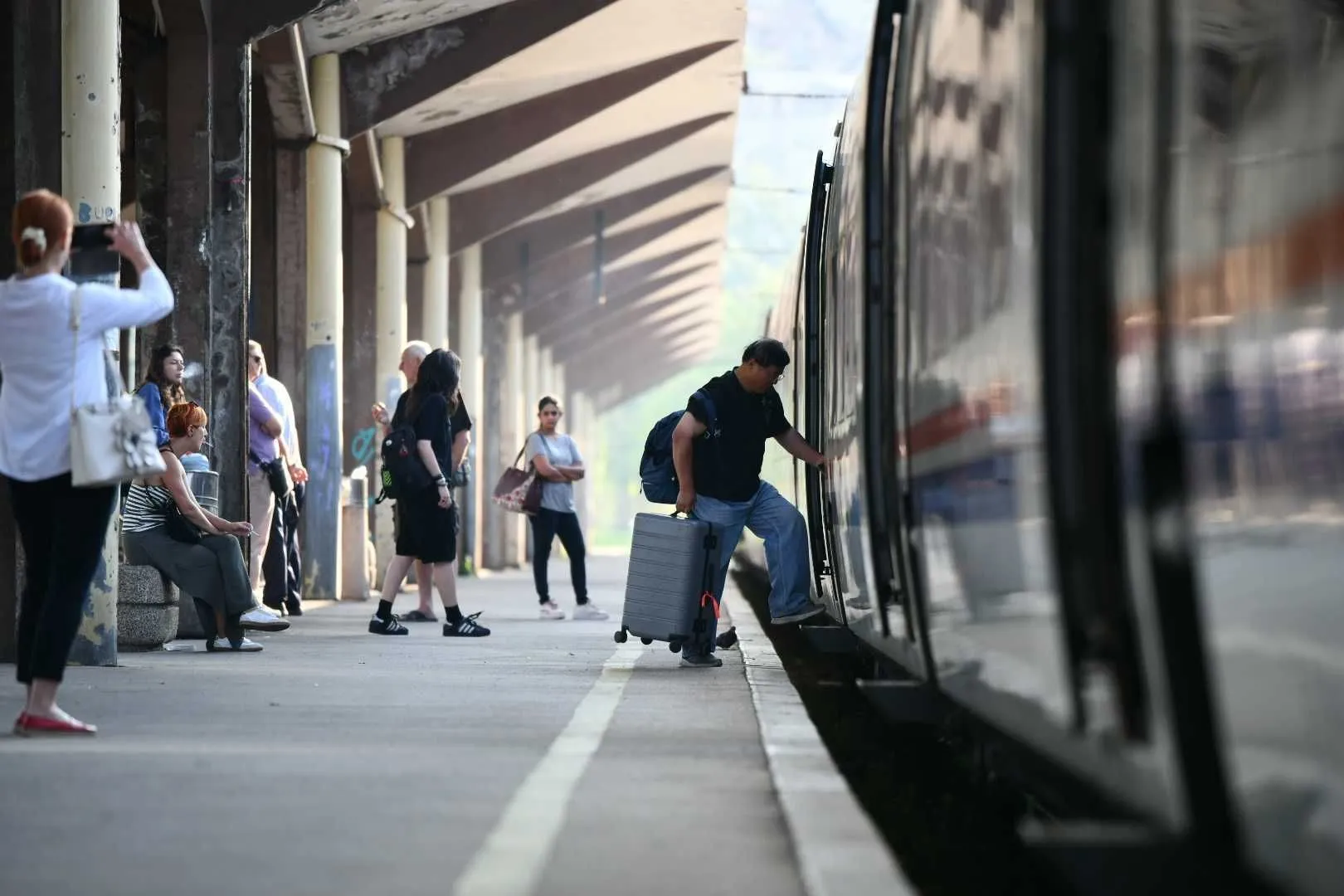
While the first rays of the sun break through the buildings of Sarajevo, unusual optimism reigns at the Railway Station. Passengers with suitcases, backpacks and children in their arms are impatiently waiting for the departure of the seasonal train to Ploče. For many, this is the beginning of their annual vacation, but also an opportunity to once again pass one of the most beautiful railways in Europe.
The train from Sarajevo leaves at 7:15 a.m. A few minutes later, the hustle and bustle of the city leaves the travelers behind, and the composition slowly conquers the mountain climbs towards Bradina and Konjic. A special atmosphere is quickly created on the train that can rarely be experienced in a car or bus. People talk, children run along the corridors, foreign tourists put their noses against the windows, while elderly passengers tell how they used to travel to the sea on this railway several decades ago.
However, already at the beginning of the trip it becomes clear that this ride has its less beautiful side.
Vagon restaurant exists – but it does not work
The train includes a restaurant car. Or more precisely – the former wagon restaurant. The door is locked, the bar is empty, and there is no staff. Passengers who didn’t bring water or food quickly realize that they won’t be able to buy even an ordinary bottle of water, juice or coffee during the more than three-hour drive.
The paradox is all the greater because this seasonal line represents one of the most attractive tourist railway routes in the region. While European tourist trains further enrich the travel experience through the catering offer, here passengers are left to what they brought from home.
It’s not about luxury. It is a basic service that passengers rightly expect on an international rail line.
A track that deserves more attention
After Konjic begins the part that many consider this railway to be one of the most beautiful in Europe. The Smaragdna Neretva follows the train almost the entire way. Canyons, bridges, tunnels and steep cliffs leave you breathless.
Or at least they should.
On a large number of sections, the view towards the river is now obscured by dense thickets, tall vegetation and neglected vegetation that has apparently not been removed for years. Exactly at the places where passengers should enjoy the panorama of the Neretva, the view ends at branches and weeds that almost touch the windows of the train.
This is especially disappointing for foreign tourists who decided to travel by train precisely because of the photos of this railway. Many of them expect open views of the river and the canyon, but instead a large part of the route passes behind a green wall of vegetation.
The Sarajevo-Ploče railway is not just a road. It is a tourism product of Bosnia and Herzegovina. This is precisely why its maintenance should not be limited only to traffic safety, but also to the preservation of unique viewpoints that make this route recognizable throughout Europe.
A train is faster than a car – at least until it reaches the border
After Mostar, the train continues towards Čapljina and the border with Croatia. It is here that travelers are in for a new procedure that could significantly lengthen their journey.
The Croatian border police is gradually introducing a new Entry/Exit System (EES), an electronic system for registering the entry and exit of citizens of third countries into the European Union.
Unlike the previous passport inspection, border police officers use mobile devices – Samsung phones with a fingerprint reader attached. The passenger’s face is first photographed using the phone, then fingerprints are taken using the attached scanner, after which all data is recorded in the system. And all that without having to get off the train
The procedure itself takes between 30 and 60 seconds per passenger.
At first glance, it doesn’t seem long. However, when one takes into account that the seasonal train is often completely filled with several hundred passengers, it is clear that delays at the border could last significantly longer than before, especially during the peak weekends of the tourist season.
A trip worth experiencing
Despite all the flaws, it’s hard to remain indifferent when the train descends towards the Neretva valley after the border and finally arrives in Ploče. The smell of the sea enters through the open windows, and passengers reach for their suitcases almost simultaneously.
This railway line has everything a European tourist route should have – spectacular landscapes, rich history and excellent connections between the capital and the Adriatic.
But there are also problems that can no longer be ignored.
A malfunctioning restaurant car, neglected vegetation that hides the most beautiful scenes and a new border procedure that will lengthen the journey remind us that the potential of this line has not yet been fully exploited.
Perhaps that is exactly why the seasonal train Sarajevo – Ploče evokes mixed emotions. On the one hand, it’s a journey that every rail lover should experience at least once. On the other hand, it also shows how little is sometimes missing for a good experience to become truly superb.
Because passengers who choose the train are not asking for much. They are looking for a clear view of the Neretva, the possibility to buy coffee or water, and a trip that they will remember for the beauty of the landscape, and not for the failures that have been repeated for years.