
The Threat of ‘China Shock 2.0’
One of the most pressing structural shifts detailed was “China Shock 2.0.” During the first China Shock after Beijing entered the World Trade Organisation (WTO) in 2001, China’s global export market share rose from 4% to 11%.
However, because China imported vast amounts of raw materials and components, trading partners shared the economic gains.
In this second wave, the dynamics have turned predatory. China’s export market share has climbed to 16%, but its import growth has stalled. Chinese manufacturers now source their inputs domestically, absorbing the entire value chain and flooding global markets with cheap finished goods.
“When you order from Shopee or Lazada today, almost everything is from China,” Paiboon warned, noting that Thailand’s lack of political appetite for aggressive protectionist barriers leaves local manufacturing exposed to severe displacement.
Compounding this is a global fiscal crisis. Sovereign debt has climbed from 60% of world GDP 25 years ago to roughly 100% today. Major economies are so heavily leveraged that governments will be severely constrained in deploying fiscal stimulus during the next inevitable economic downturn.
The Counterweights: AI Infrastructure and the Thai Advantage
To offset these headwinds, Paiboon highlighted a powerful technological counterweight: the artificial intelligence revolution.
Citing data from the US National Bureau of Economic Research, he pointed out that large firms deploying AI are already achieving 2% to 3% annual productivity gains per employee.
For smart investors, the best value no longer lies in hyperinflated, headline tech stocks but in the unglamorous infrastructure backing them.
“AI isn’t just Nvidia. It’s an entire ecosystem of energy, infrastructure, models, and applications,” Paiboon said. “Without energy, there is no AI. The energy sector remains attractively priced and indispensable.”

Thailand’s Strategic Playbook
For domestic markets, Thailand’s strict geopolitical non-alignment has transformed into a core competitive advantage. As multinationals seek neutral hubs to escape trade war crossfire, foreign direct investment is increasingly redirecting toward Thai shores.
The Thai government has stated an ambition to raise the investment-to-GDP ratio from its current stagnant level of around 22% up to 30%, using Vietnam’s higher investment rate as a benchmark. This underpins the broader national goals of achieving 3% economic growth within four years and joining the ranks of high-income economies within twelve years.
Thai equities are already showing signs of a renaissance. The SET Index has outperformed global markets year-to-date, rallying roughly 22% against a 9% gain for the MSCI World Index—its first outperformance in four years. Trading at roughly 12 times forward earnings, the market remains reasonably valued.
Furthermore, Paiboon highlighted two key domestic catalysts: a corporate “Value Up” programme (Jump+) modelled on Japan and South Korea to improve capital efficiency, and a forthcoming long-term investment savings scheme offering permanent tax incentives to retail investors.
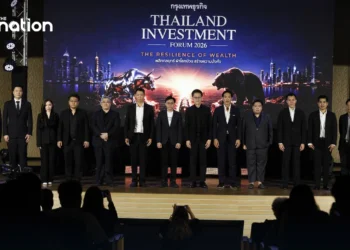
Paiboon concluded with a call for tactical selectivity: focus on global companies with highly visible dividend income, target AI power and infrastructure over software applications, and accumulate Thai equities backed by improving corporate earnings momentum.