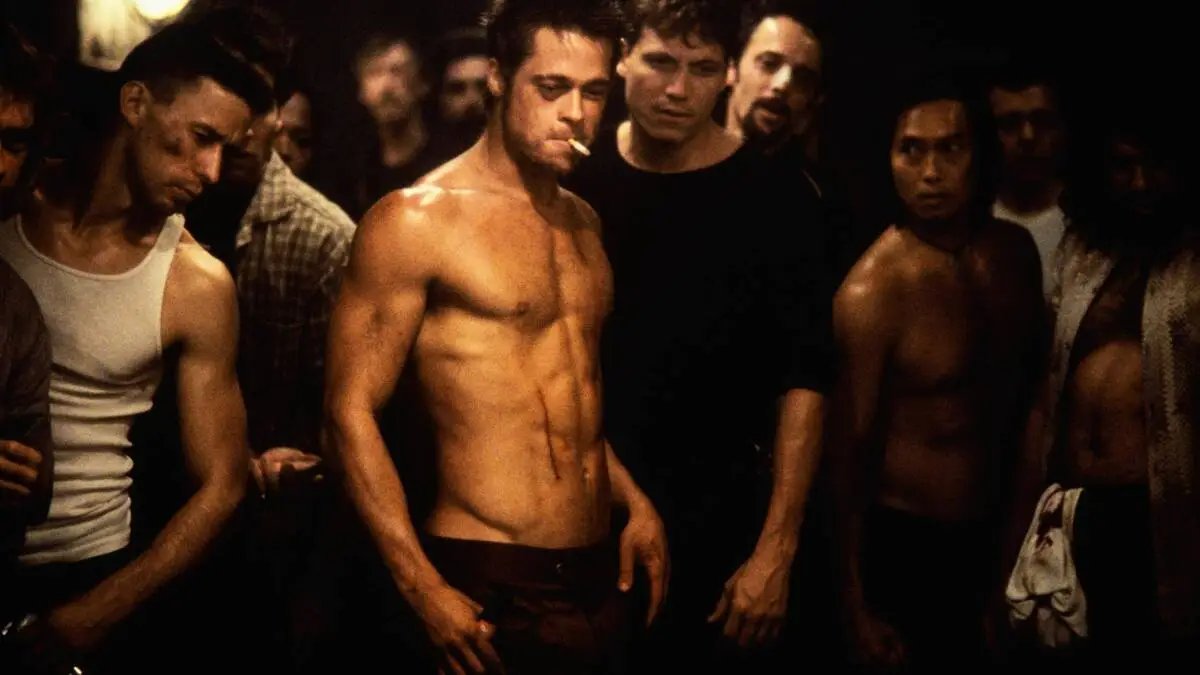
Every year I show my students excerpts from the film “Fight Club” as part of a course on democratic theory. The focus is on the criticism of modern society and the consequences for the democratic order. And like every year, these excerpts led to intensive discussions. What made this year different from previous ones, however, was a clear polarization.
While male students described the film as a visionary depiction of the crisis of masculinity, female students interpreted it completely differently: men were stylized as victims of a feminist system. The situation escalated quickly and ended in mutual insults, which forced me to put an end to the situation. This points to the increasing social gap between men and women, especially in younger generations.
If you research online, you quickly come across interpretations of “Fight Club” that emphasize male oppression by women. Welcome to the so-called Manosphere, a network of internet forums, blogs and social media channels in which misogynistic and anti-feminist content is spread. This phenomenon is particularly evident in public discourse through media representations such as Netflixseries “Adolescence“, in which a 13-year-old kills a classmate after she calls him an “incel” (involuntary celibate) online, as well as Louis Theroux’s documentary “Inside the Manosphere”, which paints a picture of a consumer-oriented digital sphere of misogynistic “manfluencers” who achieve a large following with their ideas of masculinity and success.
So far, there have been relatively few studies that shed light on the philosophical background of this phenomenon. This makes Simon Copland’s book “The Male Complaint” all the more important, which analyzes masculinity discourses from a social science perspective and examines the question of what could be the driving force behind misogyny. “The Male Complaint” attempts a balancing act – quite successfully: on the one hand, the book aims to offer an analysis of the manosphere that deals with its deeper ideas; on the other hand, it also wants to diagnose the fundamental contradictions in their worldview.
Copland describes the manosphere as a social structure that is organized around a subjectively experienced male vulnerability and at the same time functions as a community space for alienated men. Loneliness, failure, difficulties in relationships and the feeling of having low “sexual market value” often lead to anti-feminist interpretations and blame towards women. However, a paradoxical equation of problem and solution runs through the manosphere like a common thread: the prevailing ideal of masculinity, for example, is sharply criticized, only to move closer to this ideal in a subsequent step through self-transformation (e.g. in the gym); society’s consumerism is denounced, only to boast about cars, quads and the like after financial success; Loneliness is cited as a reason for one’s own radicalization, only to celebrate one’s own independence under the motto “man going his own way”; Women are demonized as dishonorable “gold diggers,” only to subordinate everything to the goal of getting sex and love from them. Therein lies the central problem of this phenomenon: the manosphere is so contradictory that it is difficult to grasp as a coherent ideological system. Although misogyny, sexual frustration and the pursuit of recognition are central elements of this structure, they hardly coalesce into a consistent worldview.
Copland’s argumentation structure follows a typical three-stage pattern that is also familiar from the criticism of right-wing extremist movements: First, it is acknowledged that the complaints expressed are at least partially understandable. These complaints are then shifted away from their immediate targets – such as women or feminism. Finally, a deeper structural cause is identified, mostly in capitalism and the associated individualism, which is described as a system of distorted incentives and social inequality. This perspective is not entirely implausible. Nevertheless, it is too convenient to use capitalism as the source of all evil (as a “root cause”).
What is interesting is the move away from identity politics that is based on social categories such as gender, ethnicity, sexuality or race. In contrast, it is argued that the problems of capitalism are of a universal nature and do not only affect certain groups. This creates the possibility of broader resistance to capitalism and all the evils associated with it (imperialism, racism, sexism). However, it is important to take into account how much so-called critical theories have relied on identity politics in recent decades. So why this change, this reorientation towards economic policy?
In many ways, the Manosphere represents a reflection of critical theories. Postcolonial and feminist approaches are based on the assumption of structural oppression of certain groups; those who do not recognize these structures as such are disqualified as “too privileged” to see the truth. A similar logic can also be found in the manosphere: the concept of the “red pill” (borrowed from the film trilogy “The Matrix”) refers to the idea of having access to a hidden truth about women, sexuality and society. The actors often describe themselves as “enlightened”. Whether “woke” or “red-pilled” – in both cases it is about the claim to have recognized a hidden reality that others miss due to their ideological delusion. This reflection is naturally extremely uncomfortable for former advocates of identity politics. In response to this we see a reorientation towards the class struggle. According to the theory, if capitalism can be buried, all other evils will also disappear.
Copland describes the Manosphere as a cocktail of desperation and optimism: the despair of being labeled a social loser and the hope of improving this position through self-optimization. Copland correctly recognizes that this frustration often translates into misguided victimization, which results in irrational misogyny. At the same time, however, he criticizes almost every form of individual self-transformation as an expression of “cruel optimism” that stabilizes existing norms of masculinity and leaves the neoliberal order untouched. “Real hope” can therefore only be found by shaking off capitalist chains.
This “real hope,” which relies exclusively on collective action against an abstract system, often has little appeal outside of academic milieus. The success of right-wing populist movements in recent years has shown that political mobilization today primarily works where people feel they can act directly and individually. The fact that this form of hope often turns into resentment towards minorities or women is true, but it does not change the fact that abstract promises of social change do not represent a tangible alternative for many people.
Anyone who limits themselves to the analysis of an abstract system of oppression runs the risk of delegitimizing individual agency and self-responsibility as neoliberal. The central problem lies less in “too much” individuality than in the lack of it. The much-talked about polarization of society is precisely the result of people increasingly uncritically fitting into the narratives of their respective reference groups. The manfluencers of the manosphere also only resonate because their followers willingly follow them. The central contradiction of the Manosphere is that it propagates a self-image of the autonomous individual, but in fact is based heavily on conformity and follower dynamics. Against this background, the political and social challenge is not to reject all forms of individual self-help as “cruel hope”, but rather to promote individuality and make it fruitful for a plural democracy.
So it can also be said that my students’ confrontation with “Fight Club” was an expression of this problem. The division into a male and female camp paints a picture of a society in which different interpretations are only possible to a limited extent. This lack of plurality is also a lack of democracy and can only be overcome by strengthening and politicizing individuality – not in order to make coexistence more harmonious, but in order to take contradiction seriously again as a democratic resource.
Christof Royer is an assistant professor at Forward College, University of London in Paris.

Brad Pitt in Fight Club, 1999. Imago