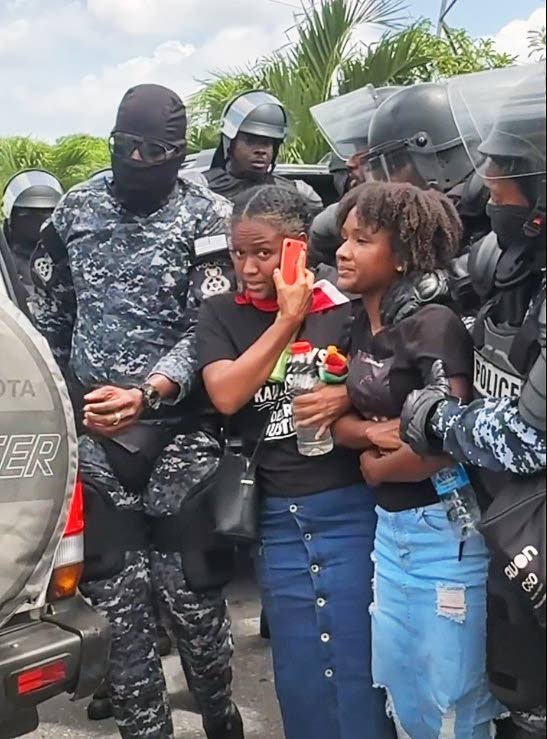
Activist Alyssa Phillip and her mother Camille Caresquero will reappear in the Siparia Magistrates’ Court on July 20 in connection with their arrest during last weekend’s Labour Day celebrations in Fyzabad.
The two yesterday appeared virtually before Master Kateisha Ambrose-Persadsingh in the High Court, South, two days after they were arrested during the Labour Day celebrations hosted by the trade union movement.
Following their arrest on June 19, they were each granted $60,000 station bail without conditions, pending their court appearance yesterday.
Phillip and Caresquero were also arrested on May 27, following a protest outside the office of the Director of Public Prosecutions (DPP), Richmond Street, Port-of-Spain.
The 19 Bullets, 19 Protests campaign, spearheaded by Phillip, came amidst heightened tensions arising out of the decision by the Director of Public Prosecutions to instruct the police to charge Kaia Sealy with a slew of offences in connection with the January 20 police-involved shooting of her boyfriend, Joshua Samaroo, in St Augustine.
Phillip’s demand for police accountability led the group to picket several government buildings and police stations, including the Red House, the Police Administration Building, the DPP’s Office and police stations up and down the East/West Corridor and in the Port-of-Spain Division.
The two were out on bail following that incident after being charged with disorderly conduct and influencing public opinion in a manner prejudicial to public safety under the Emergency Powers Regulation. Those charges carry a fine of $100,000 and a potential prison sentence of five years and two months.
During the hearing yesterday, Sandy argued that following receipt of the complaints and summaries of evidence regarding Friday’s arrest, the defence disputed allegations that Phillip and Carasquero was participating in a separate public march, distinct from the authorised Labour Day procession. She said the factual circumstances surrounding their arrest were materially different from those suggested in the recent media release issued by the Trinidad and Tobago Police Service (TTPS).
She added, “There exists extensive video footage, independent witnesses and persons associated with the organisation of the Labour Day procession who are capable of assisting the court in determining what occurred. Both Ms Phillip and Ms Caresquero maintain their innocence and look forward to the matters being determined by the Court on the evidence, rather than by competing public statements.”
She added, “As the matters are now before the Court, it would be inappropriate to comment further on the evidence or to attempt to litigate these proceedings through the media.”
In a June 20 release, the TTPS said Friday’s arrest of the two women was firmly grounded in the Summary Offences Act, Chapter 11:02.
The said the arrest was “to preserve public order, public safety, and the sanctity of the annual Labour Day procession.”
The TTPS said the trade union movement received permission to stage the Labour Day procession in accordance with Section 112, which states that no person may organise, lead or take part in any public march unless a permit has been issued by the Commissioner of Police; Section 113, which states applications must be made in writing within the statutory time-frame; and Section 114, which advises that the Commissioner may grant or refuse a permit based on public safety and public order considerations.
The TTPS claimed while the trade union procession was lawful, authorised and protected under the permit issued, Phillip and her group was unauthorised to join the procession and had attempted to join the procession although it was not part of the authorised procession.
Phillip was charged with being a leader of a march and failing to call on such march to disperse, disorderly behaviour and resisting arrest. Caresquero, who was deemed a participant in the illegal procession, was charged for being present at a march and failing to disperse; obstructing a police officer and resisting arrest.