There is a smell of departure in an attic on Neustiftgasse in Vienna’s seventh district. In the entrance area there are crates of mate tea and other caffeine-containing bottles so that enough brain power can be activated even during twelve-hour shifts. The sun beats mercilessly into the open office space through the large windows.
But complaining about the heat is not the order of the day here. Some are engrossed in the code on their screen, others are stuck in meetings. Only English is spoken here.
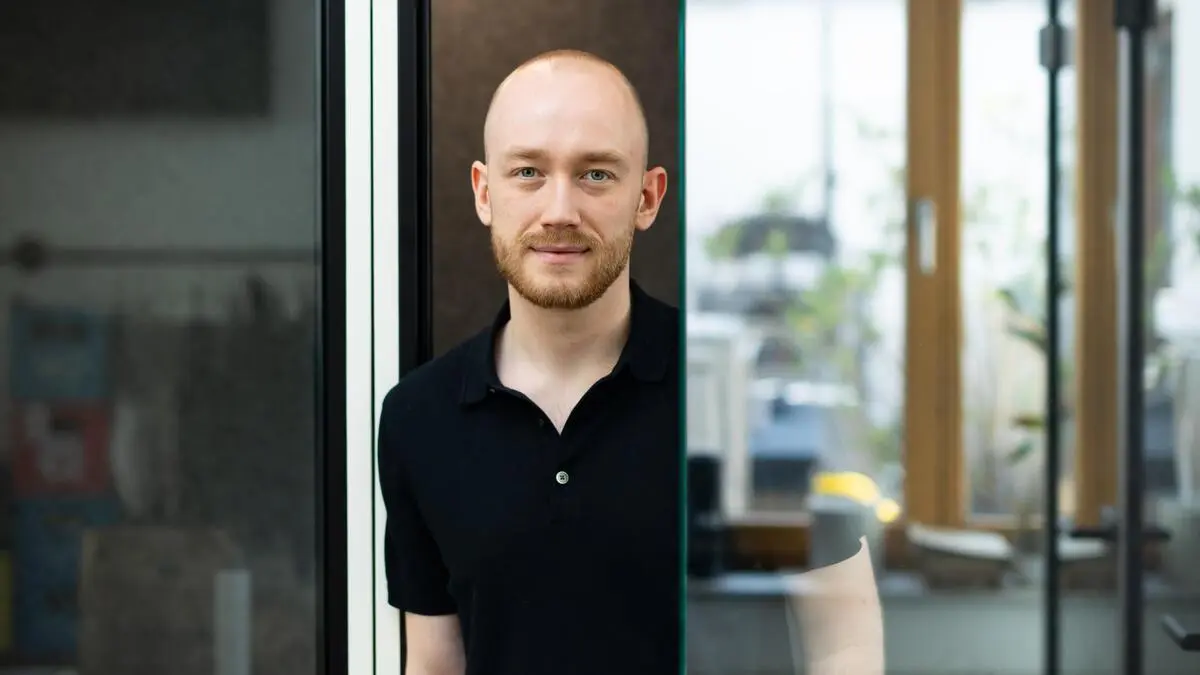
Outside on the large roof terrace, Daniel Keinrath sinks into a deep seat cushion. “We hired our first employee in June 2025,” says the 26-year-old. Today a good 50 (mainly young) people work here. By the end of the year there should be around 100. “It’s a hassle that we have to constantly expand our office,” he says and grins.
In autumn 2024, Keinrath founded the start-up Fonio AI together with Matthias Gruber (28). The idea behind it is simple: the company’s AI software always answers the company phone when no one else picks up. The installer is on the construction site, the office is currently overloaded, the dealer is talking to customers. Every missed call can be a lost job. Especially for smaller companies – the core target group is SMEs – the company solves a seemingly banal problem that every company is familiar with.
»We need more courage to think big. Then there will be more great companies here.«
Daniel Keinrath
Fonio AI
The digital answering machine is also well received by investors. The Viennese AI company has just raised 14.6 million euros in a financing round. With a valuation of 120 million euros, Fonio suddenly became one of the highest valued start-ups in Austria. Keinrath believes there is much more to it.
This makes Fonio the latest flagship of an up-and-coming Austrian start-up scene. A new generation of founders is committed to using technology to improve the world. Or at least your own account balance.
More young people are again looking for happiness in entrepreneurship. In 2025, 39,978 new companies were founded – 9.4 percent more than in 2024. Self-realization and the prospect of a good salary can hardly be reconciled in many traditional white-collar jobs. Artificial intelligence, on the other hand, opens up new business areas and desires. Solutions are developed for old and previously unknown challenges.
“Entrepreneurship is a brilliant tool for working on solving the really big problems,” says Michael Kowachev to the “Presse”. Last week he visited Necker Island, the private island of Richard Branson in the Caribbean. The British billionaire and entrepreneur regularly invites people to exclusive retreats where selected investors and entrepreneurs come together. Kowachev was a guest of the British star investor for the second time.

Heizma founder and CEO Michael Kowachew is working on solutions for the energy transition. Valerie Voithofer
At just 27 years old, the Viennese with Bulgarian roots has become an integral part of the Austrian start-up scene. Back in 2020, he developed Novid20, the first European contact tracing app. After selling another tech start-up that he co-founded, he used his financial independence to invest in emerging start-ups himself, including Fonio.
In 2023, Kowachev founded a new company to tackle one of the biggest challenges of the future. “If we want to have a continent worth living in in the future, we absolutely have to bring down emissions,” he says to the “press”. He sees the biggest lever for this in Austria in building heat. Heating is the third largest greenhouse gas driver after transport and industry. Buildings cause more than ten percent of greenhouse gases and account for around a third of total final energy consumption. Anyone who replaces oil and gas heating systems and renovates old houses not only reduces emissions, but also Austria’s dependence on imports, says Kowachev. His company Heizma will play a key role in this transformation.
»Artificial intelligence can be a good opportunity for Europe to become competitive again.«
Michael Kovachev
Heating machine
The Viennese company sees itself as a modern heat pump provider. “But we are more than just a digital installer, we build the entire energy infrastructure in single-family homes from a single source.” 80,000 heaters would have to be replaced every year in order to achieve the climate targets in the heating sector, says Kowachev. Between 40,000 and 50,000 heating heat pumps were recently installed every year. The number was largely based on the fluctuating subsidies for replacing a boiler.
Last year the market suffered a double-digit decline for the first time due to radical funding cuts as a result of tight budgets. “What happened in the funding sector in 2025 was devastating for the entire industry,” says Kowachev. “Funds generally make sense in this area because they push the market in the right direction. But with this constant ups and downs, it would be better to turn off the subsidies completely.” Both companies and households need planning security, otherwise the volatile public subsidies would actually harm the market. “The way it is currently structured, I think it is a poor use of tax resources.”
Focus: What lies ahead for us?
It’s been 30 years since diepresse.com went online, “Die Presse” took the step into the digital age. We are taking this anniversary as an opportunity to look forward again. Young entrepreneurs, researchers, artists and politicians are asking themselves the big questions of our time: How will our most important areas of life change in the next few decades? How will we work, believe and love? And what else do we need to know in the future?
To the focus.
Several dozen heat pump providers have had to file for bankruptcy since last year. While the market was long considered a secure future field, in which the lack of engineers was the bottleneck in the expansion of renewable energy, there is now a lack of orders in particular. In the first quarter of this year, the installation of heat pumps fell again by a third. The current funding pot will expire in the next few weeks, and a new funding regime is not in sight any time soon.
In just a few years, Heizma went from being an up-and-coming energy tech start-up to the travails of political funding logic. In order to break out of this situation, the company is now increasingly relying on energy communities between several households. For this purpose, Heizma has developed its own energy management system.
Lilly Eichinger is at a much earlier start-up stage. The 37-year-old aims high with her company Satellives. “Even as a small child, I was fascinated by space. If we want to make better use of the orbit in the future and perhaps colonize it at some point, we need a functioning infrastructure in space.”
If you listen to the native Hungarian, it resonates a bit Elon Muskwho protects humanity with his space company SpaceX want to take to Mars. To achieve this, we have to start building a sustainable infrastructure today, says Eichinger. There are around 16,000 active satellites in space – plus several thousand dead satellites, rocket stages and debris. The amount of space debris has been growing exponentially for years. “Satellites should no longer be individual, expensive disposable objects, but should become a modular infrastructure in orbit,” says Eichinger – like a kind of power grid, cloud storage and workbench in space.

Lilly Eichinger is building infrastructure for space with her space start-up Satellives. Clemens Fabry
Satellives is developing flat, panel-like satellite modules the size of pizza boxes. Companies should be able to book the reusable modules, for which prototypes are currently being developed in the “Space Factory” at Schwechat Airport. “In fifteen years we will have several larger factories in space. Our modules should play an essential role in this,” is the ambitious vision of the trained architect and philosopher.
“There are a lot of good ideas in Europe – then someone says that it’s too ambitious and too big, let’s stay small.”
Lilly Eichinger
Satellives
“We have to start thinking bigger in Europe too. There are a lot of good ideas here. Then someone says that’s too ambitious and way too big, let’s stay small.” Eichinger wants to break out of this defensive mentality.
Fonio founder Keinrath sees it similarly: “We need more courage to think big about things. Then there will be more great companies here.” Heizma boss Kowachev also believes that the current technological upheaval must be actively promoted: “Artificial intelligence can be a good opportunity for Europe to become competitive again.”
Focus: What lies ahead for us?
It’s been 30 years since diepresse.com went online, “Die Presse” took the step into the digital age. We are taking this anniversary as an opportunity to look forward again. Young entrepreneurs, researchers, artists and politicians are asking themselves the big questions of our time: How will our most important areas of life change in the next few decades? How will we work, believe and love? And what else do we need to know in the future?
To the focus.