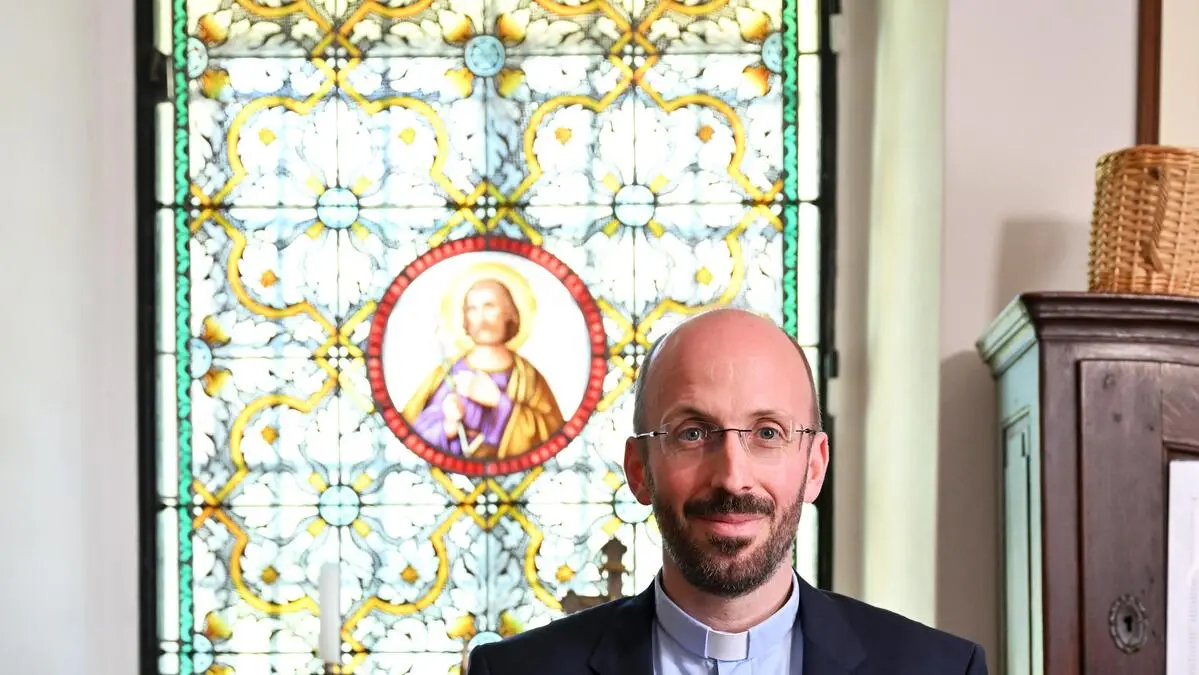
Die Presse: Pastor, how does it feel to do your job at a time when church is not considered cool at all?
Richard Hansl: Church was probably never super cool. It is a bit of a characteristic of the church that it also takes opposing positions to social developments. Not necessarily proactive, but simply as a preserving element, something that doesn’t have to be “in”. The church doesn’t necessarily need a stage, but is deeply anchored in people’s everyday lives. I also believe that the church is now making an extreme comeback.
How do you determine that?
Approximately the number of teenagers and young adults who are baptized. Of all the candidates for baptism, the young Austrians have now pushed the Persians, who have long been the largest bloc of nations, into second place. France is also a good example. More than 21,000 people were baptized there during the Easter Vigil alone. And a lot of things are breaking down in the USA too.
Why do you think that is?
I read an article about youth in New York that I found fascinating. The young people say that the church is a place where we are always welcome. A place where we are not required to perform or pay anything to participate.
Well, many people would disagree with that regarding church tax.
The church tax is just a Central European phenomenon. You can also go to trade fairs or events like this. And what I also found very nice: that the church is currently the only place that is called romantic. Namely, one of the last institutions that says love for the entire life, a “yes” that is unconditional, a relationship that has an uncanny value that must be preserved and promoted at all costs.
As a young person, what were your reasons for choosing a job in an “uncool” institution?
Of course, as a young person, you feel that not everything is necessarily hip. But you want to become a priest when you have actually had an experience of faith, when you feel faith, when you are so convinced that it becomes a certainty. Then you are ready to put aside your own ideas about how to live your life that you may have had until then, because it is simply incredibly fulfilling.
How old were you when you knew you wanted to become a priest?
23.
And you had no doubt that this could be done throughout your life? About celibacy?
You are in the world as a human being. I think you’re lying to yourself when you say you can predict what tomorrow will bring. Even if you go through the world with personal certainty, you have to know that shocks and crises are simply part of every human life and that a lot can change that you cannot predict in advance.

Clemens Fabry
How do you imagine the Catholic Church in the next 20 or 30 years? Do you see great potential for change?
Yes, we are already in a strong process of change. On the one hand, I believe the number of Catholics will continue to decline. We will certainly shrink significantly, if only because of demographic developments. But I believe the church will be more determined to do so. So that it is actually a conscious decision to live your personal faith.
You could say that those who are still in the club really want to be there?
Yes. Traditionally, it was often the case that a child is baptized because it has always been that way and will continue to be that way. That will change and there will be an ever-increasing urban-rural divide. Otherwise, I believe that the church is becoming more and more vital.
To what extent?
I see that the young generation is again living their faith very consciously and very intensively.
Yes? What function does the church play in your life?
Lots of functions. On the one hand it is stability, but on the other hand it is also a culture of welcome – a space that is always open to them. And faith is simply increasingly an issue – also in confrontation with other world religions. Suddenly you start asking questions again: What do we actually believe? How about the holidays? Why do we celebrate Easter and Christmas? This is a confrontation with the roots from which I see a very living faith emerging.
And you think that’s because we have more contact with Islam today, for example?
In France, the young people were asked why so many are returning to church. It was also about the fact that Muslims lived their faith very clearly and clearly in schools. That’s why Christians have also started to deal with it again. Less out of a conflict, but out of a demarcation. According to the motto: They deal with theirs, we deal with ours. But rediscovering faith on a purely apologetic level is not sustainable; you have to allow yourself to be touched and find your way into it.
Yoga, meditation,… One gets the impression that many people are looking for a kind of transcendence. Why is the church no longer the first port of call for this?
Christianity has become, if you can put it so loosely, one of several offers on the religious market. The church’s monopoly position as the only uncompromised institution after the Second World War is simply over. We have also moved away from an incredibly high level, from 80-90 percent Catholics. It is clear that changes are occurring in a globalized world and that the numbers are changing due to influx and migration.
Do you believe that the Catholic guidelines of our Central European society can be preserved in the long term? I’m thinking about the Catholic holidays.
During the course of religious education, we clearly noticed that the state applies equal treatment guidelines and that what applies in the Concordat also applies to other religious communities. I think that beyond a certain critical number it will probably be difficult to argue why 40 percent of Austrians celebrate Easter and there is not a single Muslim festival.
Does that worry you?
I’m not worried about that at all. The basic question is whether religion will be completely banned from public spaces, as in France. When it comes to holidays, it might be possible to set certain holidays for yourself. The future will show that. But we won’t be having the argument about the downfall of the West because the cross hangs in the school classroom or not for much longer.
Does that mean there will no longer be a cross in school?
No. For this to happen, there must be a certain minimum number of Catholic students. A priest recently told me that he looks after a school of 400 students, 16 of whom are Catholics. Discussing the cross is of course wrong.
How do you think the church is developing on the so-called “women’s question”?
Pope Leo has now appointed the Vatican’s first female press secretary, and there are more and more women taking on dicasteries that were previously reserved for bishops and cardinals. So you can also see a change from above. But the church is of course a universal church. Central European thinking should not be turned over to the whole world. But especially in Austria we are on a very good path and Josef Grünwidl (Archbishop of Vienna, note) will certainly do a lot more in this direction. I believe that after this episcopate we will see very strong changes in the structure.
If I ask you for your personal opinion: Will there be female priests by 2050?
No, because it is not an Austrian decision, but a universal church decision. What I think is possible is an opening up of celibacy towards voluntariness. But you just don’t know in which direction the Holy Spirit is blowing. And we don’t know which popes there will be in five, ten or 20 years.

Clemens Fabry
There is a virtual shortage of skilled workers in the Catholic Church. What is it like for you in pastoral care? Is it stressful?
There’s already a lot of rotation. We have eight parishes in common: a pensioner who helps out, a vicar, a chaplain and me. So you have to coordinate the appointments well. This romantic image of one priest in one place is long gone.
How many masses do you say per Sunday?
I would like to put it this way: I always make the most of canon law. So it’s rare for it to be less than three. Last weekend there were two baptisms, two funerals, four masses in between and of course conversations, senior visits… We are on duty from the cradle to the grave.
There are many Muslim influencers. Is the Catholic Church still not making enough use of the potential of social media?
Absolutely. We’re already doing a lot, but it’s not that easy. A church that looks after children through to seniors naturally finds it more difficult to find the right language for the target group, so resources are needed. But there is movement. It is said that John Paul II said that the cathedrals of the 21st century will be built on the Internet. That was very prophetic. I believe that we are slowly learning to implement this.
Were you taken seriously from the start when you started as a young pastor? Or did you have to earn the respect of the community first?
The famous triumvirate existed for a long time, especially in rural areas: mayor, local teacher and priest. That’s why you’re shown a certain basic respect, so age doesn’t matter much. It’s actually more of a challenge to teach the children to use first names.
Is that important to you?
We always emphasize Vatican II and a church at eye level – then you cannot give yourself the title of reverend and create artificial distance.
To person
Richard Hansl (41) is a native of Upper Austria and has been pastor of the Weinland Nord parish association for almost five years, where he looks after eight congregations. He was ordained a priest in 2019.
Focus: What lies ahead for us?
It’s been 30 years since diepresse.com went online, “Die Presse” took the step into the digital age. We are taking this anniversary as an opportunity to look forward again. Young entrepreneurs, researchers, artists and politicians are asking themselves the big questions of our time: How will our most important areas of life change in the next few decades? How will we work, believe and love? And what else do we need to know in the future?
To the focus.