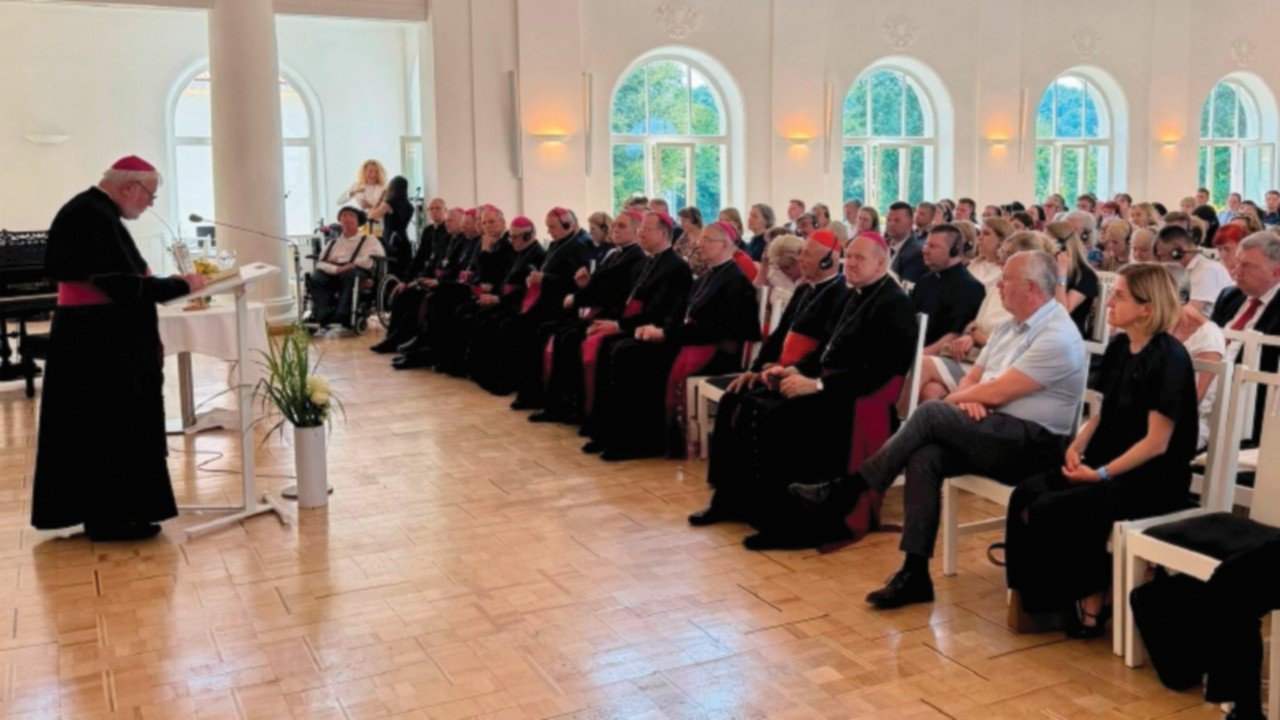
Evangelization and mercy are the founding principles of the diplomatic action of the Holy See. They were remembered today, Saturday 27 June, by Archbishop Paul Richard Gallagher, secretary for Relations with States and International Organisations, presiding as Special Envoy of the Pope at the ceremonies of the centenary of the canonical erection of the Lithuanian Ecclesiastical Province.
In Kaunas the prelate held a conference on the theme “Pontifical diplomacy and evangelization” and, bringing to those present “the benevolent and paternal greeting” of Leo XIV, he recalled the Apostolic Constitution Lituanorum folksdefining it as “a fundamental document for the religious and civil history” of the entire Baltic country, as it “conferred full jurisdictional and canonical autonomy on the local Church”.
In particular, his thoughts went to Blessed Jurgis Matulaitis (1871-1927): apostolic visitor to Lithuania at that time, thanks to his “indomitable faith” and “intense diplomatic and spiritual work”, he managed to “overcome a profound institutional crisis” by healing relations with the Holy See and guiding the local Church “towards a new season of fruitful canonical autonomy, rooted in peace and ecclesial unity”.
Blessed Matulaitis, elevated to the honors of the altars in 1987 by Saint John Paul II, reveals that diplomacy and evangelization, “although acting in different fields, share a common root: service to the truth”, continued Gallagher. And this is why pontifical diplomacy must be “distinguished” from other diplomacies: because “it draws from the Gospel and is inspired by it, and therefore works in favor of man”, who “in the depths of his being yearns for peace”.
In the same way, the diplomatic action of the Holy See, as well as evangelization, «cannot ignore the fundamental rights of the human person; indeed, it defends and promotes them.” In this regard, the papal envoy cited “the inalienable and unconditional value of human life” from conception to natural end; «the unique and irreplaceable value of the family founded on marriage, the indissoluble union of a man and a woman»; “the value of social justice which is even denied to entire peoples”, as well as “the value of peace and religious freedom, always threatened by terrorism and warmongers” of the contemporary era.
A privileged instrument of peace, added the secretary for Relations with States and International Organizations, the diplomacy of the Holy See “is not of a political nature”, but rather “an expression of the catholicity of the Church”, intimately connected to its “pastoral action” and its “evangelical mission”. In this sense, it “must act in the name of mercy”, the only one capable of “breaking the chains of hatred and revenge”. And looking “at the world stage and in particular at the war in Ukraine and the Middle East”, as well as at the apocalyptic specter of a nuclear war, all this appears to be “very topical”.
Therefore, even today when it seems impossible – concluded Archbishop Gallagher – pontifical diplomacy must “have the courage to operate with a view to reconciliation” and that “disarmed and disarming peace” so often hoped for by Leo XIV. Because, as Blessed Matulaitis said, it is necessary to “overcome evil with good”, creating “bridges where there were barriers” and restoring peace and dignity to human beings.
Having arrived in Lithuania yesterday, Friday 26th, Archbishop Gallagher had institutional meetings with President Gitanas Nausėda, who awarded him an honour; with the outgoing Prime Minister Inga Ruginienė and with the Minister of Foreign Affairs Kęstutis Budrys, as well as – at the archiepiscopal curia of Kaunas – with the bishops of the country. In the late afternoon today, the prelate will conclude the visit by presiding over mass in the Kaunas cathedral.