SYDNEY – For the past four years, Australia has been anxiously trying to win over small Pacific nations that had increasingly been drifting into China’s orbit.
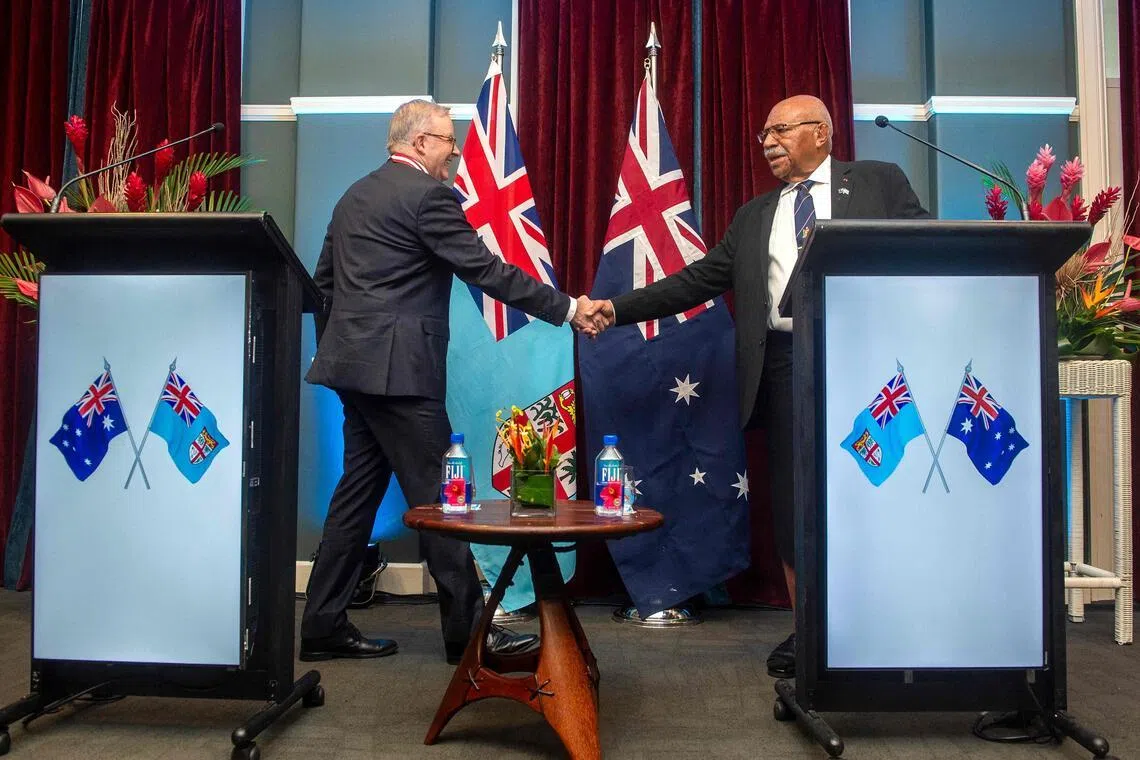
But a new mutual defence treaty signed on July 6 with Fiji – the most populous Pacific island nation – capped off a series of agreements with Pacific states that indicated Canberra is now edging ahead of Beijing in this diplomatic battle.
Australia has long been concerned that China could establish a military base on a Pacific island in the waters to its north that could be used to threaten the Australian mainland, but this series of recent deals has – for now – removed the threat.
Pacific expert Oliver Nobetau, from The Lowy Institute, told The Straits Times that Pacific nations have long insisted that they can “hedge” between the region’s great powers, but it is now clear that Pacific nations are “siding with Australia”. He said Australia was now well positioned to block China from gaining a military foothold in these countries.
“Australia has covered a lot of ground in revamping partnerships with Pacific countries,” he said. “It has secured strategic access to critical infrastructure like ports and wharves and a prioritisation of Australia as a security partner.”
Canberra’s diplomatic quest to deepen ties across the Pacific began when Solomon Islands and China signed a secretive security pact in 2022, raising fears in Australia that the deal could lead to a Chinese base there.
Australia’s concerns were heightened as Beijing expanded its outreach to Pacific countries such as Papua New Guinea and Vanuatu and tried to secure a regionwide deal with countries across the Pacific.
Piecemeal approach
Adopting a wily and creative diplomatic approach, Australia tailored a series of incentives for each country that were calibrated to its needs.
So for instance, Fiji received policing support as it battles gangs and drug-related crime, Tuvalu received access to a new migration scheme to provide Australian visas for residents vulnerable to climate change, tiny Nauru received support in accessing banking services, and Papua New Guinea (PNG) was given much-needed development support and the sports-obsessed nation will be able to field a team in Australia’s rugby league competition as part of a A$600 million (S$540 million) Australia-funded package.
These carefully designed incentives paid off, as Canberra secured a series of landmark security pacts in which each country effectively promised that Australia would be its main strategic partner.
As two of the few Pacific countries with militaries, Fiji and PNG went further and signed defence treaties in which they and Australia promised to come to each other’s aid if facing an armed attack. PNG signed its treaty in October.
The Fiji treaty, signed between the two countries’ leaders – Anthony Albanese and Sitiveni Rabuka – in Suva on July 6, was designed as a potential regional alliance, prompting speculation that the other three Pacific countries with militaries – New Zealand, PNG and Tonga – could join. New Zealand has already signalled that it may join.
China ‘lashing out’
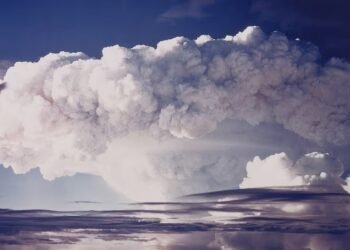
And then, in the midst of this diplomatic contest, China on July 6 conducted a test of a ballistic missile that was fired from a nuclear-powered submarine that landed in the South Pacific – an incident that angered leaders in the Pacific, whose residents are sensitive to weapons testing after decades of American, French and British nuclear tests following World War II.
Condemnation came from across the region, including from Tuvalu’s Prime Minister Feleti Teo, who expressed “grave and serious concern”, and Palau’s President Surangel Whipps Jr, who said he was “shocked and deeply concerned”. During a visit by Albanese on July 7, Solomon Islands Prime Minister Matthew Wale told reporters that the Chinese test was ”not something a friend does”.

China last tested an intercontinental ballistic missile in 2024.
PHOTO: AFP
Though security analysts said the Chinese launch had probably been prepared for some time and was not a direct response to Australia’s security agreements in recent weeks with Vanuatu and Fiji, the test was seen as a diplomatic setback for Beijing.
Pacific expert and former Australian diplomat James Batley, from the Australian National University, told The Straits Times that the test would have highlighted to Pacific leaders the difficulty of trying to steer clear of geostrategic tensions between China and the United States, along with its allies such as Australia.
“A few years ago, Pacific leaders were blithely saying the geostrategic competition in the region has nothing to do with us and is actually beneficial because people are giving us more aid,” he said.
“There is now a greater awareness that geostrategic competition has a downside and can be divisive. China’s aggressive coercive side has been seen in some of their diplomatic behaviour, and certainly with the missile test.”

Australian PM Anthony Albanese (left) and Solomon Islands PM Matthew Wale attend a press conference in Honiara, Solomon Islands, on July 7.
PHOTO: EPA
He added: “The last few years have shown that there are limits to being ‘friends to all’.”
Batley said Pacific countries have been concerned about China’s aggressive efforts to encourage the Pacific Islands Forum – the main regional grouping – to adopt China’s position on Taiwan, even though three Pacific nations – Marshall Islands, Palau, and Tuvalu – recognise Taiwan rather than China. The missile test, he said, “triggers concerns about nuclearisation that have been around for decades”.
“It could only be interpreted as a show of force, a lashing out,” he said.
Victory not yet won
But Australia’s success in winning over Pacific nations carries no guarantee of long-term success. Elections in Pacific nations could lead to changes of government and leaders who are more supportive of China.
Australia still needs to show it can implement its various deals, which come with expensive sweeteners. The new Fiji treaty, for instance, was accompanied by promised Australian investment of A$1 billion over 10 years.
“The only way to avoid a shift back to China is to focus on implementation,” The Lowy Institute’s Nobetau said.
Australia now holds several precious “pieces of paper”. But achieving a permanent victory in the Pacific will require a new level of on-the-ground diplomatic effort and, at a time when Canberra faces domestic cost-of-living pressures, is unlikely to be cheap.
“If money is coming in and work is under way, it is a hard case to sell to Pacific populations to go against development,” Nobetau added. “You can sign a piece of paper but the pressure will be on Australia to maintain that support or these countries could turn back to China.”