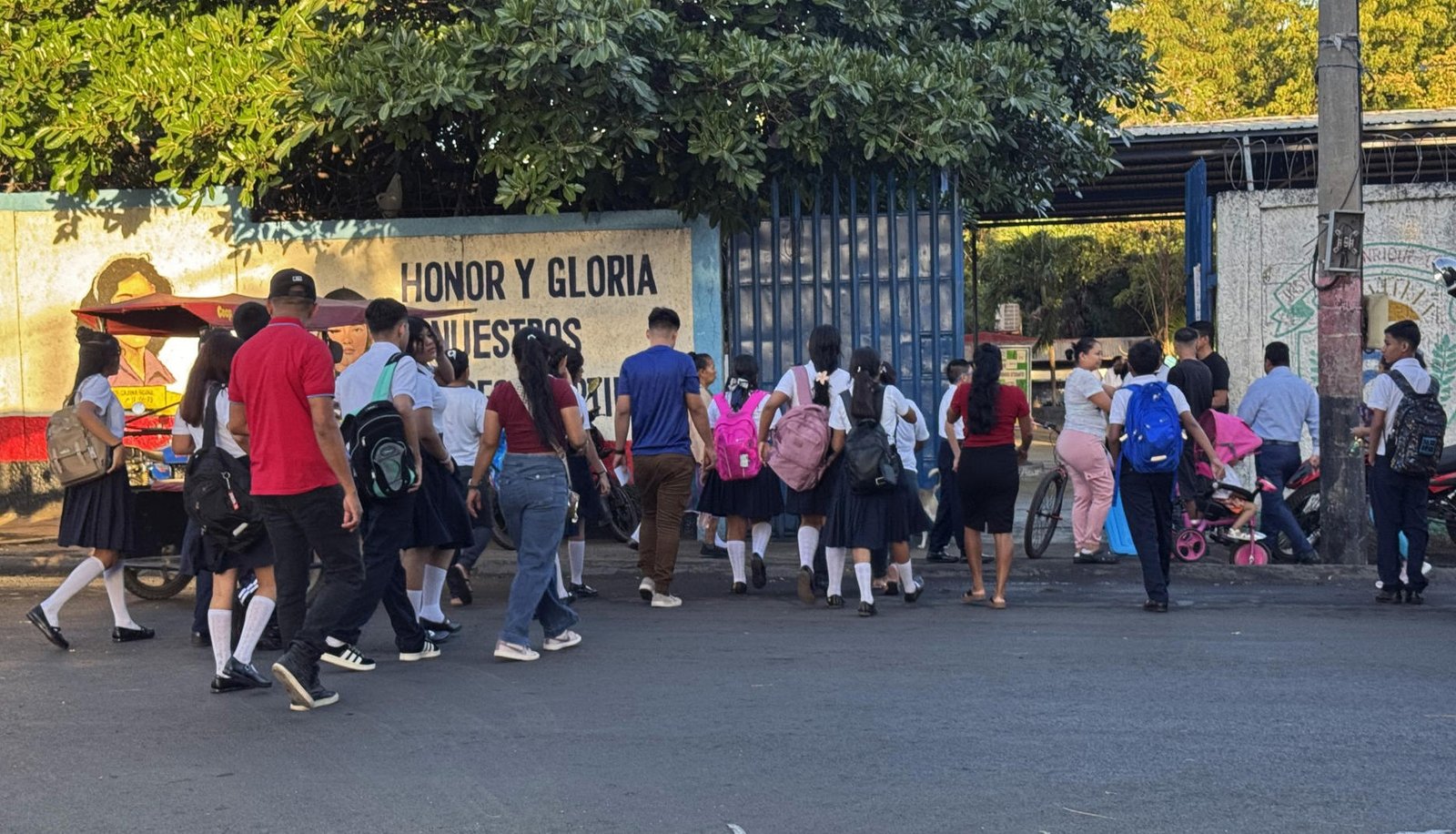
Almost 83,000 students left regular secondary classrooms in Nicaragua in 2025, according to official data analyzed by CONFIDENTIAL. Such a situation—according to a specialist in educational issues—compromises the future of the country because there will be fewer competitive young people in the labor market.
The records of the Ministry of Education (Mined)—incorporated in the execution reports of the General Budget of the Republic—show that regular secondary school enrollment went from 438,948 students in 2024 to 355,995 in 2025.
This is a reduction of 82,953 students who left the system in this type of basic education, equivalent to 18.9%. The collapse in enrollment in 2025 shows a setback in the growth that had been occurring since 2023.
By 2025, the educational authorities projected an enrollment of 433,407 students in regular secondary school. However, at the end of that year, there were 77,412 students below the goal, according to the documents analyzed.
The data, however, does not allow us to determine how many of them left the classrooms once the course started and how many did not enroll in 2025, the year in which school retention was 93.7%.
What could have caused the enrollment deficit?
Luisaa specialist in educational issues, explained that the economic situation of families, sociopolitical violence and forced migration processes configure a scenario in which permanence in education is deeply compromised.
“These young people have to enter economic activities earlier to survive, to contribute to their family’s economies,” he said. Luisawho asked that his name be omitted for fear of reprisals.
“Migration, exile, forced displacement,” added the specialist in educational issues, “are also linked to this situation. They have had to leave Nicaragua, not only because of persecution, but also because of these other factors that we have mentioned, they have gone to other countries looking for better opportunities.”
For the expert, Nicaragua will have in the future “an unskilled, non-competitive workforce that can contribute very little to the well-being, the development of the country and the improvement of the living conditions of each of the families and these young people.”
Dictatorship inflates enrollment figures
In 2025, the regime of Daniel Ortega and Rosario Murillo celebrated the entry into the school system of 1,806,518 students in the modalities of preschool, primary and regular secondary, distance education in the countryside, and secondary through meetings.
That year’s report, however, shows that general enrollment in Nicaragua’s public education system totaled 1,740,212 students in the different modalities.
During 2025, primary education reached an enrollment of 901,465 students and achieved 102.3% compliance with the programmed goal. In addition, 104,853 students were enrolled in the secondary school modality for youth and adults, an alternative to regular secondary school.
The reports also record 75,967 remote high school students in the field who during the 2025 school year participated in academic activities and mathematics festivals.
Fewer students than in 2022
Official data show that the drop in secondary enrollment in 2025 exceeds that recorded in 2022, when it decreased by almost 70,000 students compared to 2021.
The balance between the programmed and the enrollment completed in regular secondary school has been the following in recent years:
- 2021: the executed enrollment equaled that programmed with 400,309 students.
- 2022: the Mined enrolled 340,378 students, 69,630 less than the 410,008 expected.
- 2023: exceeded the goal with 427,215 students, a compliance of 104.8% with respect to the 407,634 programmed.
- 2024: registered 438,948 enrollments, the highest figure for the period with compliance of 102.6%.
- 2025: Enrollment plummeted 18.9%, going from 438,948 to 355,995 students.
School retention is not met
At the end of the 2024 cycle, school retention was 90.5%, which means that of an initial enrollment of 438,948 students, around 397,248 managed to finish the school year.
Approximately 41,700 students left the system during the year, equivalent to 9.5% of the total enrollment.
Although more than 397,000 regular high school students completed their studies in 2024, the system reported only 355,995 students at the beginning of 2025, according to the analysis.
This departure of students shows a failure in the school retention strategy, which measures the capacity of the educational system to guarantee that students enrolled at the beginning of the cycle attend classes, actively participate and remain in school, avoiding desertion or dropping out of school.
The National Education Strategy It projects that each student has the opportunity to take an educational route. For example, you enter preschool, you reach primary school, you reach secondary school, and if you cannot enter university, you can choose to do a technical degree completely free.
“What we do not know is whether, in practice, this route is really effective. Because, in addition, the educational strategy is not a long-term education plan, it is a short-term strategy, only 2024-2026, that is, it is three years of execution, and in three years it is impossible to see results that objectively speak of progress in education,” he stressed. Carlos in an interview with CONFIDENCIAL at the beginning of the 2026 school year.