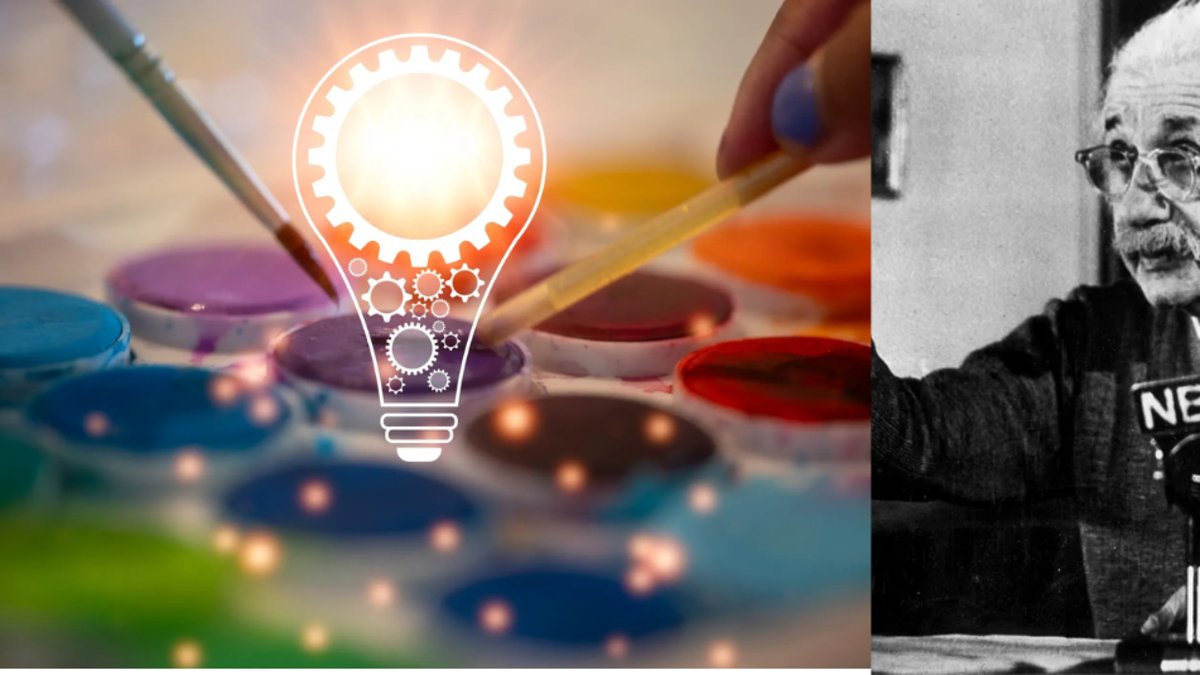
More than half a century after his death, the ideas of Albert Einstein They continue to be cited not only in the scientific field, but also in debates about creativity, the pace of life and contemporary thought.
According to a note published by ‘TN’, Albert Einstein’s legacy transcends modern physics and extends to reflections on everyday life.
READ ALSO

One of his most widespread phrases —“The monotony and loneliness of a quiet life stimulates the creative mind”— presents a view that contrasts with the current dynamics, characterized by hyperconnectivity and constant activity.
According to the same medium, Einstein maintained that creativity does not necessarily arise from pressure environments, but from spaces of reflection.
An example of this was the development of the Theory of Relativity, which, as noted, It was born in moments of deep thought rather than in contexts of urgency.
He stated that “Imagination is more important than knowledge.” Photo:Guillermo Ossa/EL TIEMPO
Creativity and the value of imagination
Einstein also stated that “Imagination is more important than knowledge,” highlighting that progress does not depend solely on the accumulation of information, but on the ability to project new ideas.
According to ‘TN’, this vision underlines the importance of reducing constant stimuli to Allow the mind to focus on complex processes.
In that sense, monotony is not presented as a synonym for boredom, but as a form of stability that facilitates concentration. Loneliness, for its part, appears as a condition that favors introspection and autonomous thinking.
READ ALSO

Routine as a tool for thinking
Einstein considered routine as an element that can release mental load. By reducing the number of everyday decisions, you create space for creativity.
Various artists and scientists agree with this perspective, pointing out that repetitive habits allow mental energy to be concentrated on more complex tasksinstead of dispersing it into minor decisions.
Another notable aspect is the value of solitude. Einstein stated that temporary isolation should not be understood as something negative, but as an opportunity for the development of thought.
Partial disconnection from the environment allows process information, organize ideas and generate new associations. The approach does not imply total isolation, but rather finding a balance between social interaction and moments of introspection.
The relationship between gravity and time derives from the research of Albert Einstein. Photo:Getty Images
Who was Albert Einstein
Albert Einstein was a theoretical physicist born in 1879 in Germany. He is recognized for developing the Theory of Relativity and for his contributions to quantum physics.
In 1921 he received the Nobel Prize in Physics for his explanation of the photoelectric effect.and his equation E=mc² became a symbol of modern science.
*This content was written with the assistance of artificial intelligence, based on publicly known information disclosed to the media. In addition, it was reviewed by the journalist and an editor.
JOS GUERRERO
DIGITAL SCOPE EDITORIAL