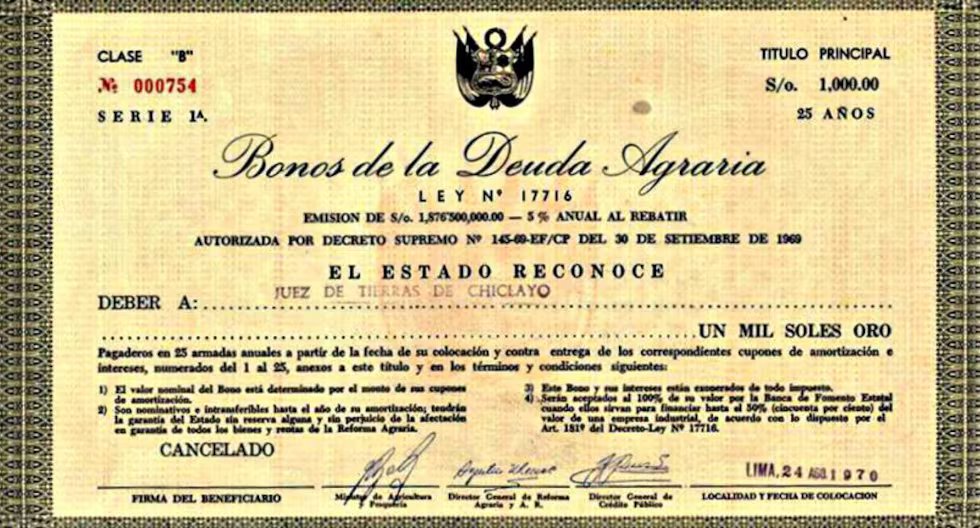

The government published this Tuesday the supreme decree approving a new methodology for updating the bonds corresponding to the agrarian reform debt.
According to the text, under this new calculation the aim is to determine, for each case, the updated value of the debt for these bonds, applying the ruling of the Constitutional Court January 2026 on the subject.
LOOK | These are the most current brands and valued by Peruvians: know the Total Brands 2026 ranking
Thus, two methodologies are taken into account: for bondholders who did not collect any coupons or for those who did collect some of their coupons.
Manuel Villa-García, partner in the dispute resolution area of Estudio Olaechea, explained that these coupons were the partial payment of the capital and interest of the bonds, made annually.
According to the decree, the coupon will be valid if all of its information for identification or the rights it represents is appreciated. Likewise, missing coupons and uncollected coupons that are broken or damaged in less than 50% of their body will be considered paid.
Mario Seoane, lawyer and legal advisor of the Association of Bondholders of the Agrarian reformconsidered that the Constitutional Court (TC) would have to verify whether the formulas published by the Ministry of Economy and Finance (MEF) are correct.
Precisely, he remembered that the MEF Previously, it had already established a formula that was different from what was ordered by the TC in 2013.
“The TC would do well to verify whether the components of the methodology have been correctly collected by the MEF, safeguarding the sentence,” he noted.
LOOK | El Niño 2026 phenomenon: are Peruvian companies prepared to face it?
The decree also establishes four payment methods for legitimate bondholders who have their debt up to date.
Thus, the payment will be with freely transferable sovereign bonds, the delivery of lands owned by the State, the payment of an exchange for investment in sectors prioritized by the State or the cash payment of up to S/100,000 in a period of up to 8 years.
For the latter case, if the maximum amount of cash payment is exceeded, exceptionally the parties will establish a payment schedule, within the aforementioned period.
Bondholders can also choose to combine payment methods, the decree states.
LOOK | BCP: The BCR will evaluate an increase in its reference rate during the second half of 2026
Villa-García recalled that with this measure the current value of the expropriated lands is not being collected, but only the value of the bond delivered after the valuation of said properties and assets.
He added that the amount of the bonds has been expressed in gold soles – a currency that was valid until January 1985 -.
In turn, Seoane indicated that the approach of different payment methods alleviates the weight of the agricultural debt in the fiscal coffers.
He added that the decree opens two scenarios: one is the payment to bondholders who are in the judicial or administrative process, and the other is that the formula is applicable to all bonds pending payment.
Thus, he explained, the MEF must dictate the provisions to reopen the payment procedure so that bondholders who are not included in the administrative or judicial procedure can appear.
Another aspect that Seoane highlighted is that the decree also establishes a provision indicating that the methodology must also be applied to those who have already collected their agricultural debt bonds, so that they can be reimbursed with the correctly applied formula.
In this regard, according to the document, the MEF has a period of no more than 120 calendar days to issue a ministerial resolution on this last point.
It is worth remembering that, as Seoane told El Comercio in May, the Association of Bondholders of the Agrarian reform He calculated that the amount of the debt was approximately S/3,000 million.