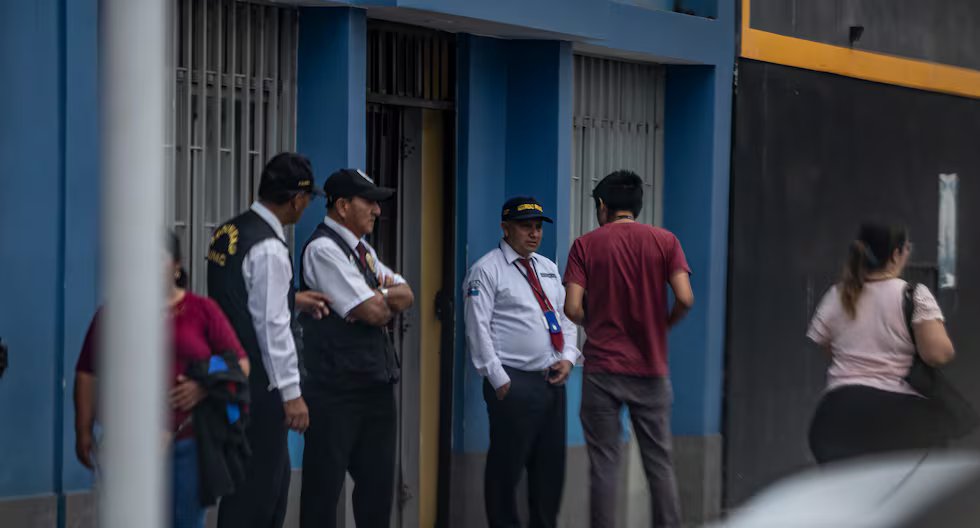
The National University of Callao (UNAC) is going through one of the biggest institutional crises in recent years after a succession of complaints for alleged administrative irregularities, questioned hiring and suspicious electoral processes. The revelations published by El Comercio and supported by reports from the comptroller’s office, tax documents and testimonies have put the main authorities of the seventh public university with the most students in the country under the microscope.
According to these investigations, the rector Arcelia Olga Rojas Salazar; the head of administration, Jorge Linares; the head of the Supply Unit, Juan Carlos Collado Félix; and other officials of the university leadership face investigations or tax proceedings for alleged crimes linked to incompatible negotiation, improper use of the position and other conduct. Among the reported events are the payment of remuneration to a deceased teacher, alleged improper payments to staff, an alleged exchange of favors and questions about public contracting processes.

The controversy extended to the recent process to elect the new rector. Before the elections, El Comercio revealed complaints against the then candidate Augusto Caro Anchay related to his professional career and alleged links with the current university management. Subsequently, students reported that they had been pressured to support list 4, headed by that same candidate, under the threat of conditioning the delivery of their qualifications. In addition, they warned that the rectorate was considering postponing the publication of the grades until after the elections, in order to increase pressure on the students to vote for that candidacy. Finally, Caro was elected rector.
As a result of these complaints, the Comptroller General of the Republic informed El Comercio that during the administration of Rector Arcelia Rojas there have been eight control interventions at UNAC, which cover observations on administrative management, contracting and use of public resources.
—A national reality—
However, the situation at the University of Callao is not an isolated case. According to information collected by the comptroller’s office, until the end of 2025, control interventions were registered in 43 public universities in the country, which reveals a scenario of repeated questions in the state university system.
Various public universities have been the subject of complaints, tax investigations and reports from the comptroller’s office for alleged irregularities. The Universidad Nacional Mayor de San Marcos faced questions related to electoral processes, hiring and administrative management. The Federico Villarreal National University registered complaints about the election of authorities, governance conflicts and non-compliance with the University Law. The National University of Engineering was singled out for complaints of alleged nepotism, corruption and sexual harassment that even motivated an evaluation in the Congressional Education Commission.
Likewise, the San Luis Gonzaga National University accumulated observations for alleged nepotism, irregular hiring, unsupported payments and deficiencies in works. The José Faustino Sánchez Carrión National University, the National University of Ucayali and the National Intercultural University of the Amazon were also questioned for alleged administrative irregularities and acts of corruption investigated by control entities.
When consulted by El Comercio, the National Superintendency of University Higher Education (Sunedu) indicated that, by virtue of university autonomy, it is initially up to each university to resolve administrative matters. However, he specified that if the complaints affect the continuity of the educational service or violate the basic quality conditions, the entity intervenes through information requirements and investigative visits. Regarding the UNAC, sources from the institution indicated that, if the rector’s responsibility is proven, the University Assembly could evaluate her dismissal.
El Comercio tried to obtain the version from the Ministry of Education; However, as of press time, no response was received.
YOU MAY BE INTERESTED