SUBMITTED
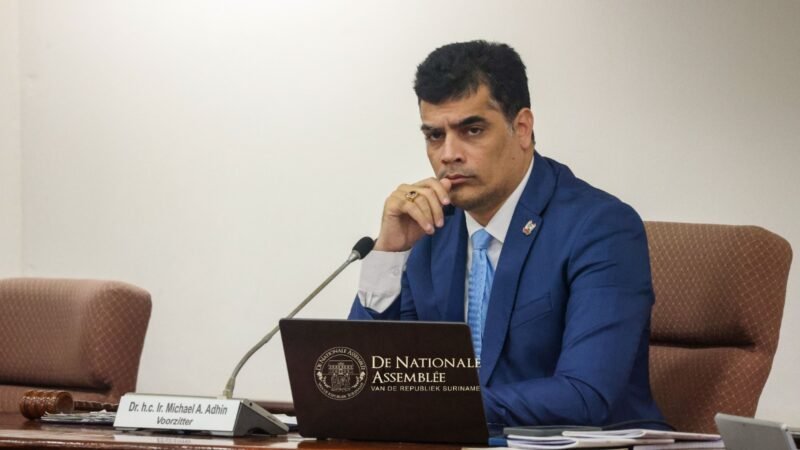
The parliament of Suriname is in full session, and the real question is what has been achieved so far. A year ago I took over the gavel of the National Assembly, with one promise in mind: that the bar had to be raised. This meant, among other things, that the order of meetings was reduced to the Rules of Order in the strict sense. It sounds simple, but we keep encountering established conventions that cloud order rather than serve it. Restoring discipline is, in short, itself a struggle.
Suriname is on the eve of income from oil and gas, and the question is not how large those reserves are, but whether our institutions are strong enough to translate that wealth into prosperity instead of waste. At the Local Content Conference of October 2025, I therefore advocated a National Productivity and Diversification Plan and a Parliamentary Forum for Economic Transition: a permanent table where parliament, government, entrepreneurs and science prepare the upcoming legislation on oil, gas, energy management and local content.
Local content must be more than a word: measurable obligations, with investors and entrepreneurs structurally involved on the way to first oil in 2028. In that context, parliament is looking forward to the Development Plan 2027-2031, which the government must submit in October, together with the budget for the 2027 service year. After all, parliament controls the government, especially in the period leading up to 2028, and monitors the budgets; it is the first line of defense against waste.
Legislation and supervision
In twelve months we held more than forty public meetings and more than 130 committee meetings. Six laws reached the finish line: the 2025 State Budget, adoption of the State Debt Plas, the amendment of the Labor Advisory Board Act, and amendments to the Driving Act, the Suriname Fire Department Act and the Funeral Act. The 2026 State Budget is now in its final phase.
At the same time, the committees are passing the heavier legislation that should lay the foundation: the Government Accounts Act, the modernization of the Judiciary, the Working Conditions Act, the Public Access Act and the Center for Innovation and Productivity Act. In addition, public committee meetings have been announced; the first was held in the context of the high-profile cases of the indictment of three former political office holders.
However, the House of the People did more than legislate; it also supervised. In this supervisory role, the Board showed its teeth: the case surrounding the State Health Insurance Fund, and the enforcement of transparency on a series of pressing issues, is making steady progress.
Strengthen the institute
In addition to legislation and supervision, we invested in strengthening the institute itself: a Multi-Year Parliamentary Program and organizational and institutional modernization of the National Assembly. Financing extra parking space around parliament, for a city center with fewer cars on the street and more quality of life, is also on the table. And we have started to digitize all legislation since 1900, not as an archive, but as a foundation for an AI instrument that gives the entire legal practice, from judge and public prosecutor to lawyer, notary, bailiff and law student, faster access to the law. There will be a standing National Security Committee for national security.
Parliament was also active outside the national borders, and not for the sake of form. In the year of our golden independence jubilee, this parliament received the Dutch royal couple and foreign guests, including the Asantehene of the Ashanti Kingdom; we spoke with the House of Representatives of the States General, with India and the United States, with Cuba and the Kingdom of Saudi Arabia. In addition, delegations from this parliament carried out various missions to international forums, such as the Inter-Parliamentary Union (IPU), which strengthened parliamentary diplomacy during the past parliamentary year.
Which isn’t finished yet
The same level-headedness suits what is not yet finished, and I call it by name. The new Rules of Order, which should improve order and the level of parliament, are not yet in place, although they are in preparation. And quorum discipline, the chronic ailment of parliaments, is improving, although not yet sufficiently.
That is why from now on we also keep track of the figures that make our work measurable: the quorum, the share of meetings that take place, the number of laws adopted, and the progress of the projects for the transformation of parliament as an institution.
The year two test
The differences between coalition and opposition are present, as they should be in a democracy. Bridging succeeds when we put purpose first, serving the community, and choose country over party. That brings me to the real test, which will fall in the coming year: not how often the gavel sounds, but how many laws actually leave the floor, and whether the promised reforms become more than good intentions.
I opt for integral rather than minimal changes when we revise laws in the council. That is why I commit myself to three measurable things: a renewed Rules of Order within this parliamentary term; a permanent and public semi-annual report, so that you can weigh our work for yourself; and the finalization of the laws that most directly affect citizens, starting with those on economic transition.
Because my own opinion about this first year is twofold: the political council has met in full and the results in legislation and regulations have not been forthcoming; on the other hand, the organizational transformation is in full swing, and what all this produces must now be made understandable and demonstrable.
Michael Ashwin Adhin – Chairman of the National Assembly
The editorial staff of the True Time allows readers to submit articles for publication. In principle, all submitted articles will be included, unless the content is harmful, hurtful or insulting to third parties. Pieces posted do not necessarily reflect the views of the True Time. The editors reserve the right not to publish articles, or to shorten or edit them without taking them out of context.