by Ivan Cairo
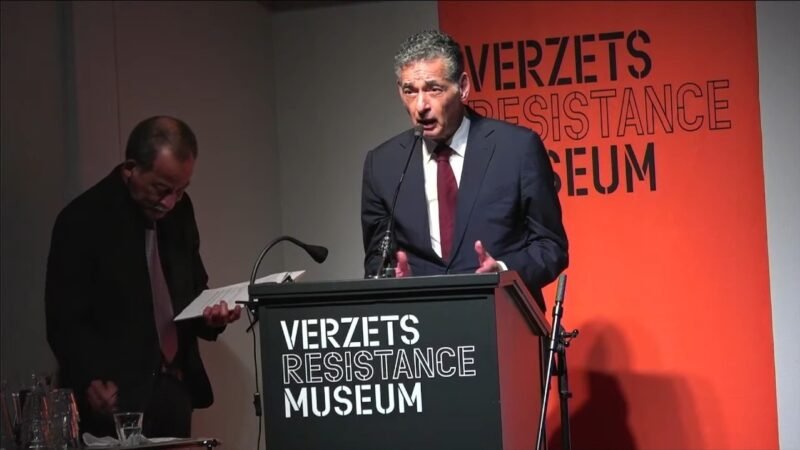
PARAMARIBO — During the commemoration of the December murders on Monday evening in the Resistance Museum in Amsterdam, the Netherlands, lawyer Gerard Spong sharply criticized the Surinamese Public Prosecution Service. According to him, judges fulfilled their task in the December 8 criminal trial with “courage and inestimable value” for the rule of law, but the Public Prosecution Service failed to ensure the execution of the sentence.
The memorial meeting, which was broadcast live on YouTube was broadcast, focused on the fifteen men who were tortured by soldiers at Fort Zeelandia on December 8, 1982 and then executed under the watchful eye of then army commander and de facto government leader Desi Bouterse.
“Bouterse has consistently ignored the basic principles of the rule of law”
Gerard Spong
Research
Spong emphasized that the convicted main perpetrator, Desi Bouterse, managed to avoid punishment for years and died in December last year, without ever seeing the cell. “Bouterse has consistently ignored the basic principles of the rule of law. His death put an end to this unedifying soap opera,” said Spong.
The Public Prosecution Service, he stated, failed to investigate who helped Bouterse to go into hiding or who kept him hidden. “That needs to be thoroughly investigated, but it is not happening,” says Spong. “After more than forty years of tough legal battles, we are here again.”
Spong praised the judges who handed down the convictions and called their work an act of courage and invaluable to the rule of law. But he emphasized that the fight is not over.
Historical milestone
During his speech, Spong reflected on the fifteen victims who were executed in Fort Zeelandia on December 8, 1982. He called Bouterse’s conviction a historic milestone, but warned that the fight for a fully functioning constitutional state is not yet over.
He also addressed reports that other convicts have submitted a request for clemency. Spong pointed out that the Surinamese Constitutional Court declared amnesty for serious human rights violations unconstitutional in 2021 and that the same reasoning applies to pardons. “Both lead to impunity,” the lawyer said.
‘Banana Republic’
International case law, such as the Inter-American Court of Human Rights and the European Court, confirms that pardons have often been reversed in similar cases. Spong therefore considers it unlikely that President Jennifer Geerlings-Simons will be able to grant a future request for clemency without harming Suriname internationally. “This would expose Suriname as a banana republic,” he said.
Finally, Spong called for looking beyond legal errors and working towards a future in which the rule of law fully functions. “The era of impunity must finally end,” Spong said.