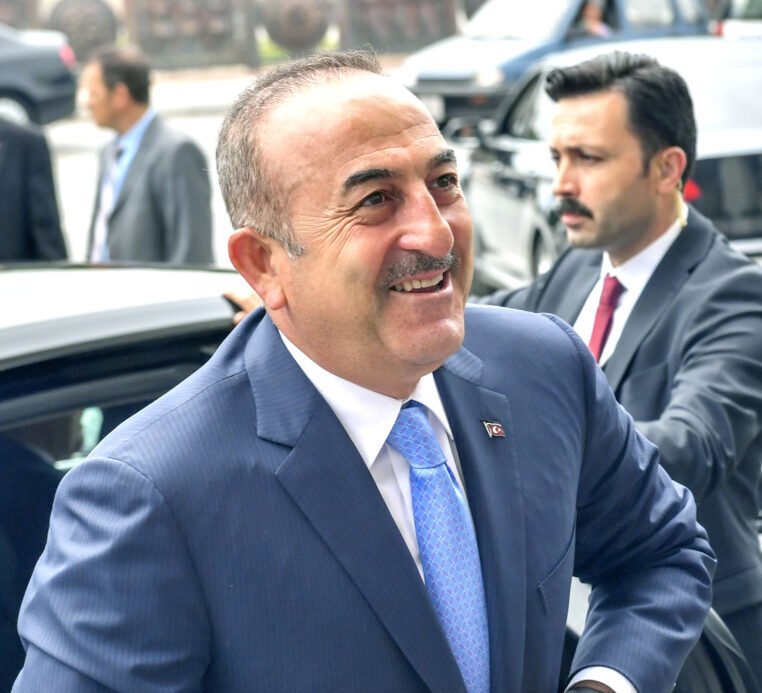
Occasion: The appearance of the former Minister of Foreign Affairs of Turkey and former head of the Turkish delegation in the NATO Parliamentary Assembly, Mevlut Cavusoglu, at the international conference “Dialogue for Unity and Peace 2026”
- Çavuşoğlu said loudly what Europe persistently tries not to hear and clearly stated that “Macedonia was asked to change its flag, then its name, and now it is asked to accept that it is not Macedonian”… The message resonated far beyond the conference hall in Skopje
Former heads of state, ministers, diplomats, university professors, researchers and representatives of international organizations from Europe and Asia gathered at the international conference “Dialogue for Unity and Peace 2026”, which was held in Skopje these days in the organization of the office of the former president Dr. Gjorge Ivanov, the international center “Alliance of Civilizations” and the alumni association of the School for Young Leaders.
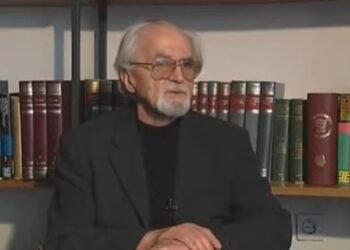
Among the numerous speakers, one performance in particular attracted the attention of the public and diplomatic circles. The former Minister of Foreign Affairs of Turkey and former head of the Turkish delegation in the NATO Parliamentary Assembly, Mevlut Çavuşoğlu, sent a message that essentially represented a direct review of the policy that the European Union has been leading towards Macedonia for years.
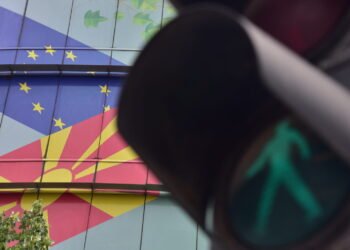
His statement was clean, meticulously composed and unequivocal: “Macedonia was asked to change the flag, so the name and now they are asked to accept that they are not Macedonians. It is unheard of and against the basic values of the EU.”
– This was not an ordinary diplomatic remark. Neither was the statement of a local politician, analyst or academic. This was a statement made by a politician with many years of experience on the highest international stages, a man who for years was one of the most recognizable faces of Turkish diplomacy and a representative of one of the most important countries in NATO – say our interlocutors, former diplomats and participants of the international conference.
When facts become accusations
What makes this statement particularly significant is the fact that Çavuşoğlu did not offer a political interpretation, but listed facts.
– Everyone knows, but many are silent, that Macedonia really changed its national flag. Macedonia really changed its constitutional name. Even today, within the framework of the European process, debates are being held and conditions are being set that directly penetrate the issues of national identity, history, language and collective self-awareness. Hence, his statement gains much more weight than a simple political criticism. It represents a public articulation of a reality that has been felt in Macedonia for years, but rarely any international official was ready to formulate it so openly – our interlocutors, experienced diplomats, who attended the conference in Skopje told us.
A serious rebuke to Brussels
In essence, Çavuşoğlu’s statement opens an unpleasant question for the European Union. If the Union is really based on the principles of equality, dignity and respect for diversity, then how is it possible for a candidate state to be faced with demands that directly affect elements of its national identity?
– His words can be understood as a serious political rebuke to Brussels. For years, European institutions have been trying to present the enlargement process as a technical and reform process based on European standards. But the case with Macedonia has long gone beyond the framework of classic negotiations on the rule of law, economy or institutional reforms. In the eyes of many observers, it has become an example of political conditioning that goes beyond the usual criteria for membership – said in his public appearance the former Minister of Foreign Affairs of Turkey and former head of the Turkish delegation in the NATO Parliamentary Assembly, Mevlut Cavusoglu.
When this is stated publicly by a former head of diplomacy of a major NATO country, then the criticism can no longer be easily ignored.
A message to both Athens and Sofia
No less significant is the indirect message resulting from this attitude towards official Athens and Sofia. In the last three decades, Macedonia has been subject to a series of demands and conditions related to issues that hardly any other European country would accept as a topic for interstate negotiations. That is exactly why Çavuşoğlu’s statement gains additional political weight. It is not an attack on the neighbors, but a reminder that European integrations must not be turned into a mechanism through which a nation will be put in a position to constantly prove its own historical and national legitimacy.
A strategic partner’s voice echoed from outside the hall
Çavuşoğlu did not talk about confrontation. On the contrary, he clearly emphasized that Turkey is for cooperation and against the creation of new divisions in the Balkans. He confirmed Ankara’s readiness to support all initiatives for peace, security and economic cooperation in the region. But that’s exactly why his words have even more weight. When a politician acting from a position of regional stability and cooperation publicly says that the demand for a country to give up its own identity marks is “unheard of” and “contrary to European values”, then it becomes a message that goes beyond daily politics.
Macedonia as a test for European credibility
Mevlut Çavuşoğlu’s performance at the conference in Skopje will be remembered not only for the clarity of his message but also for the fact that he reopened the essential question: Where do European criteria end and where does political conditioning begin? At a time when the trust of Macedonian citizens in the European process is seriously shaken, his words represent a rare international confirmation of the feeling that Macedonia in the past decades was exposed to demands that have no precedent in contemporary European politics. That is why the message from Skopje was not only a message to Macedonia.
– It was a message to Brussels. Message to Athena. A message to Sofia. And this is a message from our strategic partner with a reminder that “Europe cannot convincingly talk about values if it allows those values to apply differently to different peoples” – concluded our interlocutors. PR