Review of the literary work of the great Petre M. Andreevski on the occasion of the 92nd anniversary of his birth
- Today’s 92nd anniversary of Andreevski’s birth – on June 25, 1934 in the Demirhisar village of Sloestica – is a new opportunity to return to his literary work, which represents an exceptional contribution to the development and consolidation of the Macedonian spirit and to the defense of the Macedonian national identity.
Brothers and sisters, be alert! Do not be ashamed of anything that is ours. Despise those who appropriate our name, but also the church, the language and the script, which they borrowed from us. Despise all those who want to predetermine our historical story, which is based on so many graves. Know that all our state-building foundations and all our sacred heritage are laid in that story. History is an open process that is constantly changing. We, the Macedonians, want to write that history only with our Macedonian script and only with our Macedonian truth! This was said in 2003 by the brilliant literary critic of the Macedonian national destiny, Petre M. Andreevski, in his “Macedonian Manifesto”. These words are his timeless epistle, but also a bequest to all Macedonian generations to defend their authentic Macedonian national history from all those who distort it, who falsify it and who even want to appropriate it, like the Bulgarians with their self-deceptions about the supposed “common history” of the Macedonian and Bulgarian people. Today’s 92nd anniversary of Andreevski’s birth – on June 25, 1934 in the Demirhisar village of Sloeshtica – is a new opportunity to return to his literary work, which represents an exceptional contribution to the development and consolidation of the Macedonian spirit and to the defense of the Macedonian national identity.
Andreevski acts as the conscience of the Macedonian people and guardian of the truth
Andreevski acted, and still acts, as a critical consciousness and conscience of the Macedonian people, as a guardian of the truth, a defender of the Macedonian national identity and our self-importance. He is an interpreter and prophet of the Macedonian future, a powerful contributor to the Macedonian national memory.
– Without the language we will miss ourselves, because only the language has never left us alone and it remembers much more than we can forget – said Andreevski about the Macedonian language, in which he worked.
The great Macedonian literary figure reflects the essence of language as the guardian of our identity, our collective memory and our very existence as a people.
“Don’t let someone else control our national consciousness!”
Standing even after his death permanently on the fender of the existence of the Macedonian people and state, the Macedonian literary great Andreevski, just like Solzhenitsyn, will send a message through his “Macedonian Manifesto” to the current Macedonians to fight against the lies and violence against them, because they can defeat them, protecting their consciousness and homeland.
– Don’t let someone else control our national consciousness! We are the chosen people, who had God’s blessing to open the doors of Christianity to Europe and to be the first bridge for the passage of his holy messages to eternity. From this biblical land, Alexander the Great began to revive the idea and the first model for a world state. The first university in Europe was founded here. We have had countless riots and uprisings, we have had many executed but not defeated warriors. We have also had many blinded soldiers, but not blind sight. We have never lost touch with the light. No matter how much we have sinned against the motherland, she still forgave us. And she remained in our longing to die in her. It was always that chosen place, where we could, even dead, dream undisturbed. Brothers and sisters! Freedom is our first icon, so don’t let it go from your hands and from your love. It is not won once and for all, but every day and constantly. And through every sunrise that illuminates us. This is the only way we will see Macedonia united in such a magnificent light. Because our flag is the sun, and it is the oldest fire, on which we warm ourselves – said inspired Petre M. Andreevski 23 years ago in his “Macedonian Manifesto”.
Therefore, that “Macedonian Manifesto” is in an absolute sense an epistle of this literary genius and national thinker, perhaps especially to this Macedonian generation, to oppose all threats to the existence of Macedonia, to the Macedonian nation, to all threats and threats to Macedonianism as Macedonian national ideology and philosophy of freedom.
“Let’s build a national program, in which Macedonia will be our determination by consensus”
Today, when not only the Bulgarians but also other political powers from Europe, have stumbled at any cost, with ultimatums, threats and dictates, to change the Constitution of Macedonia, with the wholehearted help of a number of their henchmen, in function of other people’s anti-Macedonian agendas, it is worth remembering what Petre M. pointed out. Andreevski already in October 1993, in an interview for the then weekly “Puls”, regarding what is most necessary to do in such moments of pressure on Macedonia: “Instead of building a national program, in which Macedonia will be our determination by consensus, we give ready-made solutions to our neighbors for their national programs, in which our country is included. We are a nation that is most prone to destroy itself, a nation that prefers other people’s values All our neighbors deny us, and at the same time, as if their own misery is not enough. The Serbs and Bulgarians are still looking for a place to live. The Greeks are also afraid of us Under that pressure, they carried out the greatest genocide in the Macedonian population. For a long time, in their documents, they claimed the exclusive right over Macedonia. So, as a defeated country, Macedonia has a central place: the two world letters and one of the first universities. Macedonia is also a biblical country, it is older than Europe.”
“Macedonian people are like wheat – indestructible”
In 2000, in an interview for “Nova Makedonija”, when asked what advice he would give to Macedonians, the great Macedonian writer and patriot pointed out: “To regain their dignity, courage and truth for themselves!” In his cult “Piraeus”, one of the most read novels of the recent Macedonian literary era, which is a true monument of the Macedonian national essence, Andreevski imprints forever in Macedonian literature and the collective national memory the monumental symbolism and comparison of the insubordination of the Macedonian people with the indestructibility of the tares: “Piraeus is a three-stemmed weed, and some call it a weed. But as much as you like, weed it, pluck it, pluck it, it doesn’t die again. It just touches the ground and it will come back to life, nothing will destroy that grass and no army, no disease will destroy it.”
Writing in this novel about the life of two spouses, Ion and Velika, and about their sufferings during the wars, Andreevski elaborates and presents in a masterful way his basic idea and message that the Macedonian has persisted and will persist, against all obstacles and difficulties through the whirlwinds of times and storms.
Andreevski’s literary words are monuments to the Macedonian cause and testimonies to the truth about Macedonians
In his famous song and poetry collection of the same name “Denitsia”, Andreevski sings of his immense love for Denitsia, figuratively pointing to the star Denitsa. In a patriotic style, Andreevski at certain moments largely connects his love for Denizia with his love for his homeland, which causes a dilemma: whether his original intention is to sing of his love for a woman, or, in fact, he glorifies his homeland Macedonia all the time. An indication of the probability of this statement are these three verses from the mentioned collection of poems: “When I loved Denizia, it was as if I participated in the creation of the first Macedonian State. / In you were the borders of the whole of Macedonia / And I even loved you, I loved the whole homeland”.
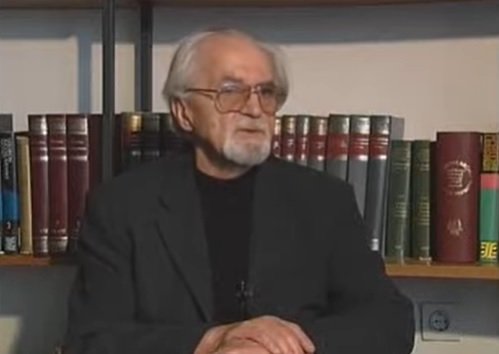
Peter M. Andreevski is one of the most gifted and popular Macedonian poets, novelists, storytellers and playwrights. In 1983, he was the president of the Society of Writers of Macedonia. In May 2000, he was elected a regular member of the Macedonian Academy of Sciences and Arts. He died on September 25, 2006 in Skopje. In 2007, he was posthumously awarded the Order of Merit for Macedonia. His literary work is diverse and includes novels, poetry, short stories, plays, essays and children’s literature. His works have been translated into several languages: Serbian, Croatian, French, Romanian, English, Spanish, Japanese, etc. In 1984 and 2002, Andreevski’s selected works were published in five and six volumes. He wrote the novels: “Piraeus” (1980), “Skakultsi” (1983), “Nebeska Timjanovna” (1988), “The Last Villagers” (1997), “Tunnel” (2003) and “Refugees (posthumously). Andreevski’s works include the poetry collections: “Knots” (1960), “And on the sky and on the earth” (1962), Denitia (1968), Distant Anvils (1971), Praises and Complaints (1975), Eternal House (1987) and Lacrimarius (1999). Then the collections of short stories: “The Seventh Day” (1964), “Unfaithful Years” (1974), “All the Faces of Death” (1994) and “Bohemians” (posthumous). From the pen of this Macedonian literary actor came the poetry collections for children: “Sharam baram”, “Kasni – porasni” (picture book), as well as the book of plays (1984), which includes “Time for singing” and “Bogunemili”.
Andreevski was the winner of the awards: “October 11” (in 1968), “Miladinovci Brothers” (twice), “Racinovo recognition” (twice) and “Stale Popov” (twice). The Macedonian critic declared the novel “Piraeus” a masterpiece of Macedonian contemporary prose, and the collection “Denizia” has been marked as a hymn to universal love, a hymn to women and the motherland, and as a golden book of Macedonian modernism.
Saint Toevski