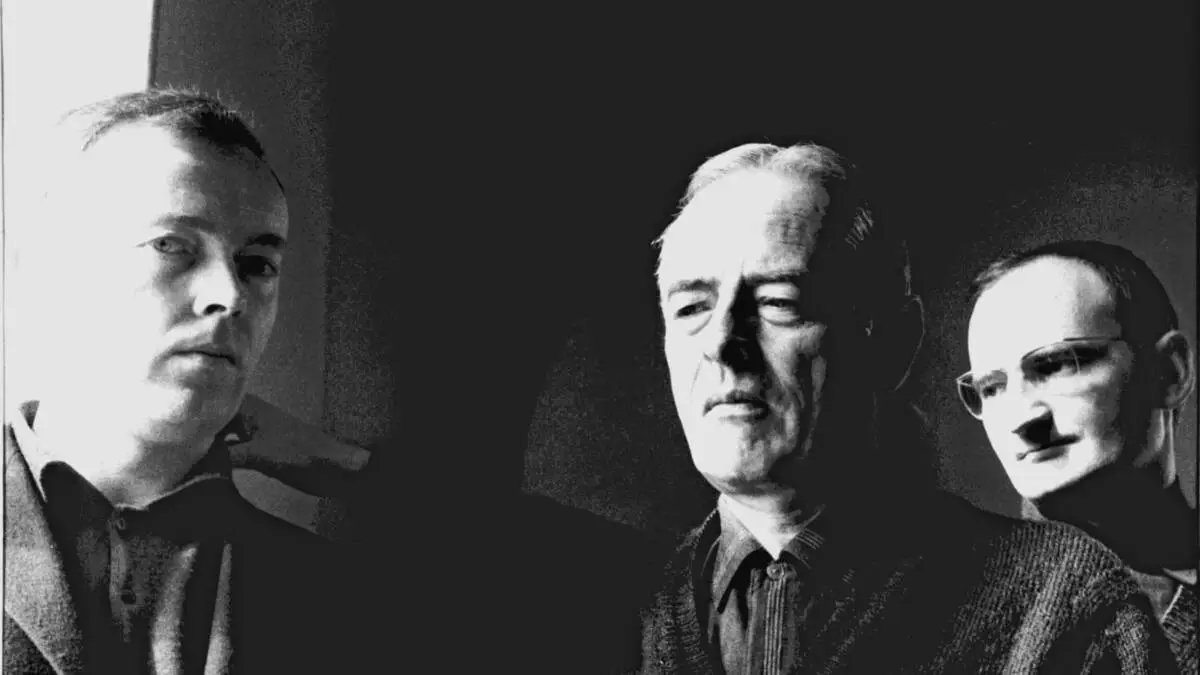
Witold Gombrowicz (center) with the Polish graphic artist Jan Lenica (left) and the Polish writer Sławomir Mrożek (right) in 1965. Imago Stock & People
Witold Gombrowicz, the great Polish writer and, in his own words, “jumping jack and tightrope walker,” returned to Europe after 24 years in exile in Argentina. The unofficial invitation from the Ford Foundation to spend a year in Berlin almost came too late; the letter only reached him after many wrong turns, so he had to fear that the invitation was no longer valid.
When the invitation was actually officially confirmed, “I immediately died – yes, all the blood drained from me in a matter of minutes. Already absent. Already over. Already ready to travel. That mysterious something that had connected me and my place was separated.” It seems typical of Gombrowicz that this trip took place almost at the last second and that he turned his back on Argentina, which had been his refuge for so long, without much regret.
Within two weeks he got ready to travel, said goodbye to friends and acquaintances, dissolved everything – it seems like an escape, and there is no question of returning at all. On the ship to Europe he is overcome by “shameless fits of love” for Argentina, but they are more likely to be incantations and a feeling of wonder that his love for Argentina has not shown itself in all this time. Only now, when he leaves the country, does a passion emerge from the Gombrowicz abyss that astonishes even him.
A disturbing scene on the ship, observed and described by Gombrowicz, is difficult to believe: A sailor accidentally swallowed the end of a rope hanging from a mast while passing by and was now being pulled upwards by this rope because the sailor’s digestive system had absorbed it. The poor man was now hanging in the air on the rope and couldn’t get him down until the captain had the brilliant idea of showing the sailor something disgusting – cut off rat tails on a plate with a small, shiny silver fork – so he could vomit. It worked, and with that we are back in the fantastic universe of the “jumping jack and tightrope walker,” who tells us Munchausian stories without batting an eyelid. Who doesn’t write an ordinary “diary”, because where would we get there? In between, he competes in chess competitions, of course becomes the ship’s chess master and receives a medal.
And we’re only on board, Berlin hasn’t even started yet. Before that there is France, the ship docks in Cannes and Gombrowicz takes the train to Paris, with which he “still has a bone to pick”. “Every time I came into contact with the Parisian street, I looked for ugliness… and found it.” In his eyes, this was like a token of love for the abandoned Argentina.
Only halfway through the book does Gombrowicz land in Berlin, Tegel, and is taken to the Foundation. And meets a poet from Austria there, Ingeborg Bachmannthe first person he became friends with. The two are amazed by this “communist ocean” that the academy formed. “After the Parisian chaos” heavenly calm welcomes the author. Readers can walk through this diary just as happily and marvel at this philosophical and poetic surprise bag.
Witold Gombrowicz
I still have my Berlin in my suitcase – Berlin diary
Translated from Polish by Olaf Kühl. 160 pages, hardcover, €20.95 (Kampa)