Saturday, May 2, 2026 2:39 pm –
Jerusalem time

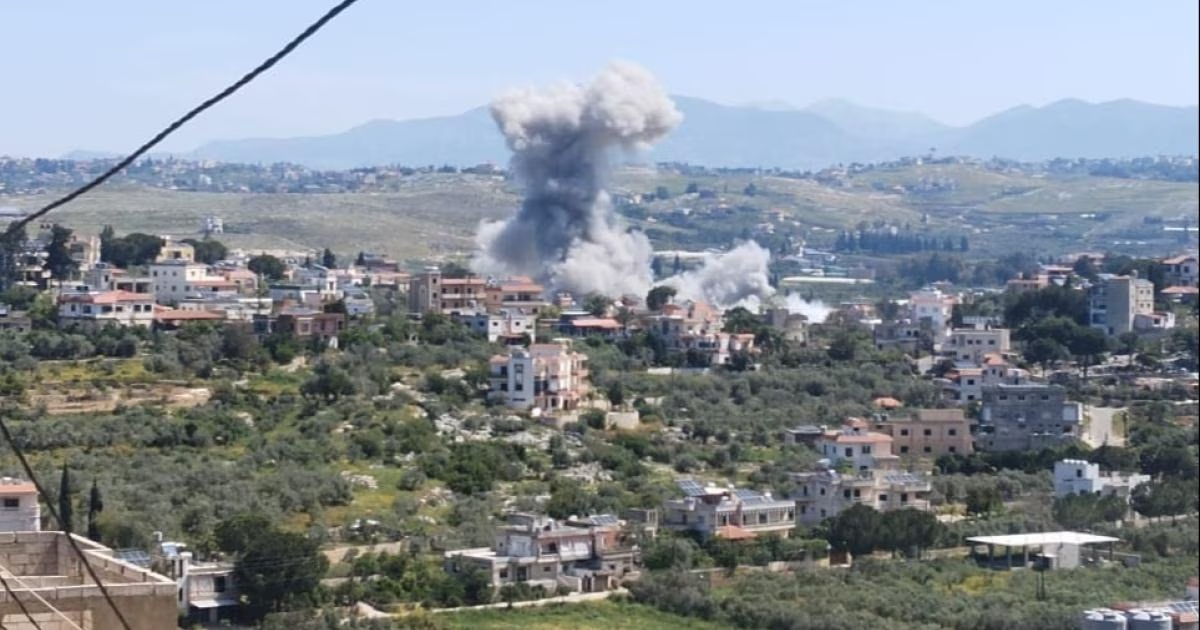
The Israeli occupation army intensified the pace of its air and artillery attacks on various areas in southern Lebanon, as it officially announced the implementation of about 50 air strikes during the past 24 hours. This escalation comes in light of the continuation of the armistice agreement extended until the middle of this month, which puts the fragile field understandings to a real test in light of civilian casualties and widespread destruction of property.
Field sources reported that the Israeli raids targeted more than 50 sites that the occupation authorities claimed were belonging to Hezbollah and used for military and leadership purposes. Since dawn on Saturday, these attacks have resulted in the death of at least eight people and the wounding of dozens of people with varying injuries, including women and local figures, including the mayor of a municipality in the targeted areas.
The violent air strikes were concentrated on towns belonging to the districts of Nabatieh, Tyre, Bint Jbeil and Marjayoun, where the bombing caused massive destruction in populated residential neighborhoods. Among the most prominent landmarks that were destroyed was the oldest Husseinieh in the Nabatieh area, in addition to the razing of entire buildings in the town of Shokin, and the direct targeting of civilian cars and homes.
In conjunction with the aerial bombardment, Israeli artillery and heavy machine guns continued to target the outskirts of the border villages, leading to complete paralysis of movement and additional displacement of residents. Israel claims that these operations fall within what it calls the ‘right to self-defense’ to confront imminent threats, which is the clause it uses to justify its repeated violations of the ceasefire agreement.
As part of continued field pressure, the occupation army issued immediate evacuation warnings to residents of nine southern towns, asking them to leave their homes in preparation for launching new attacks. It has recently been noted that evacuation orders now include entire towns instead of specific targets, which indicates an Israeli desire to empty large areas of their population.
For its part, Hezbollah responded to the Israeli escalation by announcing the implementation of an assault march attack targeting a gathering of occupation soldiers inside a house in the border town of Bayyada. This operation comes in the context of the party’s attempts to confront the Israeli ground incursion, which at some points reached a depth of approximately ten kilometers into Lebanese territory.
The Israeli escalation reflects a trend towards expanding the scope of operations north of the Litani River, with a focus on targeting what is described as the drone production and supply chains.
Field readings indicate that the frequency of raids witnessed a noticeable jump, rising from 40 raids two days ago to 50 raids on the last day, with a remarkable geographical expansion. Evacuation orders now affect areas north of the Litani River, which observers see as an indication of the occupation’s intention to expand the scope of its military operations outside the immediate border area.
Reports warned that the directives issued by the Israeli Army Chief of Staff to target “drones’ production and supply chains” may pave the way for strikes deep inside Lebanon. It is expected that these strikes will include the Bekaa region and other areas far from the front, under the pretext of neutralizing Hezbollah’s technical capabilities, which have become a growing concern for the Israeli security system.
On the humanitarian level, the Lebanese Ministry of Health revealed shocking numbers of the death toll since the start of the aggression on the second of last March, as the number of martyrs rose to 2,618 people. Medical teams also recorded the injury of more than eight thousand people, amid difficult health conditions experienced by hospitals in southern Lebanon as a result of direct targeting and lack of supplies.
The current field scene reflects great complexity, as Israel continues to occupy parts of southern Lebanon and expand what it describes as the ‘buffer zone’ through a scorched earth policy. This policy leads to the systematic destruction of villages and towns, which threatens to undermine any future opportunities to restore stability or return to previous truce understandings.
In light of this escalation, the situation remains to be awaited as to what the situation will lead to before the supposed truce expires on May 17th. International fears are increasing that the Israeli insistence on striking the Lebanese interior will lead to the outbreak of a comprehensive confrontation that goes beyond the rules of engagement currently in place, which could drag the entire region into a conflict with unpredictable consequences.