Monday, June 1, 2026 12:24 pm –
Jerusalem time

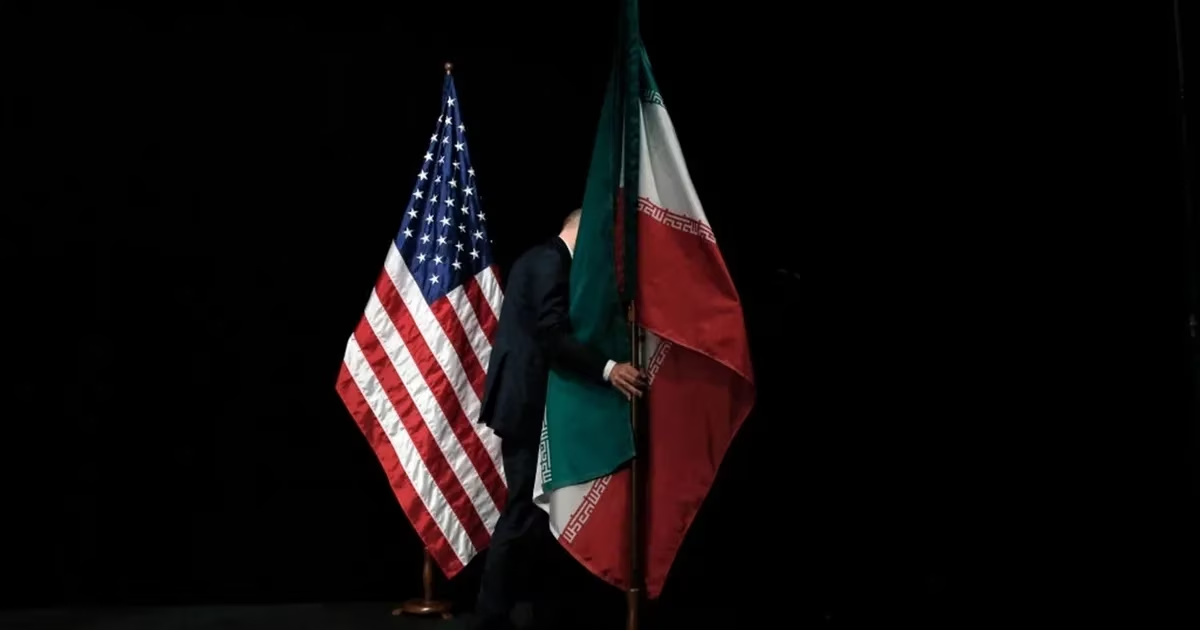
Current political readings indicate that the United States may move forward with concluding an agreement with Iran in isolation from the declared Israeli desire. However, this does not mean the complete absence of Israeli interests, but rather places them at the heart of a complex equation governed by the Trump administration’s relationship with the occupation government. In this scene, the motives of both parties regarding the confrontation with Tehran overlap, amid regional variables that imposed new equations that did not exist before.
It appears on the horizon that the option of a comprehensive war with regional or global dimensions has become excluded at the present time, as it is seen as an adventure with uncalculated consequences for the new American administration. This decline comes in light of the failure of previous rounds to achieve their fundamental goals, in addition to internal pressure and international factors, most notably the growing Chinese role in the region.
In light of the exclusion of reaching a comprehensive and permanent peace due to the deep gap in terms and positions, the option of a partial and temporary agreement stands out as the only practical solution currently available. This agreement, despite its expected fragility, may be the method preferred by Washington to ease tensions or as a tool to pressure Tehran to improve the terms of negotiations in later stages.
For Israel, Washington’s signing of such an agreement represents a resounding strategic failure, as it enshrines its inability to transform surplus military power and absolute American support into tangible political achievements. This failure means that the Gaza, Lebanon and Iranian fronts remain open as permanent hotbeds of exhaustion, instead of ending the threats as Tel Aviv planned after October 7th.
The end of the military confrontation through an American diplomatic path proves the fact that the decision to make war and peace in the Middle East has been withdrawn from the hands of Benjamin Netanyahu and his government. This decision became dependent on the vision of Trump and his team, especially if the understandings were extended to include the Lebanese arena, which would reduce the Israeli margin of maneuver to unprecedented levels.
Existential anxiety is increasing within Israeli circles as a result of these transformations, as they see that their long-term survival is linked to an international system and Western support that is going through a phase of transformation and uncertainty. Tel Aviv fears the closing of the “historical window” that allowed it to impose field facts that would be difficult to change in the future, which would push it to take violent action at wasted time.
Israel is currently working on two paths to reduce its losses: The first is the field and political attempt to thwart any American-Iranian rapprochement through military escalation in Lebanon and continued incitement against Tehran. The second path is to put pressure on the Trump administration to ensure that no deal is concluded that does not meet the minimum Israeli security requirements as seen by the current government.
Israel no longer has the independence to decide on war or peace in the region, but rather handed it over to the American administration, and any agreement between Washington and Tehran will reinforce its existential anxiety.
The occupation government is seeking to obtain what may be called a ‘consolation prize’ if the agreement is concluded against its will. This prize is represented by extracting an American green light granting it ‘freedom of movement’. This concept means the continuation of military attacks and violations under the pretext of security, even in the presence of official ceasefire agreements, as happened in previous experiences.
The field data in Lebanon over the past few days clearly reflects the Israeli desire to obstruct any diplomatic path that does not guarantee it complete superiority. Tel Aviv is using the escalation as a tool to blackmail the US administration or push it to adopt more stringent positions towards the Iranian file, taking advantage of the ideological and political overlap with the Trump team.
Although Israel has lost the independence of its strategic decision-making to Washington, it still possesses powerful tools of influence within American circles. Tel Aviv is betting that military and political support will not stop, but may take new forms commensurate with the nature of the next phase, which is characterized by fragile agreements and temporary truces.
It must be noted that the current conflict is, in essence, a joint ‘Israeli-American’ confrontation against the Iranian axis, even if the tactical calculations differ between the two allies. While Washington searches for stability that serves its greatest interests, Israel seeks to stabilize its presence through excessive military force, which makes the difference in goals inevitable.
Any upcoming agreement will not end the conflict, but may reformulate it, as the region will remain a candidate for new waves of escalation if Israel feels that its vital interests are threatened. The Israeli bet remains on exploiting American support to achieve maximum field gains before diplomacy imposes its final say.
In the end, Israel finds itself in the position of a strategic loser in the long term if Iran continues to strengthen its regional influence through diplomatic channels. This reality pushes the political and military elite in Tel Aviv to adopt more aggressive policies to try to change the course of events before it is too late.
In conclusion, the scene remains open to all possibilities, as the ongoing war may be interrupted by temporary truces, but the roots of the conflict remain present and deep. The question remains about the extent of Israel’s ability to coexist with a new regional reality in which Tehran is an internationally recognized party, which is the nightmare that Tel Aviv is trying to prevent by all available means.