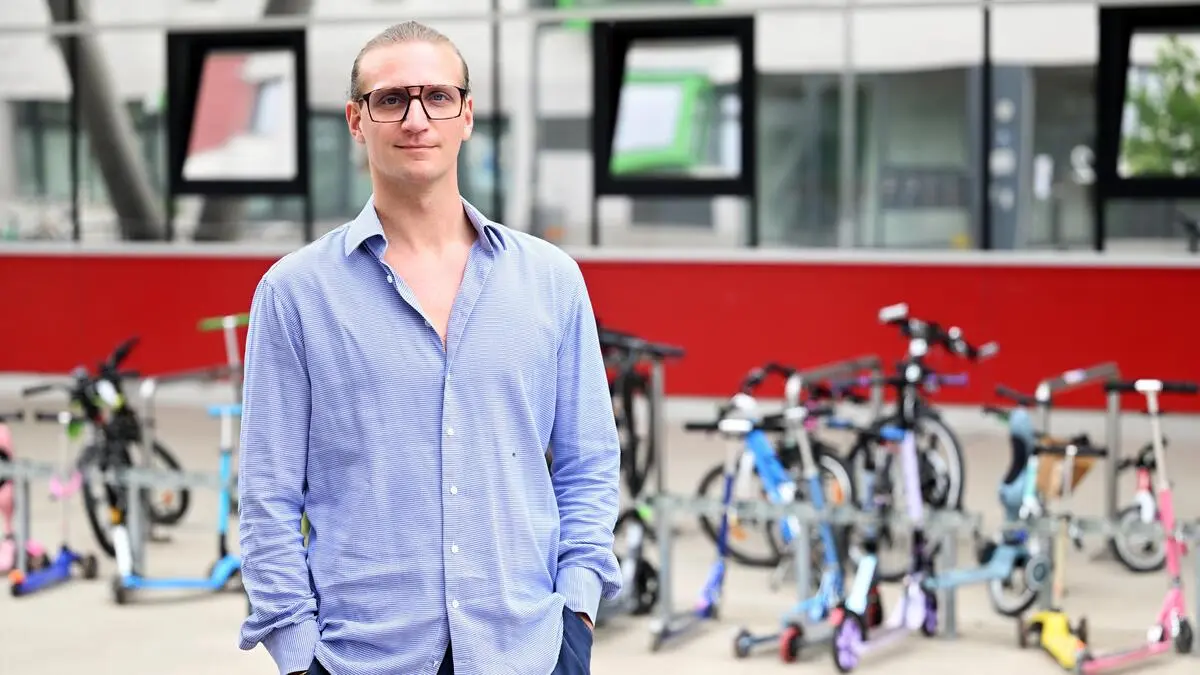
Felix Ohswald: In the past few months I have worked intensively on AI content generation, especially on creating videos. Yesterday I learned how to change certain elements from a real video. Of course there are many restrictions and data protection issues. But it always helps to understand how such technologies really work.
Artificial intelligence will also massively change the school system. What skills should a primary school child learn today in order to be able to meet the challenges of the future?
Exactly what children had to learn 100, 200 or 500 years ago: reading, arithmetic and writing. These fundamental basic skills must be ensured. There are no ifs and buts about it. If you don’t master it, you’ll be excluded from all fancy future topics. Even if you do an apprenticeship, you can’t avoid it. But if you look at Europe over the past 20 to 30 years, you can see that these basic skills have become worse.
»The dilemma is: As soon as a child starts school, he or she sits in frontal teaching for five or six hours. That doesn’t work in my head. I think the principle of a teacher standing at the front and rattling off the curriculum is outdated.«
Felix Ohswald
Which school subject is most underestimated today?
Sport. Social activities and fun need to be given much more space. I’m talking about football training, boxing lessons, but also drawing, crafts or science courses. Children need to come into contact with mixed groups. On the football field it doesn’t matter whether a child comes from a luxury villa or a municipal building. There you learn to be part of a community. But the dilemma is: As soon as a child starts school, he or she sits in frontal teaching for five or six hours. That doesn’t work in my head. I think the principle of a teacher standing at the front and rattling off the curriculum is outdated.
Which subjects would you eliminate and which would you introduce?
I believe we should generally combine education more with entertainment: edutainment! At GoStudent, for example, we offer robotics courses in which children build Lego robots. Or financial games in which they learn with virtual starting credit what interest, loans and investments mean. Content creation would also be important: How do you build an Instagram page for a business? How do you produce a short film? Children and adults consume hours of video content every day. Then they should also learn how these are created.
School subject artificial intelligence or Latin?
For me this question doesn’t even arise. Whether a child learns Latin or has an AI subject is of secondary importance if basic mathematics and language skills are missing. If a 17-year-old tutor has problems with mathematics, it is usually not because of the current task, but because the basics are missing. The same applies to AI. As Google came up, people made fun of people who couldn’t google. In Google you had to enter keywords. With AI systems, I have to be able to formulate complete sentences and, ideally, also ask follow-up questions on a meta level. If I don’t speak the language well, I won’t be able to use AI well either.
What does the school of the future look like?
I believe that the school with 20 or 30 children in a class and a teacher who teaches frontally will disappear. The future is small group teaching.
This would also require more teaching staff. In times of teacher shortages and more and more bureaucratic tasks for teachers, there is no longer so much time left for the individual…
The state is often not good at judging which teacher is better than another. Internationally, for example in the USA, we see different models of private and charter schools. These are free for families, no matter what demographic group they come from. The state pays a fee per student, but the school is privately run. This leads to less administrative effort and more efficient structures. I believe that things will move more in this direction.
But that also means more privatization in the education sector.
Yes, but that doesn’t mean that education is becoming more expensive for families. What matters is how the financing is organized. If the state already spends 10,000 to 15,000 euros per student per year, one can ask whether these funds could not be used better.
»As a result of this extreme consumption, young people and adults can do less and less. «
Felix Ohswald
Founder and CEO of GoStudent
What value will knowledge have in the future when almost everything can be accessed at any time?
I differentiate between two areas. Everything that has to do with people is becoming more important: teachers who sit with children, empathy, interpersonal relationships. As a human being, you want to do something together with other people. That makes you happy. These interpersonal activities will become even more valuable in the future. The other is skills. If someone works in a finance function and produces monthly reports, then they have to grit their teeth and deal with AI systems every day.
Focus: What lies ahead for us?
It’s been 30 years since diepresse.com went online, “Die Presse” took the step into the digital age. We are taking this anniversary as an opportunity to look forward again. Young entrepreneurs, researchers, artists and politicians are asking themselves the big questions of our time: How will our most important areas of life change in the next few decades? How will we work, believe and love? And what else do we need to know in the future?
To the focus.
Would you still advise young people today to study law or financial mathematics?
Yes, especially in regulated professions. If you have finished your law degree in your early or mid-20s, I would even say: Don’t necessarily go to a large law firm for five years and work there, but rather become self-employed and use AI tools. Large law firms are often paralyzed by IT security, processes and approvals. In addition, for someone who has worked in a certain way for 30 years, it is difficult to accept that a younger person can suddenly achieve a similar amount using AI tools. In regulated professions such as lawyers or doctors, training remains important because liability, responsibility and licensing depend on it. But with AI, you can build a practice or law firm ten times more profitable than someone who doesn’t use these tools. It’s different in areas where you don’t need formal training. I would then ask myself why I should study for five years when I can specialize more quickly.
»For someone who has worked in a certain way for 30 years, it is difficult to accept that a younger person can suddenly achieve a similar amount using AI tools. «
Felix Ohswald
For many people, AI is already the best tutor. Why is GoStudent actually needed?
I see more of a different problem. Probably the most addictive social drug for children and adults is short videos. This content will increase ten thousandfold thanks to AI. It will become more and more optimized for what you want to see. I don’t see how children can teach themselves all the skills with TikTok and YouTube Shorts. On the contrary. Due to this extreme consumption, young people and adults can do less and less.
What do you think makes an educated person?
Above all, self-reflection. The ability to constantly question yourself. You have to question your positions regularly. That is true today and it will be true in 2040. A lot of general knowledge is nice. But if someone never stops talking at dinner and doesn’t let others have their say, that’s actually uneducated to me.
»A lot of general knowledge is nice. But if someone never stops talking at dinner and doesn’t let others have their say, that’s actually uneducated to me. «
Felix Ohswald
GoStudent grew extremely quickly over the Corona years. Then the crash followed. What have you learned from this entrepreneurial roller coaster ride?
We had a record loss of almost 200 million euros in 2022. We have expanded into too many countries and have built up far too large a cost apparatus. We then spent three years restructuring: reducing employee costs, withdrawing from countries and refocusing on the core business. We now have positive operating cash flow again.
What did you misjudge during the hype phase back then?
I believed I could solve everything by delegating. But that’s not how it works. In retrospect, my biggest mistake was that I wasn’t operationally familiar enough with the core issues. But if you want to compete with the best companies in the world, you have to be behind them every day. There is no shortcut. We had raised a lot of money, everyone tells you how great you are. When times get harder, you don’t hear from many people anymore. But that’s exactly when you have to stick with it.
»When times get harder, you don’t hear from many people anymore. But that’s exactly when you have to stick with it.”
Felix Ohswald
Founder and CEO of GoStudent
Did GoStudent simply grow too quickly over the Corona years?
Everything is easier in hindsight. I wouldn’t say everything was fundamentally wrong. But if I were in the same situation today and had the same amount of money available, I would definitely spend it differently. As an entrepreneur you have to know exactly what you actually want. Do I want to build the largest education company in the world? Then it won’t work without capital. You need access to capital to build infrastructure, open physical locations or buy local market leaders. Or do you say: I don’t want the pressure of external investors, I enjoy my daily work, I’m building a good business in a niche? Both are legitimate. But you have to answer this question for yourself in order to really do your thing.
To person:
Felix Ohswald (born 1995) is co-founder and CEO of GoStudent. At the age of 14, he studied mathematics at the University of Vienna, later also at Cambridge and at the ETH Zurich. In 2016 he founded GoStudent together with Gregor Müller. The Vienna education platform was valued at 2.7 billion euros in 2022, but has now had to restructure.