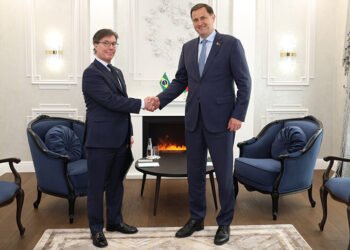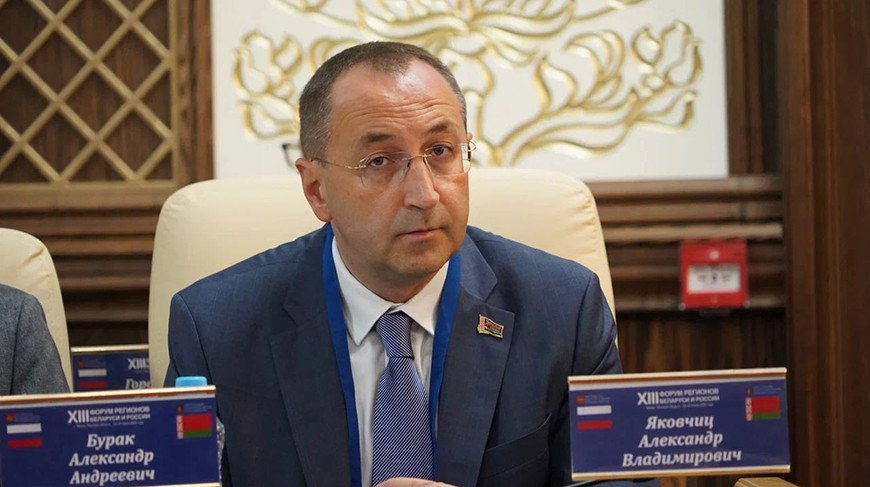

Aleksandr Yakovchits. Photos courtesy of the press service of the Council of the Republic of the National Assembly of Belarus
MINSK, 25 June (BelTA) – Belarus increased its dairy export to African countries by 12 times in January-April 2026, BelTA learned from Belarusian Deputy Agriculture and Food Minister Aleksandr Yakovchits at the panel session “Legal support for food security of the Union State” during the 13th Forum of Regions of Belarus and Russia in Minsk.
“In the four months of this year Belarus doubled dairy export to the CIS countries and increased this export by 1.5 times to Asian countries. Great work was done in Africa – an increase by 12 times,” Aleksandr Yakovchits noted.
In his words, shipments of dairy products to Russia were deliberately reduced. He emphasized the importance of joint decision-making aimed at preventing uncontrolled import of critically important dairy products into the Union State market, which will allow all manufacturers to operate correctly and comfortably in our market.

“Stable food security remains one of the key priorities of the state social and economic policy and the agricultural policy of our country. The previous five-year period demonstrated that the agribusiness sector is capable of guaranteeing the country’s food security,” Aleksandr Yakovchits stressed. “The Belarusian model of ensuring food security is highly praised internationally: we rank 55th among 113 countries in the global ranking.”
The deputy minister noted that the more intensively the industry develops, the more acute the need to improve the legal mechanisms of its regulation becomes. “We are required not just to preserve what has been achieved, but also to adapt the legal framework to new challenges and threats. The state program ‘Agribusiness sector of the future’ for 2026-2030 plays a key role here. This is a strategic document that becomes the legal foundation for a new stage of the industry’s development,” Aleksandr Yakovchits added.

The program was developed in accordance with the national food security doctrine of the country. It defines agricultural production volumes both to supply the domestic market and to ensure efficient export. The document outlines the development of crop farming and animal husbandry while the modernization of production includes technological re-equipment, the introduction of precision farming, robotization, and digital logistical platforms for resource management. Emphasis is placed on deepening import substitution, stimulating domestic production of seed material, and developing year-round greenhouse farming.
“Apart from that, ensuring food security is one of the most important avenues of cooperation between our country and Russia. This is why the legal dimension of our interaction is of particular importance. Trade and economic cooperation in the agribusiness sector plays a special role in strengthening integration processes and the food independence of the Union State of Belarus and Russia. Mutual trade volumes grow higher every year, and we maintain positive dynamics this year as well,” Aleksandr Yakovchits explained.


To reach a new level of interaction, it is necessary to further develop the legal framework within the framework of the integration association, the deputy minister is convinced. Systematic work has been underway since 2021 to work out a unified agricultural policy aimed among other things at ensuring the food security of the Union State. “A significant amount of work was done over the past period to form the regulatory and legal framework for interstate cooperation in agriculture. Currently, a draft agreement on a unified agricultural policy has been developed at the interagency level, which outlines the core principles and directions for implementing the agricultural policy of our integration association. I am confident that the successful implementation of the state program of the future combined with the formation of the coordinated legal framework at the Union State level will strengthen mutually beneficial cooperation and ensure the food security of our countries in the long term,” Aleksandr Yakovchits concluded.