At the previous world championship in 2022, Emily Boere “almost” had defender Denzel Dumfries’ name tattooed on her arm, according to the 22-year-old. In the quarter-final against Argentina, her idol caused a penalty, after the lost penalty series he received a red card for provoking. “I’m saving the Dumfries tattoo for this World Cup,” she says. “If the Netherlands becomes world champion, it will be in a place that not everyone gets to see,” she says, laughing at a quarter past twelve at night on a terrace at Stadhuisplein.
Dressed in a green shirt with the print Brazil she sits around a table with friends. ‘Don’t talk, just drink beer’, is the exhortation on the reservoir with three liters of beer. The Brazil-Morocco match is shown on large screens. She herself has Indonesian roots, but the Brazilian team also “has my heart”.
Xuxa Natalia da Silva’s aunt wears a self-crocheted top with the Brazilian flag and has green-yellow glitter nail polish
A few tables away, Xuxa Natalia da Silva (33), with a Brazilian mother and Dutch father, has settled down with her family. Her aunt wears a self-crocheted top with the Brazilian flag and has green-yellow glitter nail polish. „Tira a bola!” (Take away the ball!), she shouts at the screen as soon as Morocco approaches the penalty area. “She can make a bandana very quickly,” offers Da Silva NRC jokingly.
Since many matches are broadcast at an unchristian time due to the time difference with the United States, her children, aged four and six, are “unfortunately” already asleep. The fact that the times are favorable for family members in Brazil, including her 99-year-old grandmother, who called in before kick-off, eases the pain of sleep deprivation. When Da Silva is not looking at the screen, Morocco scores.
Also read
World Cup of migrants: a quarter of football players do not play for their country of birth
:format(webp)/s3/static.nrc.nl/wp-content/uploads/2026/06/13105610/150626DAT_2033582943_doue2.jpg)
Nibble on nachos to relieve the tension
On the heated terrace at Stadhuisplein, Moroccan supporters are in the minority, Amar Azarkan notices. This can be “somewhat compensated for” with fanatical support, he thinks. “Morocco is just my blood, my parents were born there,” he explains his passion.
The medical student nibbles on nachos together with his twin brother and a study friend, all three of them nineteen years old, to take away the tension. “I get stressed when Brazil gets a chance,” he says. That turns out to be right: the Brazilians equalized not much later.
To Azarkan’s surprise, a tall boy in a body warmer plops down right in front of him. View away. In close consultation and with a horizontal sweeping hand movement, Azarkan makes it clear how many centimeters the new neighbor must move. The match is so exciting that even the Polaroid photographer prefers football to selling tulips.
In the 85th minute the waitress comes by for a final round. Patio patrons try to look at her politely while ordering, but their eyes inevitably move to the television.
In the end it remains 1-1. At a table next to Azarkan, over which a Moroccan flag is draped, someone opens the gambling application Toto on his phone. The odds for Australia-Turkey, the next match, light up.
:format(webp)/s3/static.nrc.nl/wp-content/uploads/2026/06/15145609/150626VER_2034436278_curacao5.jpg)
Curaçao eventually lost 7-1 to Germany.
Photo Boudewijn Bollmann
‘Differences, not disputes’
With small eyes, Turkish-Dutch (young) men enter the Mevlana Mosque around half past four in the morning, about ten minutes by bike from Stadhuisplein. Many watched Brazil-Morocco, some stayed through the night.
Will Australia be defeated? “You never know,” says Imam Ismail Mercimek, grinning. “The ball is round, said Johan Cruijff.” The morning prayers were more attended than usual because of the match, he noticed. “You can also pray at home, but it is much more fun to look at Turkey here together afterwards.” Everyone gets a cup of lentil soup and a slice of Turkish bread.
After praying, the prayer room, with red carpet, chandelier and framed Koran verses, is exchanged for a snow-white room with a projector screen
Recently the mosque was visited by unwanted guests. Six threw beer bottles against the house of worship and urinated against the wall. “We now have thick skin,” says Mercimek. He has no illusion that the World Cup will remove social polarization. Yet, according to him, the tournament shows that despite “mutual differences, the Dutch do not have to have disputes.”
After praying, the prayer room, with red carpet, chandelier and framed Koran verses, is exchanged for a snow-white room with a projector screen. Onur Ozay (38) sticks a garland with flags of Turkey into the suspended ceiling.
:format(webp)/s3/static.nrc.nl/wp-content/uploads/2026/06/15145107/150626VER_2034436278_turkije1.jpg)
:format(webp)/s3/static.nrc.nl/wp-content/uploads/2026/06/15145225/150626VER_2034436278_turkije3.jpg)
Turkish fans watch the World Cup match against Australia at the Mevlana Mosque in Rotterdam.
Photos Bart Maat
‘A Turk without a flag’
After 24 years, Turkey is participating in a World Cup again, Ozay says proudly. “My son is experiencing it for the first time.” His cousin has traveled to the United States and has promised to send videos from the stadium. “Maybe we will see him on screen,” says Ozay hopefully.
Ozay, with a red and white jester’s hat and red Turkey tracksuit, has the most striking outfit in the packed room. “It’s even crazier in front of my door.” Three weeks earlier he hung the first Turkish and Dutch flag. “You can’t have a Turk without a flag, right?” Twenty flags are now hanging on the facade. He rented an aerial work platform for the project. “I hope I don’t have to remove everything again in three weeks,” he laughs.
Next to Ozay is Arda Eren (19), chairman of the mosque’s youth committee. “Normally you only become one from the age of 21,” he says proudly. The early time is a bit inconvenient, he says. “We love to honk, we can’t contain our joy.” But this Sunday morning “we will try as much as possible not to disturb” people who are still sleeping.
Because Turkish commentators “shout louder and sympathize more”, a livestream of the Turkish Radio Television (TRT) is on. Halfway through the first half the screen freezes a few times. “Refresh!”, it sounds from the audience. And later: “Just turn on NPO! Better than getting stuck.”
The obligatory NPO advertising seems to last for hours; Jacob Derwig addresses the audience about a pension investor. NOS commentator Ragnar Niemeijer then speaks. “He does his best,” Eren admits, “but he can’t pronounce the Turkish soft G.” In the second half the familiar Turkish reporter sounds again.
After the final whistle, Australia wins 2-0, the screen immediately goes black. “My, my, not nice,” sighs someone. The chairs are quickly piled up for the Quran lessons, which start at 10am. A boy at the back of the room has fallen into a deep sleep. Three boys wake him up by pretending that Turkey has scored a goal.
:format(webp)/s3/static.nrc.nl/wp-content/uploads/2026/06/15145635/150626VER_2034436278_curacao6.jpg)
Supporters of Curaçao.
Photo Boudewijn Bollmann
:format(webp)/s3/static.nrc.nl/wp-content/uploads/2026/06/15145509/150626VER_2034436278_curacao4.jpg)
The national anthem was sung before kick-off.
Photo Boudewijn Bollmann
:format(webp)/s3/static.nrc.nl/wp-content/uploads/2026/06/15145416/150626VER_2034436278_curacao2.jpg)
Supporters celebrate the 1-1 against Germany
Photo Boudewijn Bollmann
:format(webp)/s3/static.nrc.nl/wp-content/uploads/2026/06/15145359/150626VER_2034436278_curacao1.jpg)
“Are we awakerrrr?”
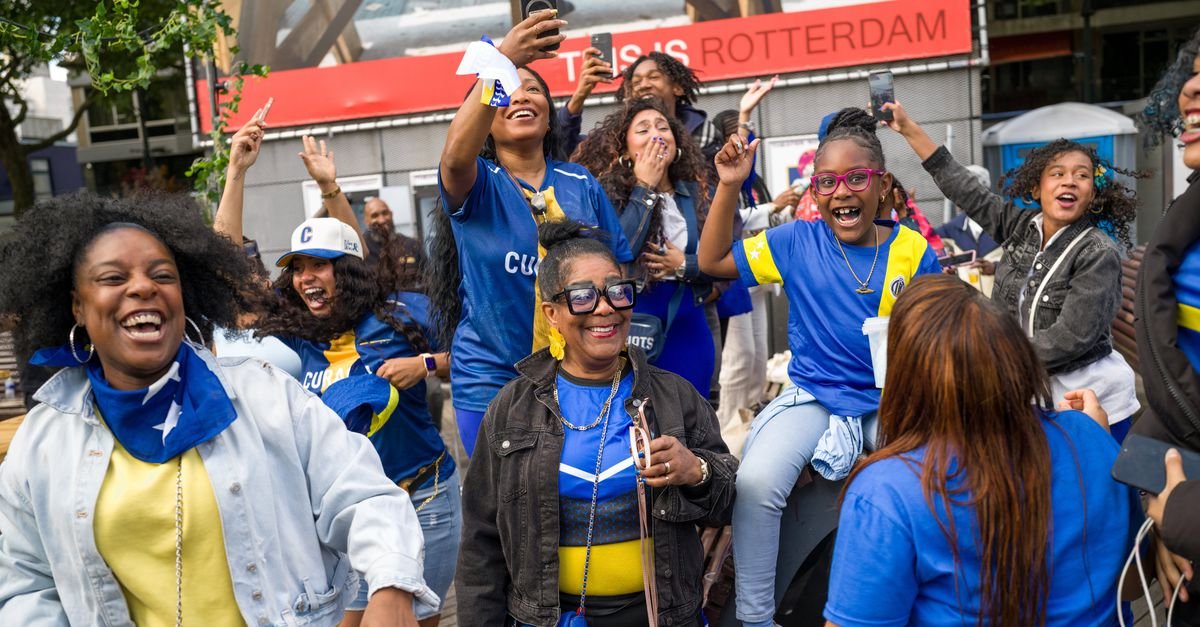
“If I say blue then you say wave. Blue, wave, blue, wave!“, is heard in the city center from the stage on the Schouwburgplein. Germany-Curaçao is broadcast on a large screen. A man rides laps around the square on a fat bike decorated with Curaçao flags. “You are still sleeping, Rotterdam, are we awake?” asks the master of ceremonies half an hour before kick-off.
To excite the richly decorated, face-painted crowd, the Curaçaoan artist D-kaya – gold chain, black-gray goatee – sing-along number ‘Butt Train’ in: “Are your buttocks big or are your buttocks small? It really doesn’t matter, just get on the Butt Train.” This call is being heeded by the supporters.
When Livano Comenencia scores 1-1 for Curaçao in the 21st minute, people jump around each other’s necks. They let people at home share in the festive spirit via FaceTime.
“We are a big family and it is great what they have achieved,” says Sidris van Sauers (54), himself of Surinamese descent. “Even though it is a small island, you just belong at this level. And they just score against Germany!”
When the match is over, Germany wins 7-1, the crowd moves to the surrounding bars to watch the Netherlands-Japan
Van Sauers calls the World Cup participation “a boost for the identity” of people of color, who are “treated as second-class citizens” in the Netherlands. “Every racist comment from Johan Derksen on national television feels like a stab in the back.” The football team shows that Curaçao “is not just a paradise for European migrants – I refuse to say expats,” she continues. “It is an island with history and pride,” says Van Sauers.
“At the last World Cup, the entire neighborhood celebrated for Morocco,” says Van Sauers, who lives in Rotterdam-West. “Now you hear the song everywhere “Mama Wa”. Moroccan or Turkish people, Cabos (Cape Verdeans), everyone is happy and supports each other.”
When the match is over, Germany wins 7-1, the crowd moves to the surrounding bars to watch the Netherlands-Japan. Two women in Curaçao football shirts and white skirts switch effortlessly and swing to Wolter Kroes’ ‘Viva Hollandia!’
Also read
Many tickets sold and scanned and still empty seats: this is why the stadiums do not appear full according to FIFA
:format(webp)/s3/static.nrc.nl/wp-content/uploads/2026/06/15150708/150626VER_2034471888_stoelen2.jpg)