Two hundred and ninety police officers are currently on suspension.
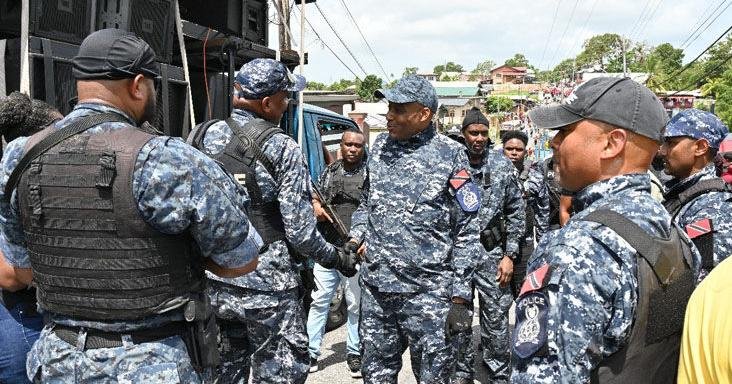
This, according to Commissioner of Police Allister Guevarro, is part of the Trinidad and Tobago Police Service’s (TTPS’) ongoing efforts to address misconduct within the organisation.
In an interview at the Police Administration Building, Port of Spain, on Thursday, he said one of the challenges facing the TTPS was a public perception that police misconduct often went unpunished.
He argued that while allegations involving officers frequently received significant attention, disciplinary and criminal proceedings against those officers attracted far less public interest.
The Commissioner said shortly after assuming office, he was confronted with several incidents involving alleged misconduct by police officers and recognised the importance of taking action against individuals accused of wrongdoing.
“We try to root out the negative elements within the Police Service itself,” Guevarro said.
As an example, he referred to the case involving PC Stefon Khan, who was charged with misbehaviour in public office following an investigation into the tampering and theft of police exhibits.
PC Khan was charged after an estimated $242,000 in marijuana was removed from the Chaguanas Police Station in February.
The original cannabis blocks had been replaced with packages containing wood and a ceramic tile.
“That, the incident itself, was well known,” he said. “The officer was placed on suspension, arrested and (brought) before the court (in May).”
However, the Commissioner argued that many members of the public remained unaware of the disciplinary and criminal action taken against officers after allegations emerged.
He said social media discussions frequently questioned whether cases involving police misconduct were being investigated despite several of those matters already before the courts.
“You know, the general public, they don’t know what happens after, even when we issue releases. I can’t tell you how many times we would see comments under our (social media) posts where persons are asking what happened to this case or that case,” Guevarro said.
Guevarro confirmed there were currently 290 police officers on suspension throughout the organisation.
“To the point, I have 290 officers on suspension right now. The public doesn’t know that,” he said.
The last time that a similar number was made public was in 2020, when then-police commissioner Gary Griffith noted that an estimated 280 officers were on suspension with pay, which was costing an estimated $50 million to taxpayers annually.
Guevarro said the figure reflected the existence of several accountability mechanisms.
He pointed to the work of the Professional Standards Bureau, internal disciplinary units, and the independent Police Complaints Authority (PCA), which investigates complaints against officers.
“We are able to investigate, arrest and charge our own,” he said.
The Commissioner maintained that those systems demonstrated the TTPS’ willingness to address misconduct within its ranks and remove officers who breached the law or professional standards.
Guevarro also reflected on broader issues surrounding public confidence in policing and information sharing.
He noted that public opinion surveys conducted shortly after his appointment suggested that many citizens initially viewed his leadership positively.
According to the Commissioner, polls conducted after his first 100 days in office indicated approval ratings of approximately 80%.
While acknowledging those findings, Guevarro stressed that his personal popularity should not be confused with perceptions of the wider organisation.
“Guevarro is not the TTPS,” he said. “I am the leader of the organisation, and it is for me to take decisions and operate in a particular way with integrity and everything else that comes with the office.”
What can be shown
to the public
The Commissioner said transparency remained a key factor in building trust but argued that existing laws often restricted what information police could release to the public.
That issue, he said, was particularly relevant to body-worn camera footage and other forms of evidence gathered during investigations.
Guevarro said the TTPS was frequently criticised for not releasing video evidence following controversial incidents, even when such material appeared to support the actions of officers.
He pointed to a recent case in Tunapuna in which a police officer was stabbed while responding to a domestic incident and he subsequently shot and killed a man during the confrontation.
According to Guevarro, the officer’s body-worn camera captured the attack and showed the circumstances that led to the shooting.
“He had on a body cam, and the body cam footage showed him being attacked by the individual when he went into the home to save the gentleman’s mother,” the Commissioner said.
Despite the existence of the footage, Guevarro said the TTPS was unable to release it because it formed part of evidence in a matter before the courts.
“I still can’t even show that to the public,” he said.
He explained that current legal restrictions surrounding active court proceedings often prevented the disclosure of information that could influence judicial outcomes.
“The police is limited by its ability to share information,” he said. “It may be prejudicial to the outcome of a matter before the court.”
He noted that the same restrictions applied to high-profile matters such as the Joshua Samaroo case.
“I cannot discuss what went on with the Joshua Samaroo or any other of those situations because it is now before the court, and it should be vented before the court,” Guevarro said.
The Commissioner indicated that he would support discussions on policy changes that could permit the release of certain body-camera footage to the public, in similar mechanisms like the United States and the United Kingdom.
“I would support it,” he said.
However, he cautioned that such reforms would require changes extending beyond the TTPS and would involve lawmakers, the Judiciary, and other stakeholders within the criminal justice system.
“I could write policy recommendations to allow me to show body cam footage or whatever footage to the public, but at the end of the day, that matter, under our current laws, as long as that footage is to become part of evidence before the court, cannot be shown,” he said.
Guevarro described the issue as part of a larger national conversation about transparency, public accountability and the administration of justice.
“That’s a question not only for the TTPS. That is for the Judiciary, for the legislative arm and for everybody else,” he said.
Guevarro marked his first year in charge of the TTPS last week.