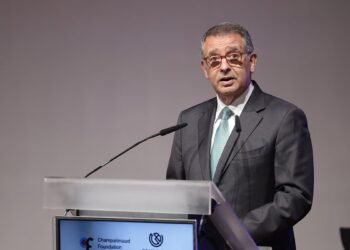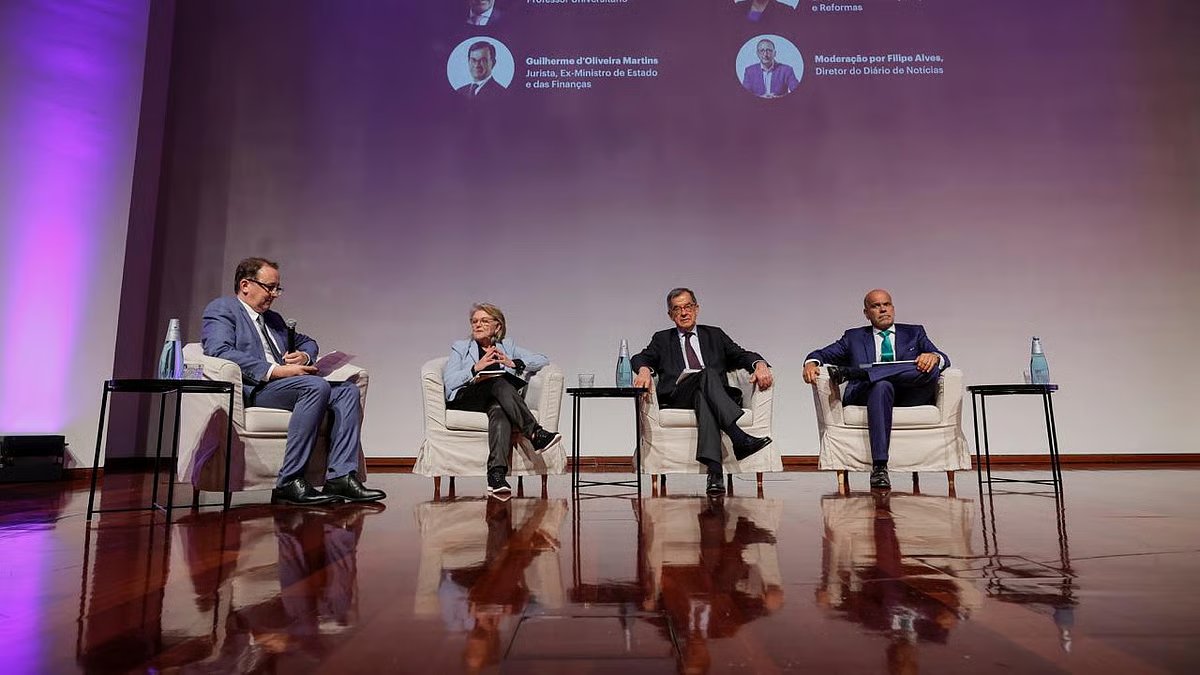
Jurist and former ruler Guilherme d’Oliveira Martins took advantage of his intervention in the panel “Portugal in the Era of Uncertainty”, at the Diário de Notícias Grand Conference, to counter the idea that we should focus on improvisation. “We were always good when we didn’t improvise”, he argued, at the event taking place this Monday, at the Champalimaud Foundation, in Lisbon, highlighting the importance of planning in Portugal.
Debating with the university professor and former deputy of the CDS-PP, Diogo Feio, and with the former European Commissioner for Cohesion and Reforms, Elisa Ferreira, moderated by the director of the DN, Filipe Alves, Guilherme d’Oliveira Martins, he pointed to the example of Infante D. Henrique, “who got to where he is because he surrounded himself with the best of his time”, and the advances in education that made it possible to combat high illiteracy in Portugal.
Likewise, the former ruler, who assumed several portfolios in socialist governments, coinciding with Elisa Ferreira on the Council of Ministers, advocated a “reform of mentalities”, refusing the “fatalism of delay”, in which the State “must be a catalyst for initiatives”.
“I don’t believe in structural reforms as being miraculous”, said Guilherme d’Oliveira Martins, opposing them to “concrete reforms, with means to achieve objectives”, highlighting the idea of decentralization as a priority.
The panel began with former European Commissioner Elisa Ferreira warning that Portugal’s low productivity “must be resolved with very well thought out strategies, in the medium and long term”. Not least due to the transformations underway in the country and the world, amidst a succession of crises that ranged from the attack on the Twin Towers to the global financial crisis, and from the Covid pandemic to the invasion of Ukraine.
Regarding Portugal’s problems, Elisa Ferreira mentioned the “feeling that the system does not have space for everyone” to reflect on the need for the entire country to “make a contribution to national wealth”, allowing Lisbon to focus on “offering what is best to offer”, particularly in areas such as science, research and innovation.
In this sense, he gave the example of Denmark, where funds from the Recovery and Resilience Program were used to develop 15 areas of its territory, reinforcing the focus on medium-sized cities that tends to occur more in Northern Europe. And he concluded by talking about the “reform of mentalities”, overlapping it with reforms in Public Administration, “from whom the impossible is asked, always changing the topic”.
For his part, Diogo Feio spoke about the phenomena of polarization and the tendency to reduce the debate on complex issues to a few hundred characters on social media.
One of these issues is demography, addressed by the former centrist deputy when talking about an “increasingly aging population”, which led him to predict that among those present in the Champalimaud Foundation auditorium, many will be centenarians.
Taking a risk on this issue, Diogo Feio said that “we have to defend politicians”, highlighting that the Prime Minister of Portugal is the eighth lowest paid in the European Union. And, when the director of the DN asked him if asking this question could not fuel populism, the former centrist deputy replied that “if we are afraid of populism it is better to dedicate ourselves to other things”.