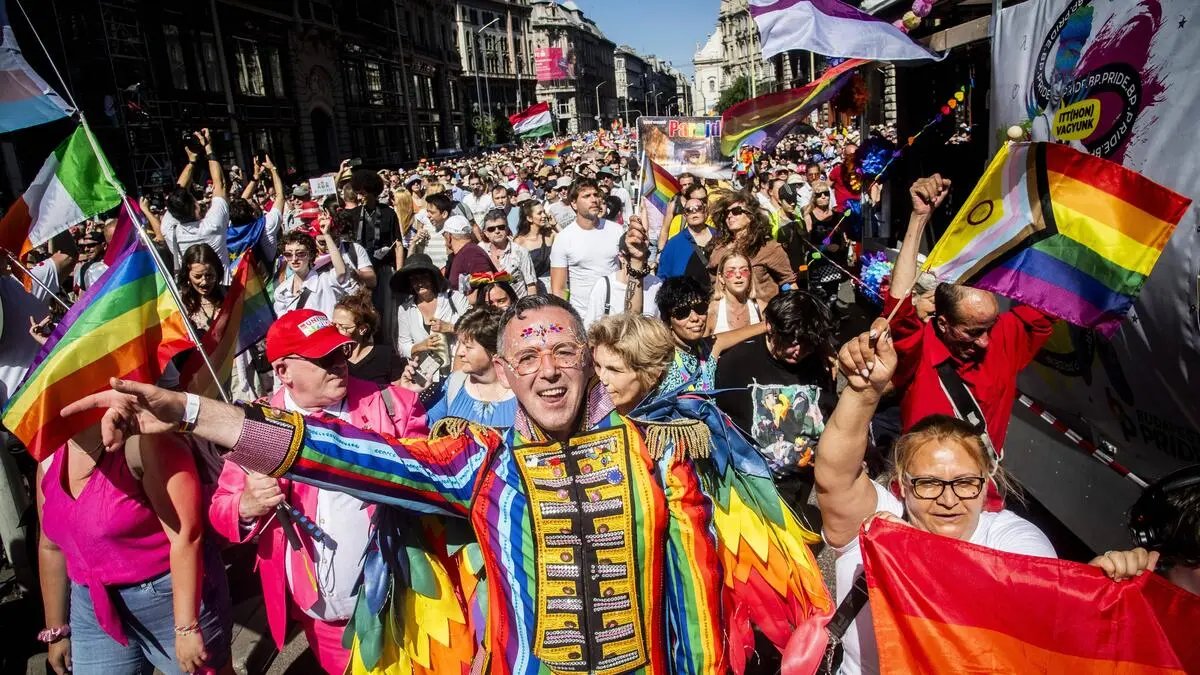
Yesterday’s rainbow parade on Vienna’s Ringstrasse once again made it clear how colorful the society we live in today is. A look at the abundance of flags on display at the joyous parade shows that today there are dozens of different gender identities with which people identify themselves – as an “inner self-image that is independent of (biological) gender and does not necessarily correspond to it,” explains Rogers Brubaker, a sociologist at the University of California (Los Angeles), in his recently published book “Gender Identity: The Career of a Category” (208 p., almond tree, €21). The book is an expanded version of lectures that Brubaker gave last year at the Institute for Human Science (IWM) in Vienna.
In it he soberly traces the history of the institutionalization of this “new principle of social classification”. Brubaker locates the origin in the 1960s in medical and psychological discussions about rare disorders of sexual development and transsexuality that were then understood to be pathological. Driven by activists, gender identities were subsequently anchored in more and more areas – in medicine, law, administration, education, statistics, etc. From the 1980s onwards, the idea that sex is innate, but that gender is socially and culturally constructed, became widespread in large circles of society.
Around 2015, a new phase began: While gender identity that differed from birth gender was largely seen as a personal matter, as the new categories became more widely known, it became a matter that also affects others – and that also confers legal rights. The postmodern idea of diverse and fluid identities became a differentiated catalog of categories. This leads many people to think about their identity and find a category that suits them (“identity imperative”).
Brubaker sees five central processes behind this development: “Depathologization” was followed by “universalization” (gender identity is no longer seen as relevant for just a few people, but for all people). At the same time, there was a “vernacularization” – a transition of the debate from expert circles to the public. “Formalization” (legalization in many areas) played a major role. And ultimately, it all resulted in a trend that “promoted gender identity to a position of primacy over gender.”
This is where we currently stand – accompanied by heated controversies about gender, queerness, LGBTIQA+ & Co, which Brubaker sees as a fight “between nature and culture”, a fight for the “possibilities and limits of self-determination in an interdependent world”.
Word of the week
Every week in his column, Martin Kugler takes on a central scientific term and presents the latest findings on it. The author headed the “Presse” research department until 2014 and is now a science communicator at AIT.
→ All articles by Martin Kugler