An international team with Austrian participation analyzed almost 800,000 fashion photos from the past 25 years. Diversity is nothing more than an “outlier.”

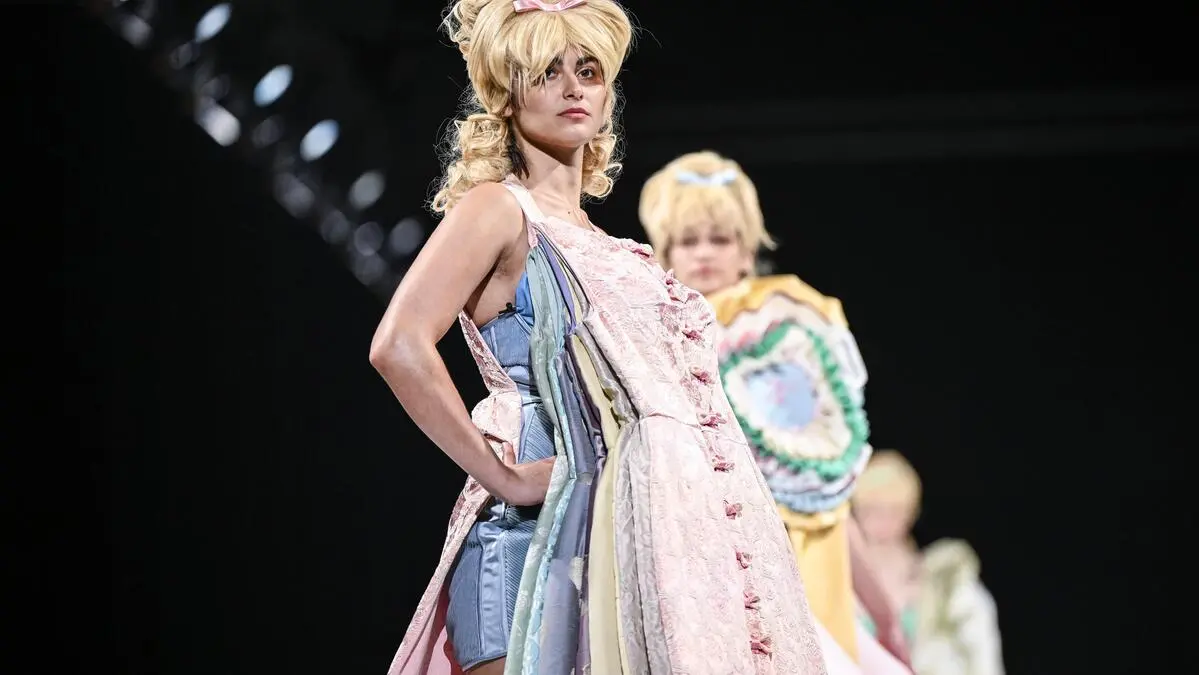
The diversity of body types has increased, but the average ideal has not changed (pictured: student graduation show at the Belgian Royal Academy of Fine Arts). Imago / Tom Goyvaerts
Who is beautiful and who decides? The media and fashion industry set unrealistic beauty ideals that have measurable consequences for body dissatisfaction and eating disorders. Even if today you can find more different types or origins among the female models gracing magazine covers or walking the catwalks of major labels, these are only “outliers”. Essentially, the body ideal hasn’t changed much in the past 25 years. Researchers with Austrian participation come to this conclusion in a comprehensive study published in the journal PNAS recently presented image and data analysis.
The “cultural evolution of beauty standards,” as the study is titled, appears to be less dynamic – or, conversely, resistant to cultural mixing. The Danish researcher Louis Boucherie and his team, which also includes Katharina Ledebur from the Complexity Science Hub (CSH) Vienna and doctoral student Karolina Sliwa from the WU Vienna listened to, evaluated 793,199 recordings from the years 2000 to 2024. These are images from fashion shows, advertising, covers of various magazines and editorial articles from all parts of the world.
The study, which also included image analysis supported by artificial intelligence (AI) and health data from surveys, showed: The variety of types, especially body dimensions and shapes, has actually increased among female models since 2000, but the ideal, namely “white” and rather thin compared to the general population, remains constant. Requirements regarding size, hip and waist circumference, etc. are also aligned across the various areas of representation in the fashion world – from the catwalk to the media.
“Of course, there has been a strong movement calling for greater body size diversity for some time,” Ledebur said. Many brands then hired more diverse models. But the data paints a different picture: The diversity of body types has increased, but the average ideal has not changed. The increase in more diverse body types is an “outlier”: “So it is a symbolic change, but not a structural one.”
What is suggested as beautiful by the fashion world and what it potentially does to individual self-perception – including health consequences – has repeatedly caused debate in the past. “Body positivity” initiatives provide counterpoints here. But there is still a big gap between the ideals conveyed by the fashion world and reality. Especially in the USA, as a further analysis as part of the study showed, where larger to overweight body sizes are known to be a central health policy challenge. The researchers related the results on US models to health data from the US population: even plus-size models are, on average, “just below the body measurements of the average American woman,” according to the CSH researcher.
When it comes to ethnicity, the results are also rather sobering for the researchers: the proportion of non-white models has increased from around 13 percent in 2011 to over 40 percent in recent years. But it is often mainly plus-size models who are “non-white”. Non-white models are 4.5 times more likely to represent the plus-size category, the study says. Different body shapes and ethnicity often shape individual people at the same time – and are therefore not widespread independently of each other.
When it comes to regulation, the researchers observed that the minimum limit for body mass index, i.e. weight in relation to height (a BMI of 18.5), introduced at Fashion Week in Milan in 2006, was associated with a measurable decline in extremely thin models, while a less strict system based “only” on a medical certificate in France has not been associated with a decline since 2017. However, the authors point out that there is not automatically a causal connection here.
The data on male models was also examined, but it was comparably thin. And it showed an (even) less pronounced trend towards diversity: “Male models are still significantly slimmer and more muscular compared to the general population, and there is no noticeable expansion in the body types depicted,” says the study.
According to Ledebur, the study cannot provide any information about the reasons that lead to the rather constant body ideal in the fashion industry. But a variety of factors certainly played a role here. (APA/cog)
Shortly
For the current study 793,199 recordings from 2000 to 2024 were evaluated. These are images from fashion shows, advertising, covers of various magazines and editorial articles from all parts of the world.
While the diversity of representation has increased, the average body type of models remains stable. This is due to the selective inclusion of plus-size models at the top of the representation statistics, while the typical body type continues to diverge from the US population.
The diversity indicators have improved, but the ideal of beauty itself has remained essentially unchanged. There is a broader cast of models, but it is still limited to exceptions that do not change the norm.
The paradox: The models in these roles are disproportionately non-white, revealing a symbolic diversification. The industry satisfies multiple demands for representation by focusing it on already marginalized people rather than changing who is considered desirable.
→ About the study: Cultural evolution of beauty standards (PNAS)