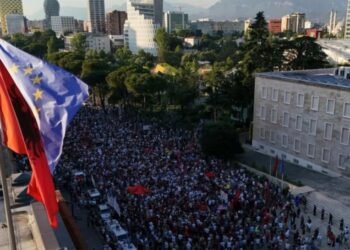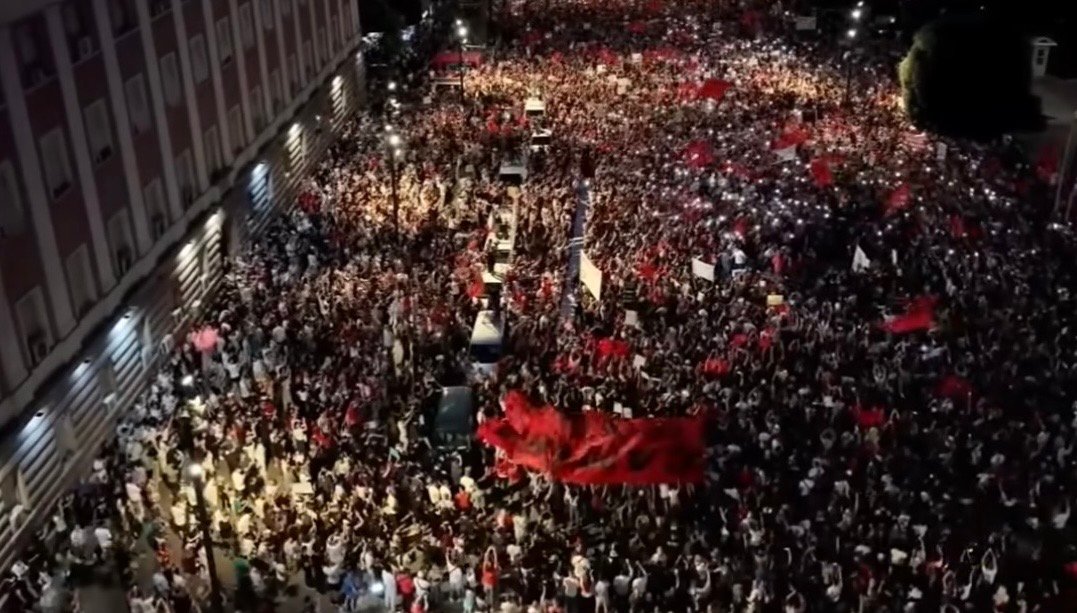
The protests against the project in Zvërnec, which then turned into a revolt against the government and Edi Rama, have highlighted an unusual phenomenon in Albanian politics. The square does not show the classic division between the supporters of the government and the opposition. On the contrary, the protesters simultaneously attack the socialist government of Edi Rama and the opposition led by Sali Berisha. At this point, Rama and Berisha seem to be the most troubled people in the entire Albanian space, because they are being massively rejected, at least by those who are in the square.
The calls heard before the Prime Minister’s Office were as harsh towards Rama as they were towards the Democratic Party. Slogans such as “Rama in prison, Berisha in prison” or “Opposition sold out” show that some of the protesters do not see the traditional opposition as a political alternative, but as part of the same system. In fact, PD risks losing its monopoly on oppositionism.
The protest included environmental activists, representatives of civil society organizations, politically disengaged citizens, but also individuals with different ideological beliefs. This makes it difficult to identify the protest as a pure left or right movement.
One element that has fueled the debate is the fact that some of the activists taking part in the protests have previously been linked to organizations funded by international foundations, including structures that critics link to George Soros’ network. However, their presence is not enough to define the entire protest as a politically organized project by a certain wing.
The paradox becomes even greater when international reactions are observed. Some of the voices most critical of the project have come from figures on the American left. Senator Bernie Sanders linked opposition to the project to concerns about the impact of investments linked to Jared Kushner, the son-in-law of US President Donald Trump. In this perspective, the project in Zvrnec is not seen only as an environmental or local issue, but as part of a wider political and economic debate.
This creates an unusual situation, a protest against a left-wing government, which simultaneously rejects the right-wing opposition and finds moral support in the figure of the American left. For this reason, Zvrnec’s protest looks more like a revolt against the political establishment as a whole than a traditional clash between left and right.
The question that remains unanswered is whether this movement will remain a protest focused on the environment and property, or whether it will transform into a broader political platform against the elites who have dominated Albania in recent decades.