By Marlon Bute
It could have been any day of the week: Monday, Tuesday, Friday, or even Sunday.
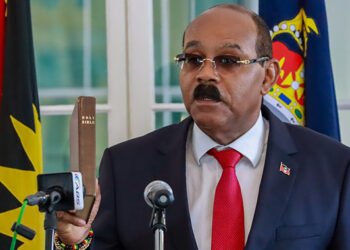
He rose from his seat and walked towards the podium. A few feet away, one of his security officers stood attentively, dressed in red, the colour of the party. His eyes moved across the crowd, alert, ready to respond to any threat, real or imagined.
The Comrade surveyed the gathering, settled himself before the microphone, and began in that familiar cadence.
“No government in the Caribbean cares more about the poor and working-class people of this country than this government, this Unity Labour Party, led by me, the Comrade.”

The crowd listened.
“We have built more houses than any government in the history of this country. We have put roofs over poor people’s houses.”
Then came the familiar boast:
“And you see this government, we get a high, high, high, high rating when it comes to no corruption. None.”
That was the story.
It was told often. It was told with confidence. It was told with the authority of incumbency, the force of repetition, and the comfort of a political machine that had grown accustomed to controlling both the microphone and the message.
For years, Vincentians were told that the Unity Labour Party had built a housing revolution. We were shown houses, figures, ceremonies, photographs and promises. We were told that no government in the history of St. Vincent and the Grenadines (SVG) had done more for housing. We were even told, as recently as 2025, of an ambitious plan to build 1,000 houses in 12 months.
That was the roof of the story.
But now the roof is being lifted, and the foundation is showing serious cracks.
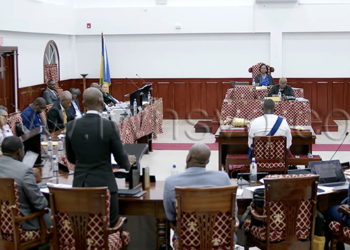
The new Housing Minister, Andrew John, of the recently elected NDP government, has told Parliament that contractors were paid in full for houses that were never built under the old ULP regime. He has said that materials were distributed with little regard for accountability. He has said that the situation was troubling enough that the Housing and Lands Development Corporation is no longer allowed to make direct payments, and that all such payments must now go through the Treasury.
That is not a small administrative adjustment. It is an alarm bell.
It forces us to ask how much of the so-called housing revolution was real construction, and how much was political packaging. How many houses were built? How many were contracted but never completed? How many were counted before completion? How many were paid for but never delivered?
This is where Arnhim Eustace’s old warning returns with force. He warned that corruption robs people of resources that could alleviate poverty, create opportunity, and develop a country. That statement stayed with me because it understood corruption not merely as stolen money, but as stolen possibility.
A stolen housing dollar is not only a stolen dollar. It is a roof not repaired. It is a child sleeping under a leaking ceiling. It is an elderly woman waiting for galvanised sheets. It is a family in Union Island, Mayreau, Canouan, North Windward, North Leeward, or anywhere else in this country waiting for help that was announced, budgeted, celebrated, and even paid for, but never delivered.
But housing is no longer the only issue. A pattern is beginning to appear.
A top news report involving the National Lotteries Authority and the Langley Park Playing Field is deeply troubling.
According to the report published in iWN, a senior minister approved a payment of EC$250,000 to a contractor just eight days before the general election. The payment was for works related to the Langley Park Playing Field. The contractor cashed the cheque the following day, with the contractor receiving 2,500 one-hundred-dollar bills.
And yet, no work was done on the playing field.
If that report is correct, the question is unavoidable: what was that money really for?
Was it truly for a playing field, or was public works language being used to disguise something else? Was the National Lotteries Authority being used as an instrument of national development, or as a cash window for political convenience?
These questions must be asked carefully, but they must be asked.
The Langley Park Playing Field itself has a history. It was the subject of more than one groundbreaking ceremony. It became one of those projects that appeared often in political talk, but not sufficiently in physical reality.
Then, days before an election, EC$250,000 was handed out for work on that same playing field, and still the playing field was not done. Is this the only instance? Or are there many instances throughout the country? How deep and wide does this kind of recklessness with public resources go?
That is not merely bad optics.
This looks like a system. A system of state-sanctioned corruption.
When placed beside the housing revelations, the concern deepens. Money was dished out to contractors, if in fact they were contractors. We simply do not know if they were bona fide contractors. These people were paid for houses that were never built and on lands that can’t be found or simply, which do not exist. In both cases, public money was connected to physical works that the public should be able to see, touch, inspect and use.
Millions moving without transparency and accountability. A recipe or symptom of corruption.
That is why this cannot be brushed aside as politics. If houses paid for cannot be found, if a playing field paid for cannot be shown, if materials were distributed without proper accountability, then the issue is national. Who approved the payments? Who certified the work? Who inspected the sites? Who received the contracts? Who signed off? Who benefited?
Housing was not a side issue. Sports facilities are not side issues either. These are areas that touch ordinary people directly: the poor family needing shelter, the young man needing a field, the child needing a safe place to play, the community needing basic facilities.
When money meant for those things disappears into promises, paperwork, or private hands without delivery, it is not only the Treasury that is damaged. The people are damaged.
It reminds me of something journalist Lyf Compton admitted after the change of government. He had visited the Southern Grenadines many times after Hurricane Beryl, yet only after returning with the new administration did he fully appreciate how much work remained to be completed.
That admission troubled me.
What was he shown before by the old ULP regime? What was he not shown? What did the cameras capture, and what did the official tours, led by the old ULP regime, avoid?
Those questions matter because governments not only manage projects; they also manage information. They frame reality. They decide what to show, what to emphasise, what to celebrate, and sometimes what to hide.
I wrote years ago about this kind of political intoxication. I wrote of a leader who “fed the people with words, lyrics and verses”, until too many became “intoxicated with the beauty and brilliance of this man”, as he often portrayed himself. I wrote of a politics in which “right was wrong and wrong was right”, where “up was down and down was up”. That was not merely poetry. It was a warning about what happens when charisma replaces scrutiny, when propaganda replaces evidence, and when a people are encouraged to admire power instead of questioning what power is doing.
The concern extends beyond housing and playing fields. It also goes to how the state maintained its own property.
I have written before about the Official Residence of the Prime Minister. Over roughly two and a half decades, significant public money was given, year after year, for repairs, maintenance, and improvements. Some have estimated that the figure could approach $10 million when all allocations over that period are considered.
Yet when the new prime minister took office, the official residence was not fit for occupation. It remains unfit while resources and expertise are mobilised to restore it into a proper home for the prime minister, his family, official visitors and, by extension, the Vincentian public.
So again, what exactly happened?
The former prime minister himself said that, during his time there, the railings around the official residence had been changed three times. He even knew the type of wood used. He said pine was used at the official residence, while greenheart was used at his private residence in Gorse.
Anyone familiar with construction knows the difference. Pine exposed to the elements will not perform like greenheart. Greenheart is stronger, denser, more durable, and better suited to harsh exterior conditions.
So how could BRAGSA, the state agency responsible for such maintenance works, get something so basic wrong, not once, but repeatedly?
That may seem like a small example, but it is not. A country does not only waste money through outright theft. It also wastes money through poor judgment, weak supervision, careless procurement, political comfort, and a culture in which nobody is made to answer when public funds produce poor results.
That too is a corruption of standards.
And while these examples of financial mismanagement are emerging, there is another image I cannot forget: the washerwomen.
I wrote recently about encountering laundresses attached to the hospital system still scrubbing hospital linen by hand before placing it into washing machines. That observation was made last November, days before the old ULP regime had suffered a humiliating defeat at the polls.
I was out walking and had come upon it. They were not in a modern facility with proper hot water systems and stainless steel basins, but in concrete sinks, with cold water, doing work that no serious healthcare system should leave in that condition.
One woman explained it plainly: “We scrub the linen in them.”
When asked whether they still scrubbed by hand, the answer was yes. When asked whether they had hot water, the answer was no.
That answer should shame us.
Here we are, hearing of houses paid for but not built; Lotto money allegedly approved days before an election for a playing field where no work was done; millions allocated over the years to maintain the Official Residence of the Prime Minister, yet the residence still left uninhabitable; and a farmers’ support agency struggling under serious delinquency.
Yet women washing hospital linen, some of it heavily soiled, are still expected to scrub by hand in conditions that belong to another era.
What does it say that say about national priorities under the old regime? What does it say about how public money was managed by the ULP regime? What does that say about the poor and working-class people whom the former administration so often claimed to love?
Because if there was money to move through state agencies with such looseness, surely there was money to provide a proper hospital laundry. If there was money to approve questionable contracts, surely there was money for hot water, stainless steel basins, proper machines, protective systems and decent working conditions for women doing essential work.
The washerwoman does not stand apart from this story. She is at the centre of it. She represents the person for whom development is always promised but too often deferred. She is the woman whose labour holds the system together while speeches are made elsewhere about progress, revolution, transformation and care for the poor.
Financial mismanagement is never abstract. It shows up in the hands of the laundress. It shows up in the cold water. It shows up in the concrete sink. It shows up in the indignity of women doing public healthcare work under conditions that a modern country should not tolerate.
Then there is the Farmers Support Company.
This agency was supposed to support farmers and fisherfolk by giving them access to money. Yet we are hearing that it has not issued loans to farmers and fishers since 2021. We are also hearing that of the loans already issued, the delinquency rate is about 75%.
If that is so, then the country must ask what the money actually achieved.
Did it strengthen agriculture? Did it modernise fisheries? Did it increase production, support food security, and help working people become more independent? Or did another state agency become a good-sounding idea weakened by poor execution?
This is where the debate about a national development bank becomes important. The former prime minister vehemently opposes the idea, arguing that existing institutions already perform some of the functions that a development bank would perform. But that argument must be measured against the actual condition of some of the institutions and programmes left behind.
If existing institutions were working properly, why do we have these questions around housing? If existing financial support mechanisms were sufficient, why is the Farmers Support Company in such difficulty? If state agencies were so well managed, why are we now seeing Treasury controls, investigations, renegotiated debts, missing houses, unpaid loans and public works payments where the work that was supposed to have been done, simply cannot be found?
The case for a development bank is not weakened by these revelations. They sharpen it.
St. Vincent and the Grenadines needs development financing. That is pellucidly clear. Farmers need capital. Fishers need equipment. Young entrepreneurs need access to funding. Small contractors need working capital. Agro processors, manufacturers, vendors, shopkeepers, creative workers and tradesmen need an institution that understands development and not merely collateral.
But a development bank must not be built in the image of the old political culture which sprang to life under the old regime.
It must not become another agency for political favour. It must not become another place where money is issued without discipline and never recovered. It must not become another programme whose figures sound good until someone begins to inspect the foundation.
It must be professionally managed, independently audited, properly capitalised, and protected from political interference. It must have clear lending criteria. It must follow the money. It must measure outcomes. It must treat public funds as sacred because public funds belong to the people.
The lesson from housing, the Lotto payment, the official residence, the hospital laundry, and the Farmers Support Company is not that the state should withdraw from development. The lesson is that development without accountability becomes waste, and waste in a poor country becomes poverty extended.
A house is not just concrete, steel, galvanise, timber and paint. A house is shelter. It is dignity. It is a family’s peace of mind.
A playing field is not just grass and grading. It is community. It is youth. It is discipline. It is somewhere for children to run, compete, gather and dream.
A farmers’ credit facility is not just a loan book. It is food security. It is rural survival. It is production.
A hospital laundry is not just linen. It is healthcare. It is sanitation. It is worker dignity. It is infection control.
And an official residence is not just a house for a prime minister. It is a public asset. It belongs to the state and must be maintained with the seriousness that any responsible homeowner would bring to his own property.
Taken together, these are not isolated embarrassments. They point to something far more serious: state-sanctioned corruption.
Houses allegedly paid for but not built. Public money approved days before an election for a playing field where no work was done. State property maintained so poorly that millions could be spent over the years and still leave the official residence uninhabitable. A farmers’ support institution unable to function as a serious credit facility for the very farmers and fisherfolk it was created to serve. Hospital laundresses still washing linen partly by hand while money moved elsewhere with astonishing ease.
This is not mere mismanagement. It is a system. And if it is a system, then the response must also be systemic.
That is what the 14-to-1 mandate means.
The Vincentian people did not simply reject the ULP on election day. They rejected an era. They rejected a political culture. They rejected the arrogance, the looseness, the excuses, the party capture of the state, and the casual treatment of public resources.
But the change cannot end with the rejection of the ULP as a party. It must reach the actors, the enablers, the beneficiaries, and the public officers who helped make that system possible.
A system does not sustain itself. It is sustained by people, by decisions, by silence, and by those who facilitate, approve, enable, and look away.
A mandate of that size is not a decoration. It is an instruction.
It is an instruction to investigate. It is an instruction to recover public money where possible. It is an instruction to prosecute where the evidence supports prosecution. It is an instruction to remove from influence those who treated public office, state agencies, public contracts and government programmes as tools of party power.
It is also an instruction to build a state grounded in accountability, transparency, structure, progress, public safety and prosperity.
So yes, the roof must be lifted from the housing programme. But it must also be lifted from the National Lotteries Authority, the Farmers Support Company, BRAGSA, the hospital laundry system, and every state agency that handled public money in the name of development, maintenance, poverty reduction, healthcare, agriculture, community upliftment or public service.
The former administration spoke often of revolution: housing revolution, education revolution, development, transformation.
But it is a story. It is propaganda. It is political gimmickry meant to hoodwink the people and advance the fortunes of the party over the country. Nothing could be more egregious to the state.
Therefore, we are required, as a government and as a people, in the valleys, on the hills, on the plains, in every nook and cranny, to demand better for ourselves, but more importantly for the generations to come.
The obvious wastage, greed and corruption that characterised much of the past 25 years must never be replayed.
There is an awful lot of work required to take SVG out of the state it is in, but it is essential work. Economic revitalisation in farming, fisheries, agro processing, technology, science, the arts, sports, construction and other areas must be combined with a serious thrust towards law and order, community development, youth development, women, gender, and family development.
We can reimagine SVG. And in doing so, we can undertake the hard but exciting work that now awaits us.
The opinions presented in this content belong to the author and may not necessarily reflect the perspectives or editorial stance of iWitness News. Opinion pieces can be submitted to [email protected].