In this article we analyze US foreign policy towards Cuba as it relates to pressure measures, including talks and brokerage.
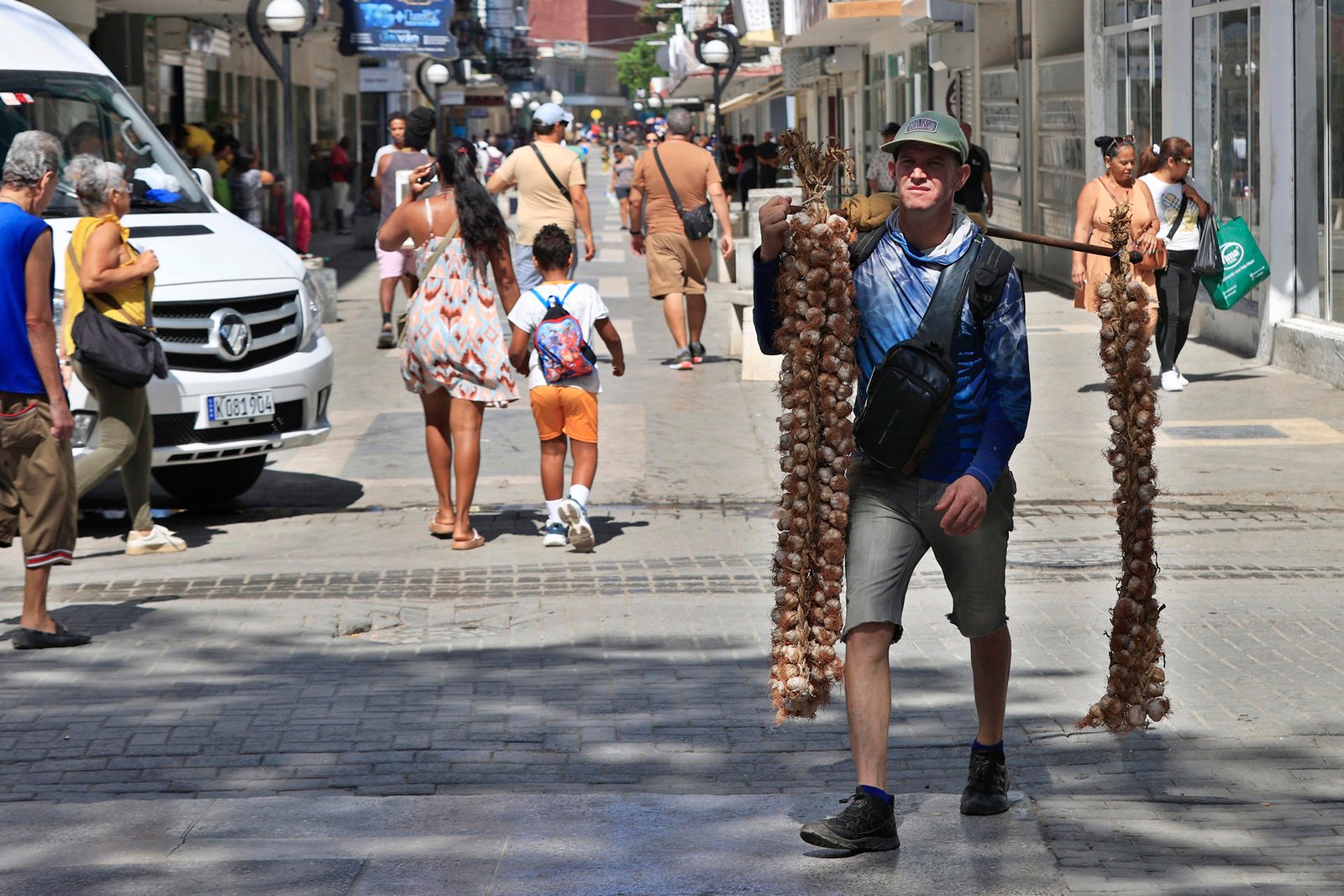
Uncertainty about the future of Cuba is reaching a tipping point due to the humanitarian crisis, which is substantial, with a shortage of basic and food goods and services.
The oil fence and GAESA
The blockade of access to oil transported to Cuba, in effect, since December 2025, within decree 14380, continues to be the main instrument of pressure, along with sanctions and naval mobilization in the Caribbean, with the purpose of creating a political transition in Cuba that promotes a change of regime.
The main strategy has been to weaken the business state, in particular, all the ties that the entity called Grupo de Gestión Empresarial SA (GAESA) has in the international commercial environment, starting with oil and its international operators.
The Trump administration’s approach is to reduce the room for maneuver of the management team in charge of GAESA, since it is the entity that leads or has a monopoly on the business state. Although its officials come from the FAR, in practice they are disconnected from the Army institution.
The management structure of GAESA acts as a de facto government because it has control of consumption, production and foreign trade within the framework of a State that, through GAESA, regulates, intermediates and executes all economic activity—with the exception of the financial activities of non-sanctioned banks outside FINCIMEX (subordinated to GAESA).
Meanwhile, the Army, from a strategic perspective, has lost its political capital and the entities in charge of the decision-making process within the Council of State; The Politburo and the Communist Party maintain a formal, but not real, weight to control the population or the State.
In general terms, apart from GAESA, those who have the most weight in the decisions are the Castro family—now also sanctioned.
Other pressure actions by the United States on Cuba in 2026
The United States has implemented four points of pressure on the Island, among these are sanctions on Cuban officials and entities, naval military mobilization in the Caribbean, the legal lawsuit against Raúl Castro, and meetings with State officials.
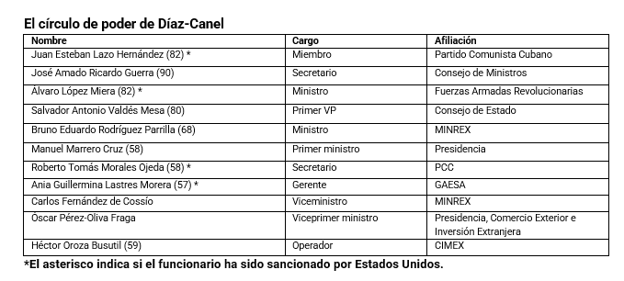
Regarding sanctions, the government imposed 15 against key figures, including Díaz Canel, Raúl Alejandro Castro, and Guillermina Lastres, manager of GAESA. The administration’s reading is that this entity is the key to the transition, because its operational infrastructure remains stable, especially territorially, and any mechanism for Cuba’s economic liberalization depends on having existing funds.
According to the State Department, this entity has more than US$18 billion in reserves—no coincidence, considering that income before investments between 2016 and 2025 is at least US$21 billion. However, the lack of transparency in the management of these funds generates distrust and uncertainty regarding any promises offered by officials, since the discretion in their use has been characterized as part of a network of corruption in the country.
The majority of those sanctioned in 2026 are political pieces linked to GAESA, belonging to a generation more removed from the Revolutionary Armed Forces and, on the other hand, to the Castros.
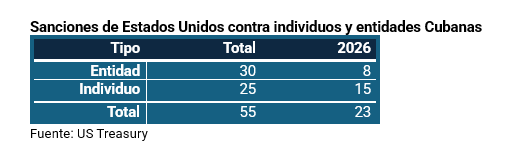
At the same time, the United States has mobilized several ships, Coast Guard forces and reconnaissance flights. The most recent movement of the aircraft carrier USS Nimitz and the preparation of the USS Kearsarge to leave Virginia. The consideration of a military intervention by the United States is not off the table, since it considers the probability of a popular uprising in favor of intervention and that a vulnerable army suggests an opportunity.
On the other hand, there is the scenario of repeating an extraction episode like that of Nicolás Maduro, although with low probability. The media perspective would imply a negative perception of extracting an octogenarian dictator, whom the regime itself presented to the public in a fragile state. However, the pressure to use force is not reduced to an extraction in itself but rather as a consideration of last option if meetings and communications between the United States and the Cuban regime do not progress.
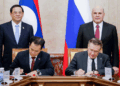
Between February and June 2026, the United States and Cuba have held continuous meetings on a political settlement that will allow the country to undergo a transition and, at the same time, implement an economic stabilization plan that includes foreign investment, restitution of confiscated properties, elimination of the business state through a system of free competition, and ending the one-party system.
These meetings have included meetings with officials from the FAR, GAESA and other actors, such as Raúl Castro’s grandson with the director of the Central Intelligence Agency (CIA), John Ratcliffe, on intelligence cooperation issues.
That meeting was followed by another with the head of the US Army’s Southern Command, Gen. Francis Donovan. These meetings included high-level officials such as General Roberto Legra Sotolongo, Chief of the General Staff of the Cuban Armed Forces. The Secretary of Defense/War’s visit to Guantanamo and Miami indicates a very likely military contingency plan.
Speculation revolves around the inevitability of territorial action on Cuba in the face of a refusal on the part of Díaz-Canel to enter a transition stage.
The next steps
The Cuban situation is at a critical point. For some analysts, in less than two months, the regime will have to offer an exit strategy that includes total economic liberalization, or the United States will use more forceful tools to achieve political change.
Until now, Díaz-Canel has offered to release political prisoners; however, the gesture is considered symbolic.
The energy crisis, which does not precede the economic one, is already of a humanitarian nature; Six months without full access to supply the country with more than 70% energy represents a substantial challenge for the regime and an urgent food emergency.
Transnational companies are leaving the country, including Visa and MasterCard, which suspended their payment services through their platform and their link with the state company Fincimex.
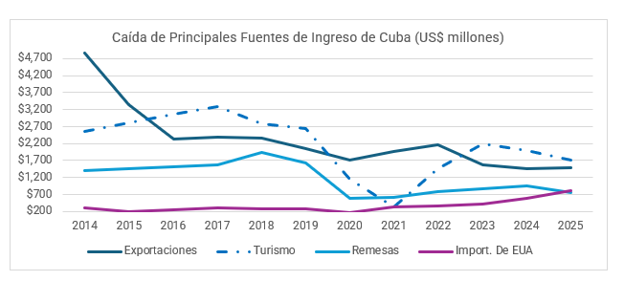
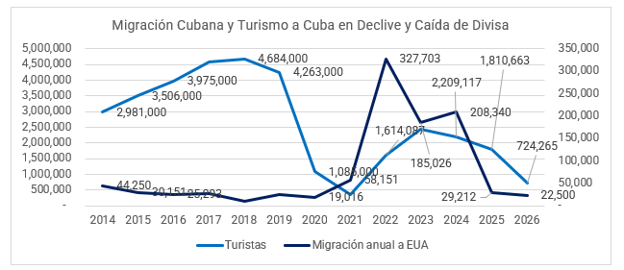
Other companies, such as the Canadian mining company Serritt International, have suspended their intentions to invest. Tourism has declined by at least 40% and there are no possibilities of recovery for the rest of the year. Meliá and Iberostar, the hotel chains, are operating at half capacity, while Archipiélago International and Blue Diamond Resorts have left—a situation that is seen in a 60% drop in tourism and the loss of profitability of GAESA.
Exports continue to decline. Only exports from the United States to Cuba show a growth of 20% in the first quarter of 2026, reaching $300 million. The interesting thing is that the type of imported merchandise revolves more around supporting infrastructure and equipment than food security.
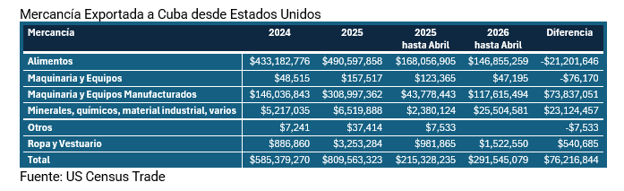
There is a decrease in air flights (carrying tourists in particular) by half, from 80 to 40 flights daily during the first five months of 2026—less than half of those arriving from the United States.
This decrease in flights highlights the impossibility of sending remittances in kind (food packages, medical and hygiene goods), given the fall in cash remittances that have been declining since 2024.
Sending money to Cuba had been in decline since the sanctions on Fincimex and, since then, the volume has not grown, even though the majority of transfers were informal and by air. Finally, migration is at a very low point, mostly linked to authorized entry with pending legal residency cases.
There are also no third countries or other actors involved in any intermediation process.
The only three countries that could play that role, Spain, Canada or Mexico, have not intervened or offered their diplomatic offices, largely because Cuba agreed to hold bilateral talks. Mexico has sent food ships to supply the population, however, they are gestures of low proportion given the needs throughout the territory—in total there are 6 thousand tons that feed 10,000 people in a single day (the previous year its contribution was more than US$2 billion).
The fundamental problem, at this point, depends on the decision of the political circle around Díaz-Canel to facilitate the transition and contradict the Castro family, which has defied to the death any pressure from the United States. The other, unlikely option is for the United States to abandon the blockade and take a step back.
Between these two scenarios there are imponderable factors, such as a massive departure of rafters (even motivated by Díaz-Canel) and a social protest in the streets, repressed in a bloody manner, that could create or accelerate an agreement or a transition. The other is that the desperation of the deterioration may lead thousands to take to the sea on rafts again in the face of a sharp drop in migratory relief through flights and arrivals at the border with Mexico.