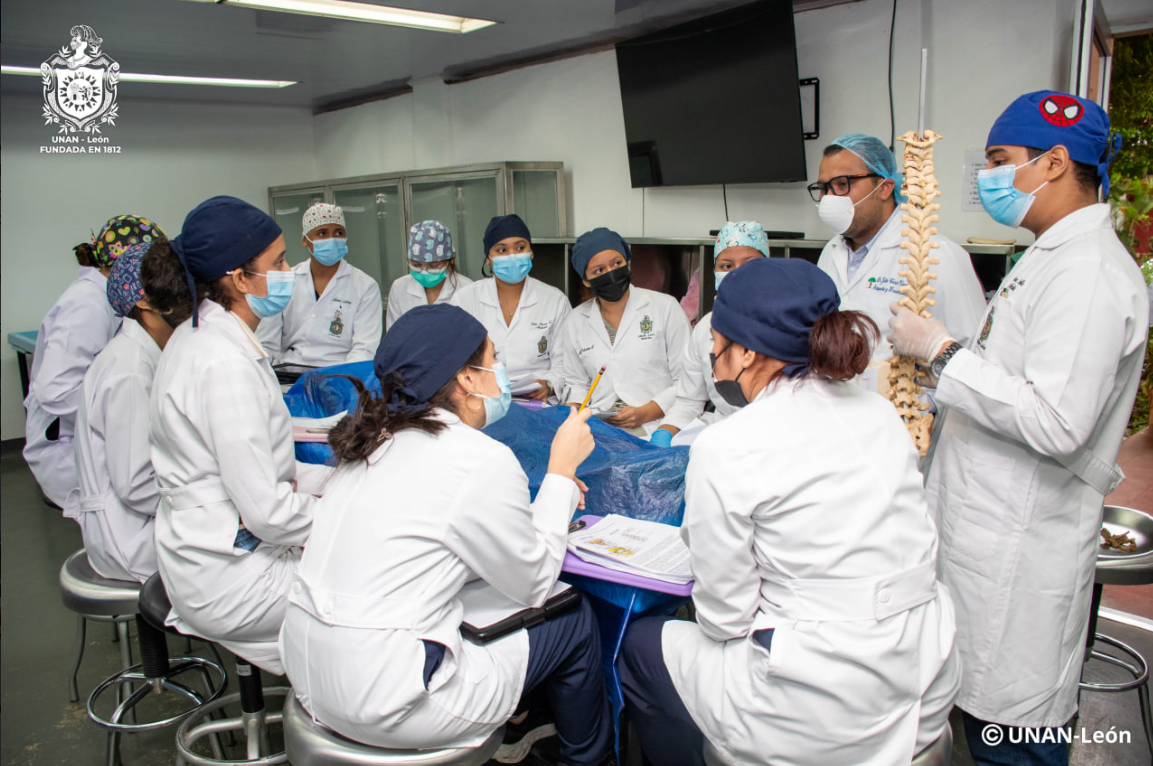
Expulsions of university students and a climate of discontent, fear and uncertainty shake the Nicaraguan health sector after the implementation of new requirements to study Medicine and the order to psychologically examine the youngest doctors. The measure is due to a resolution of the Technical Secretariat for Attention to Universities (SETEC) —which establishes new criteria for entry and permanence in the race—and the provision of the Ministry of Health (Minsa) to perform psychological evaluations on 3,742 doctors under 35 years of age who work in the public system.
“There is a lot of tension in universities,” he says. Jorge, who studies fifth year of Medicine. “They are coming to the classrooms with lists of those expelled, they are taken away and forced to sign a document in which they renounce continuing to study the degree,” he says.
The majority of these young people do not return to the classrooms “and left the university crying,” the student details.
“It’s very cruel” the expulsion
Jorge considers that it is “very cruel” to cut short the dreams and efforts of students from one day to the next. In his classroom, five classmates were expelled.
“It’s very hard (to be expelled), especially for someone who was about to finish their studies and go to boarding schools,” he says.
The young man knows the case of a student who was expelled because he left the university during the pandemic and when he returned he had to take some classes again.
“It is very unfair, because he was already about to defend his thesis and go to do his internship in a hospital,” he insists.
He considers it irrational that they demand an average of 90 and not drop any class when “for a long time” they were flexible with students who allowed them to enter without having the requirements.
In addition, he claims that they should evaluate the teachers because “the quality has deteriorated” and now many of the teachers are no longer specialists “but rather they take recently graduated general practitioners to teach.”
Many medical students “on hold”
Xavier He is studying second year of Medicine at UNAN-Managua and explains that there is “a lot of fear” because “without prior notice they are leaving students without a career.”
“There is not even a kind of extension where the students are given one last chance, they simply decided that they have the right to make them waste so much time invested,” he says.
A third-year medical student published on social networks that she is advocating before the SETEC authorities, since she left a single class for not being able to take an exam, while she was hospitalized. “The university denied me the extraordinary, my grade record is impeccable (…) now I have to wait, my destiny,” he states in his publication.
A lesson or a smoke screen?
The measures announced by the regime of Daniel Ortega and Rosario Murillo were released days after the public exposure of a young doctor, who was initially reported missing and was found in a hotel in Granada, after going through a depressive situation linked to family problems. The dictatorship announced the suspension of the young woman while she completed her recovery process.
In the case of medical students, the measure establishes the requirement of a minimum average of 90 points to enter, the approval of psychological and behavioral evaluations, as well as “acting with social commitment and being consistent with cultural and national identity.”
Meanwhile, in the case of doctors, the Minsa document indicates that they will evaluate the staff to “ensure the safety of the patient and the worker, as well as the quality of the services provided.” To do this, they argue that they will seek to identify “states of anxiety, depression, substance use that generates addiction and risk of suicidal intent.”
Mauritius, A doctor from a hospital in the south of the country points out that “there is general discontent, both among students and staff who work in the public sector because they suddenly became more demanding, but they do not see that it is necessary primarily to improve training and that starts with better teachers and in the case of medical staff we must improve the conditions in which we work.”
“First they exhibited the doctor colleague at a national level and now they try to show that they are concerned about our mental health, clearly it seems like a smokescreen to not talk about other issues that have been reported. But also limiting the evaluation to those under 35 years of age, when depression is an issue that affects us all regardless of age,” he says.
“They want to ignore how we work”
Relief He has worked in a health center for more than ten years and affirms that on social networks he has read a lot of celebration for the measures dictated by the regime “because everyone demands better medical personnel.”
“It is understandable that we want a better-prepared generation and higher quality care, but it is ignored that for years the authorities have cared very little about educational quality and medical personnel are poorly paid and also mistreated,” he says.
He claims that one cannot expect “that the staff is not under pressure” when there is surveillance, constant layoffs, lack of personnel, long hours, the obligation to participate in party activities, among other violations of the Sandinista regime.
“There is a clear threat to doctors, pretending to ignore how we work within the public health system,” he laments.
“The entire system is failing”
For Edith, If the regime was interested in improving training and the quality of medical care in Nicaragua “it would have to make a total change.”
“Being an excellent doctor not only depends on qualifications, but also on the teachers who train them, on the training they have from their schools, everything is interrelated and we know that we are very bad in this regard in the country,” highlights the doctor.
He believes that not only Medicine should be demanding, but that it should be extended to all careers in the country. “But we know that the entire system is failing, better preparation is needed in primary and secondary school to begin with, more investment is needed in education and health,” he reiterates. Edith.