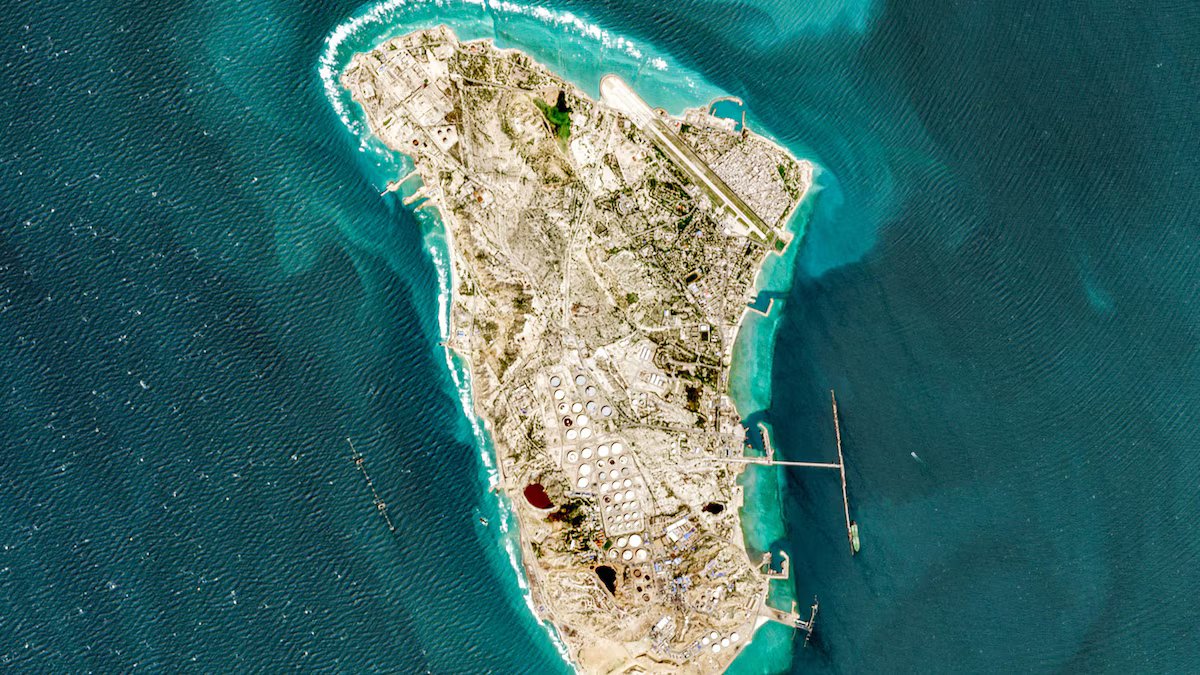
TEHRAN.– Under the strong sun of the Persian Gulf, the small Iranian island of Kharg, which today was bombed by the United Statesas reported by the Iranian Mehr agency, occupies a disproportionate place in the global energy geopolitics.
With just 22 square kilometers off the coast of the province of Bushehr, this territory, restricted to those without access credentials, became the main oil node of the islamic republic and, in the current context of tensions in the Middle Eastin a strategic objective for the United States and Israel.
For years, access to the island remained strictly controlled by the Islamic Revolutionary Guard Corps (IRGC).
The military presence protects facilities that constitute the engine of the Iranian economy: Almost 90% of the country’s oil exports come from this enclavewhich connects Iran to international markets, especially China.
There is debate in Western military circles whether attacking the Kharg facilities could decisively hit Tehran’s financial capacity. Former Israeli Prime Minister Yair Lapid, for example, recently called for destroying the island’s infrastructure to weaken the Iranian regime.
Until then, Washington had cautiously evaluated a direct attack due to the risk of regional escalation and the possible consequences for the global energy market.
The strategic importance of Kharg lies in its geography. The deep waters that surround it allow the safe docking of supertankersa natural advantage that much of the Iranian mainland coast does not possess.
Crude oil from oil fields is channeled from this island and transported through a network of underwater pipelines before storage and export.
In February 2026, Iran increased cargoes from Kharg to exceed the three million barrels per dayaccording to market data, further consolidating the central role of the island in the country’s energy system.
But Kharg’s story did not begin with oil. Archaeological records indicate presence human since the end of second millennium BCwith settlements linked to different civilizations, including the Elamite, the Achaemenid and the Sassanian.
Religious vestiges from different periods also coexist on the island, from Zoroastrian tombs to Christian monuments and the Islamic shrine of Mir Mohammad, built in the 7th century.
During the colonial era, European powers disputed this enclave for its maritime value. In 1753, the Dutch East India Company established a fort there to protect its trade routes. The occupation ended in 1766, when the local governor Mir Muhanna expelled the foreign forces.
Centuries later, under the reign of the Shah Reza Pahlavithe island was used as a prison for political prisoners.
Its destiny changed definitively in 1958, when the oil infrastructure began to be developed that would turn Kharg into the main energy export point of the country.
The island has been the scene of attacks in the past. During the Iran-Iraq war in the 1980s, Baghdad launched repeated bombing raids on Kharg in an attempt to cripple Iranian oil exports.. The facilities were severely damaged, but Tehran quickly rebuilt them and made them a national strategic priority.
Currently, Iran reinforced the island’s defenses until it became a one of the best protected points in the Gulf.
An attack on Kharg would have global repercussions. Financial analysts and security specialists warn that the destruction or capture of the island could cause a sharp jump in oil priceswhich recently reached $119 per barrel amid the regional escalation.
Furthermore, Tehran could respond with attacks against energy infrastructure in Gulf countries such as Saudi Arabia or Bahrain, or even try block the strategic Strait of Hormuzthrough which a fifth of the world’s oil transits.
For this reason, some analysts maintain that a direct attack could backfire. Depriving the Iranian regime of its main source of income could push it into a broader and more dangerous response.
A scenario of regime change in Iran is also being discussed in Washington. In that context, keeping the Kharg facilities intact would be key so that an eventual new government could stabilize the economy by rapidly resuming oil exports.
For this reason, some strategists propose alternatives such as operations of cyber sabotage or limited military actionsinstead of a massive bombing.
However, any ground operation would expose the forces involved to Iranian missiles and drones, risking further widening the conflict.
Meanwhile, Kharg continues to operate at full capacity. From its oil terminals, ships continue setting sail towards the global market, in an enclave that today concentrates both the backbone of the Iranian economy and one of the most sensitive pieces of the current geopolitical chessboard of the Middle East.
Agencies AFP and Reuters