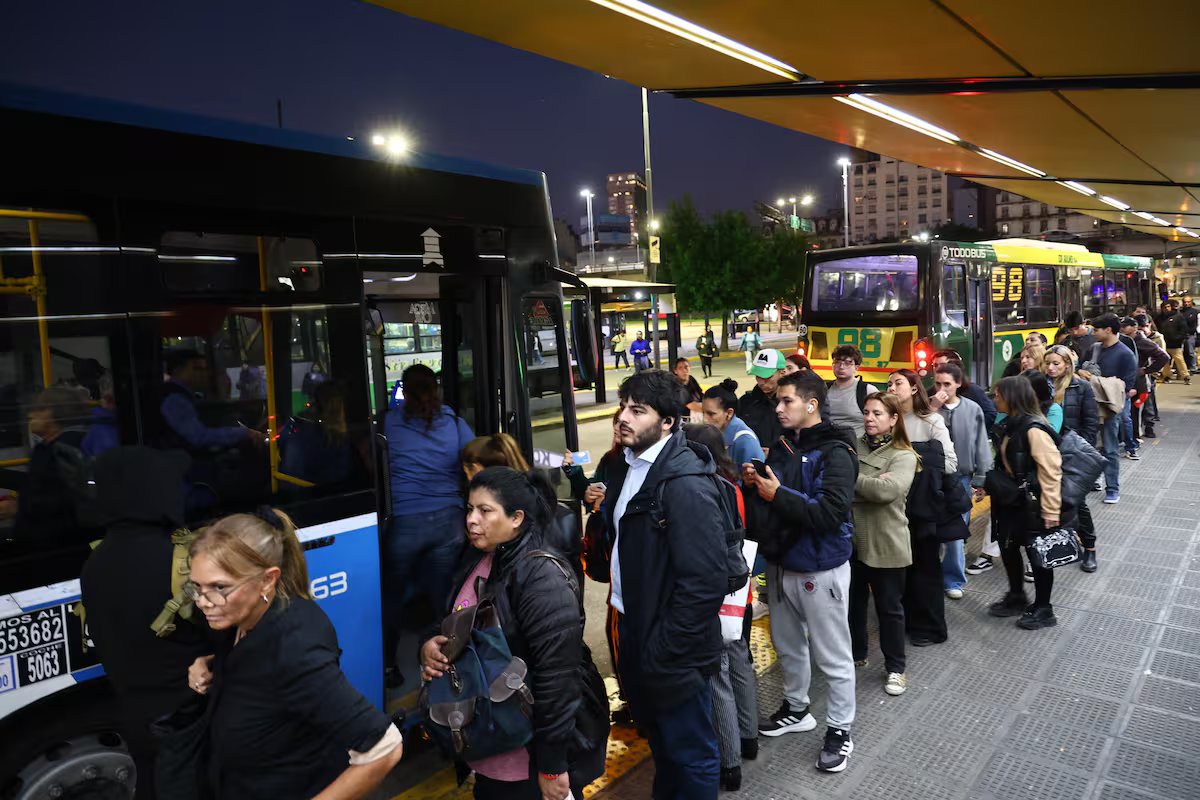
He bus ticket in the province of Buenos Aires increases since this Monday 11.16% and moves the tariff scheme again Buenos Aires Metropolitan Area (AMBA)in a context still going through the recomposition of costs, the rise in fuel prices in the context of the war in the Middle East and the open discussion about the level of subsidies after years of tariff freezes. The increase combines the monthly update formula with an additional differential linked to diesel, as explained to THE NATION sources from the Buenos Aires Transportation Secretariat.
Without this extra component, the increase would have been 5.4%in line with the current formula —inflation plus two percentage points—, taking as reference the March 3.4% of March CPIlatest data available. The difference responds to the impact of fuel on system costs.
With this adjustment, the minimum fare (0 to 3 kilometers) goes to $968.57, while the section from 3 to 6 kilometers is $1089.64; the 6 to 12 km one at $1,210.71; the one from 12 to 27 km at $1,452.85, and trips of more than 27 km reach $1,708.07 in values with SUBE registered.
This is a new adjustment within the current update scheme, which combines inflation with variations in operating costs, especially diesel, one of the main inputs to the system. The provincial authorities have been pointing out for weeks that they have little fiscal room to increase the level of subsidies.
The impact is especially relevant due to the weight that the Buenos Aires system has: they circulate 321 linesof which 129 are provincial (with numbers 200 to 499) and 192 municipal (from 500 onwards), with exclusive operation in the suburbs. In terms of demand, the system registers around 4 million daily transactions on business daysa figure that falls to an average of 1.7 million during the weekends.
The travel structure also shows a strong concentration on the shortest routes: 41% of passengers pay the minimum ticket, while 25% use the second section (3 to 6 km). The longer sections have a lower incidence: 15% in the third section, 16% in the fourth and just 3% in the fifth. This pattern explains why changes in the base fare have a direct and massive impact on household transportation spending.
In the province they maintain that, despite the adjustment, the service shows some normalization compared to the most critical weeks in mid-March. At that time, some companies were reducing frequencies due to uncertainty about how much of the increase in diesel would be recognized in rates.
The reduction in frequencies, which reached around 30% when the price of fuel skyrocketed, today is below 5% on most lines, according to official sources. “The majority are complying with the services,” they indicated, although they recognize that the situation remains sensitive to the evolution of costs. Companies believe that we will have to wait the next few days to observe significant normalization.
The Buenos Aires increase widens the gap with the rest of the AMBA jurisdictions and once again highlights the fragmentation of the system, which today operates under three different schemes. On the one hand, there are the province lines—those that go from 200 onwards—; on the other hand, those of the City of Buenos Aires, about 30 lines (such as 4, 7, 12, 39 or 151), which operate entirely within the district; and finally the national linesmore than a hundred (such as 1, 8, 10, 60, 86, 152 or 168), which connect the City with the suburbs and depend on the Secretary of Transportation of the Nation.
This division implies that, on the same route within the AMBA, users can pay different rates depending on the line they use. Today, the minimum ticket is $968.57 in the province, $753.74 in the City and $700 on national lines with SUBE registered, which generates differences of up to 38% between jurisdictions.
The City applied an increase on Friday, May 1, 5.4%under a formula similar to that of Buenos Aires. “With this new rate table, the City seeks to make up for the rate delay, taking into account that it currently covers 70% with subsidies,” the Buenos Aires government stated.
At the national level, however, Official sources confirmed that the Government is analyzing applying an increase in the lines under its jurisdiction, within the framework of the review of the system’s cost structure. The definition still does not have a confirmed date or percentage, but the sector assumes that it could be communicated in the coming days. This decision is key because it affects more than a hundred lines that concentrate a good part of the AMBA’s daily trips and today maintain the lowest rate in the system.
The background to these definitions continues to be the tension between tariffs and subsidies. Last week, the Nation moved forward with a transfer of $56,000 million for companies, which was added to $30,000 million contributed by the province, in an attempt to alleviate the financial situation of the sector.
In this context, a meeting was held at the Ministry of Economy between national officials, representatives of the province and business chambers in which they sought to channel the system’s financing crisis. There it was agreed to move forward with technical tables during May to review the cost structure and define a more predictable update scheme.
According to sources from the sector, the meeting – the first led by the new Secretary of Transportation, Mariano Plencovich – left a sign of relaxation after weeks of conflict, although without concrete definitions on rates. “A more technical instance of dialogue was opened,” they indicated near the companies.
The companies consider that the transfer of funds may imply relief in the short term, after weeks in which the service operated with cuts of between 10% and 20% on some lines, which led to longer waiting times and discomfort among users.
In addition to the direct impact on the pocket, increases in transportation have an effect on inflation, given that the item is part of the regulated prices. Although its weight is limited within the general index, the increases have a direct impact and also through expectations, in a context in which the Government seeks to avoid shocks in the CPI.