
Photo: Mondadori Portfolio via Getty Images
The restoration of the famous mosaic of the bull in Milan has caused many reactions in Italy, and many, with a touch of disbelief, wonder what happened to his “lucky” testicles.
Recently, work began on the repair of minor damage, caused by the long-standing custom of tourists to turn their heel on the bull’s genitals, believing that it brings good luck.
City councilor Marco Granelli announced over the weekend that the mosaic had been “completely restored,” and his statement sparked an avalanche of comments on social media.
Some claim that the bull’s testicles disappeared during the restoration, while others joked that one of the most recognizable symbols of Milan is actually – “neutered”.
However, the city authorities say that the work on the mosaic in the historic Vittorio Emanuele Second Gallery has not yet been completed and that the final look after the restoration is yet to be presented.
The beige and blue painted bull mosaic, surrounded by the coat of arms, represents the city of Turin, the first capital of Italy.
The mosaic has become popular among tourists due to the tradition of visitors turning their heel three times clockwise on the bull’s genitals.
According to legend, this ritual brings good luck and promises a return to the city to those who perform it, but over time it led to the creation of a small dent in the mosaic.
A post by city councilman Marco Granelli on social media drew ridicule.
“What happened to the testicles?” asked one user.
Another commented tersely, “Something is missing.”
The city authorities of Milan announced that the work on the mosaic is still ongoing and that part of the surface is still partially covered in order to strengthen the new tiles and “catch” the color.
It was also pointed out that there was no “disappearance” of the bull’s testicles, and that pink marble, which is considered the closest to the original, was used for the restoration.
The city administration also says that during the previous restoration in 2017, darker marble was used.
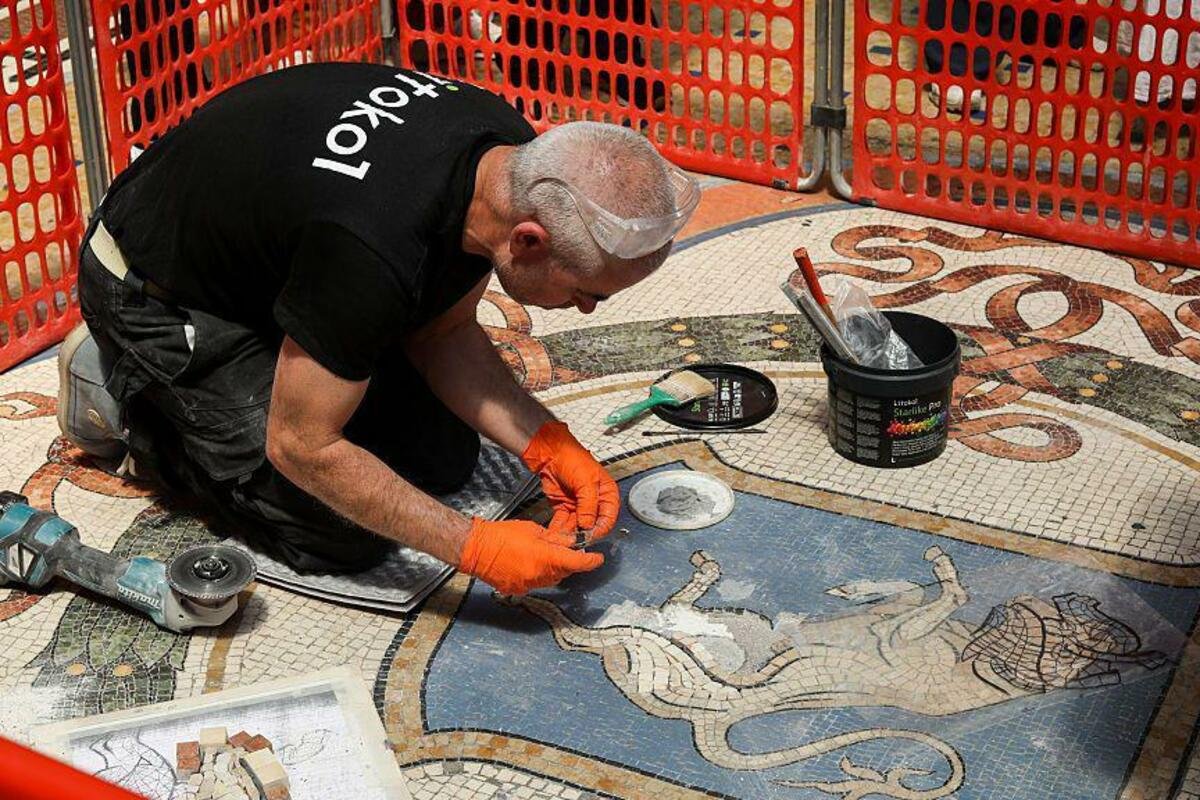
Since the beginning of the restoration, a protective fence has been placed around the mosaic.
Master restorer Gianluca Galli began the work by kneeling in front of the mosaic, carefully shaping and cutting new pieces of stone by hand for its restoration.
He is for the Italian newspaper Corriere della Sera (Corriere della Sera) confirmed that the works have not yet been completed.
He added that he had received no objections to the work, which takes place under the “watchful eye” of the city administration.
BBC is in Serbian from now on and on YouTube, follow us HERE.
Follow us on Facebook, Twitter, Instagram, YouTube and Viber. If you have a topic suggestion for us, please contact us bbcnasrpskom@bbc.co.uk
Download the application and follow the news


FOLLOW US ON

News