The new proposals of the big five Europeans confirm the phased accession
- Although Brussels bureaucrats publicly claimed that the package-admission and phased membership project had been rejected, the joint document of Germany, France, the Netherlands, Belgium and Luxembourg prove that “New Macedonia” rightly announced that behind the scenes in Brussels intensive work continues on the ‘trial membership’ details of new members
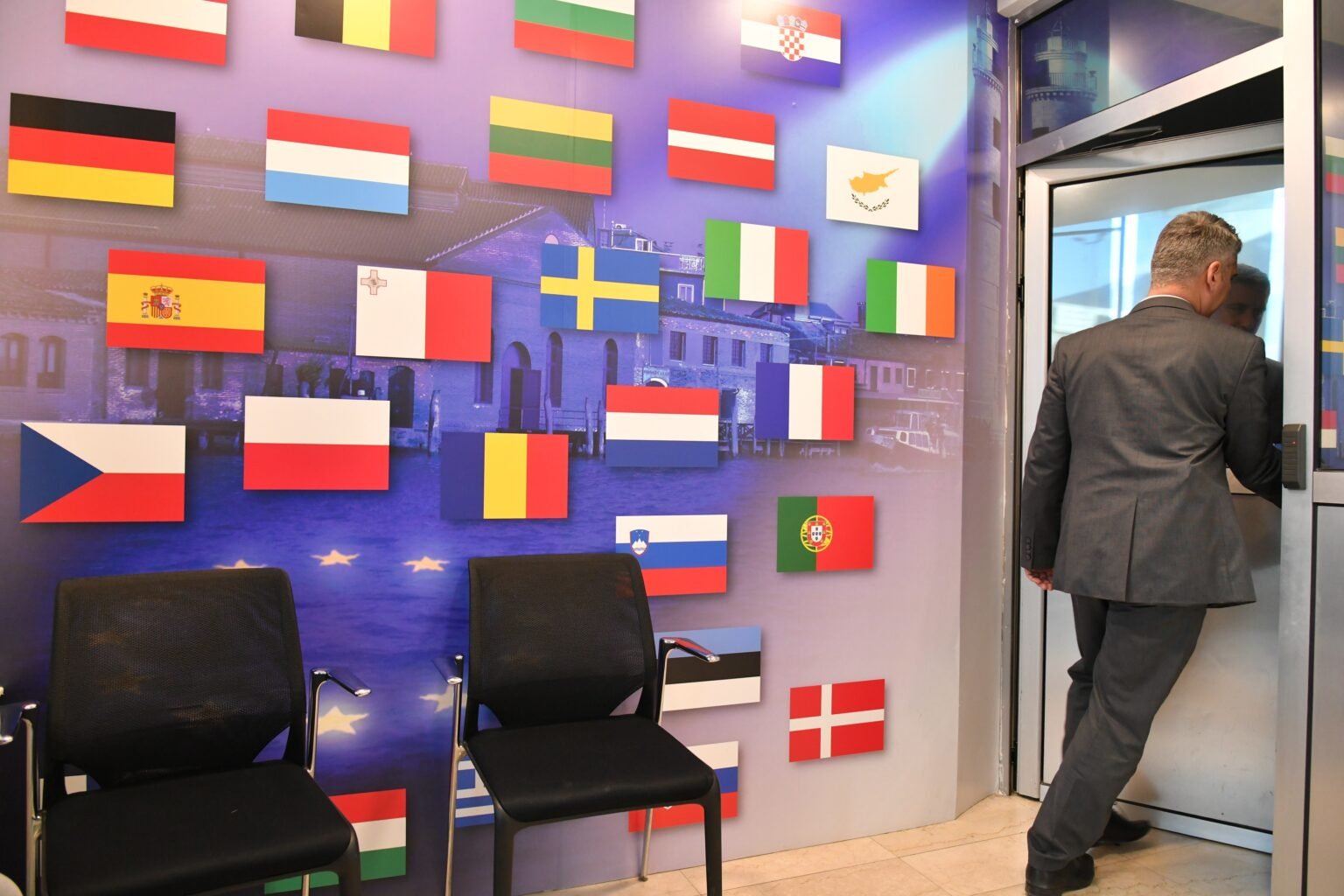
The project of the so-called “phased accession” and Europe in multiple speeds, which for a long time tried to present itself as a dead idea in the Brussels debates, is apparently returning to the big door. The latest joint document prepared by the five influential member states of the European Union – Germany, France, the Netherlands, Belgium and Luxembourg – clearly shows that the Union is preparing to radically change the rules of the game for future members from the Western Balkans.
The document, obtained by the Reuters news agency, provides for the introduction of temporary restrictions on the right to vote for the new members, as well as protective mechanisms with which Brussels could react in the event of a decline in democracy and media freedom in the candidate countries.
Backstage announcements become reality
This revolutionary change in the accession policy is nothing new, and that the idea of an admission package with limited rights is not dead and is the only way to speed up the expansion process and prevent bilateral blockades, “Nova Macedonia” wrote on several occasions. Although several EU officials claimed in the past that the package-admission principle is off the table, sources from Brussels briefed our newspaper that many analytical centers continue to work on modalities for the package-admission of the Western Balkan countries. According to the same briefers, the goal is for Ukraine to enter the European society without causing a revolt among the candidate countries, which are not only far more prepared but have been waiting at the European gates for more than two decades.
– The EU should have a detailed discussion on the possibility of temporary, transitional restrictions on the right to vote for the new member states, especially in parts of the EU legislation where unanimity is required – the document of the European five states explicitly.
This directly applies to key areas such as enlargement, foreign policy and the Union’s budget, where new members would be mere “mute observers” without veto rights for years.
The non-paper from Tivat as a palpation of the pulse
The recent EU-Western Balkans summit in Tivat also showed that the ground was being strategically prepared. There, French President Emmanuel Macron and German Chancellor Friedrich Merz came up with a specific non-paper. Knowledgeable analysts recognized even then that that document was nothing but an initial draft version of this big project, released to the public purely to feel the pulse of the countries of the Western Balkans and to inject some kind of new energy into the long-stalled expansion process.
It is now more than clear that the strategy is entering its second phase: piece by piece, the strict rules for the candidate countries will begin to be released to the public. According to the new plan, future members in the first phase will not have the right to their own European commissioners, will be deprived of the right to vote in making key decisions and will not have their own representatives in the European Parliament.
The pattern of concentric circles as a “membership test”
This is a classic example of the revival of the model of Europe in concentric circles. Instead of classic full membership, the EU plans to finally close the issue of enlargement with the Western Balkans through a kind of “test membership”. In this model, the countries of the region will be included in the internal market and certain funds, but they will be put in a race – who will meet the set criteria faster and more efficiently, so that even after many years it will reach the true, full membership.
In other words, the EU will already officially treat the Western Balkans as its part, it will prevent the penetration of third parties, and at the same time the non-full membership will dampen the revolt of some member states that oppose the introduction of even greater discord and “Trojan horses” into the Union.
Analysts confirm: the EU is protecting itself from new blockades
Political analysts believe that this move is a direct response to Brussels’ fear of institutional paralysis if ten new states with veto rights enter the bloc.
– This document is definitive proof that the EU will no longer accept members with full sovereignty in decision-making. Brussels is scared by the experiences with Hungary and Poland, so a “second league” of membership is being created for the Western Balkans. This is a formula by which the great powers want to tie the region to themselves, eliminate the influence of third parties, and at the same time not spoil their commodity in decision-making. For our countries, this will be a long and painful game in the purgatory of the EU – analysts point out.
However, everyone agrees that this is a positive step because the limited rights within the EU are acceptable for us.
– Our ultimate goal must remain full membership, but at this point even entry with limited rights is a good thing. We will be present in the common European market, we will attend as observers the meetings of the EU bodies, we will be familiar with European policies, we are also becoming part of the common telecommunications space, so we are already integrating into the Union. The issue of the free movement of people in the Schengen zone should be addressed very quickly. When all this starts to work, then the reform process will have to follow these new conditions because the citizens will demand it, and the parties will have to deliver it – analysts point out.
According to them, the new methodology, wrapped in the wafer of “protection of the rule of law”, is essentially an attempt at geopolitical management of the Balkans, where the decision-making baton will remain firmly in the hands of Paris, Berlin and The Hague.
Geopolitical blackmail under the guise of European integration
Albania forced to play the “Bulgarian game” for minorities
- With the well-known “carrot and stick” tactic, Sofia subtly reminds Albania that support for Brussels has a clear price – turning a blind eye to the obvious. assimilation of the Macedonians on its territory
The centuries-old Bulgarian state doctrine of denial and systemic erasure of the Macedonian identity is gaining clearer and more aggressive contours on the international scene. This strategy is no longer aimed directly at Macedonia through the conditions imposed in the negotiation framework and historical protocols, but also extends through neighboring countries in the region. Sofia’s main tool since 2017 has been the artificial assimilation of the indigenous Macedonian minority in Albania, Kosovo and Serbia, in order to institutionally portray those people as Bulgarians.
This kind of engineering on the ground, supported by blackmail, is now used by Sofia as a primary condition and main mechanism for putting pressure on candidate countries for EU membership. Every diplomatic meeting of Bulgarian officials is used to push the issue, sending a clear message to the region that the road to Brussels does not depend on reform, but on embracing Bulgarian nationalist narratives.
It was in this context that the last bilateral meeting took place in Sofia, where the Minister of Foreign Affairs of Bulgaria, Velislava Petrova, met with her Albanian counterpart, Ferit Hoxha, within the framework of the meeting of the cooperation process in Southeast Europe. Although Petrova emphasized that Albania is a friend and reliable partner of Bulgaria in NATO and in the region, the focus of the talks was immediately placed on the issue of the “Bulgarian national minority” in Albania, directly related to the country’s European integration.
The mention of the minority in the same context as the promise of “consistent support for the EU” is not at all accidental. Sofia uses the well-known tactic of “carrot and stick” – offering support, but subtly reminding that Tirana must continue to turn a blind eye to the obvious assimilation of Macedonians in Mala Prespa and Golo Brdo. With this, Sofia sends a clear signal to Tirana that if it tries to dispute this issue, it has prepared the same blocking and veto mechanism that it has already used against Macedonia. On the other hand, Albania, wishing not to fall into the same trap as the country, consciously accepts to play this dangerous game.
Experts on Macedonian-Bulgarian relations, as well as former diplomats, claim that official Sofia will continue the pressure on Albania not to obstruct the Bulgarianization process of the Macedonian minority in this country, subtly conditioning its advancement towards the EU with this very operation.
– What we see today on the Sofia-Tirana route is a classic example of diplomatic extortion, which the EU silently observes. Bulgaria successfully packages its national romanticism as a European criterion. Tirana is put in a position where, in order to advance towards Brussels, it must allow Sofia to create a non-permanent Bulgarian minority on its territory at the expense of erasing the Macedonians who have lived there for centuries. The most tragic thing is that the Albanian authorities, driven by pragmatism for a quick entry into the EU, consciously decide not to react to the Bulgarian pressure on the Macedonian population in Albania through the distribution of passports and humanitarian aid. This is a dangerous precedent, which shows that Bulgaria has no intention of stopping with the veto in Skopje; it builds a geopolitical ring around the Macedonian identity in the entire region. If the EU does not put an end to this kind of instrumentalization of minority issues, the Balkans will enter a new phase of identity engineering under the dictates of the more powerful members of the Union – our interlocutors conclude. ST.