Over the past five years, the prices of outpatient dental services have only increased, and last year was no exception. The Statistical Office of the Slovak Republic recorded an 8.5 percent increase last year. If we look deeper into history, the most dynamic change came in 2023, when they rose by almost a fifth.
According to the data provided by the office to Pravda, it does not look like it will decrease in the future either. Data for the first four months of 2026 show that patients will have to dig deeper into their wallets this year as well. The year-on-year increase was 10.1 percent in April. What is behind the higher amounts we invest in healthy teeth?
The President of the Slovak Chamber of Dentists, Igor Moravčík, defends his colleagues. Behind the more expensive procedures is not the will of dentists, but the growing costs of clinics. The prices of materials, energy, rents, but also wages, service of devices, disinfection and modern technologies are constantly increasing. According to him, another factor is reimbursements from health insurance companies, which for a long time no longer cover the real costs of multiple procedures. The difference is then reflected in the patient’s co-payments.
Prices of outpatient dental services – year-on-year change in %
| month/year | 2026 | 2025 | 2024 | 2023 | 2022 |
|---|
| January | 9.0 | 7.4 | 19.5 | 13.0 | 5.1 |
|---|---|---|---|---|---|
| February | 9.1 | 7.1 | 15.6 | 17.1 | 5.4 |
| March | 9.3 | 7.4 | 13.3 | 18.4 | 6.4 |
| April | 10.1 | 7.1 | 12.3 | 18.9 | 7.4 |
| May | – | 7.5 | 11.1 | 20.2 | 7.7 |
| june | – | 8.2 | 11.3 | 19.4 | 9.1 |
| July | – | 8.1 | 10.9 | 18.3 | 10.0 |
| August | – | 7.9 | 9.6 | 19.7 | 10.4 |
| September | – | 8.6 | 7.6 | 20.6 | 11.1 |
| October | – | 9.0 | 5.5 | 21.5 | 11.2 |
| November | – | 11.6 | 5,6 | 21.4 | 11.5 |
| December | – | 11.5 | 4.7 | 22.1 | 11.9 |
| cumulant 1.-12. | 9.4 | 8.5 | 10.4 | 19.2 | 8,9 |
Source: ŠÚ SR SR
For which performances we pay more
Moravčík perceives the most noticeable increase in prices for services that require time, material, technology and expertise. “This mainly concerns endodontic treatments of root canals, prosthetic work, implantological procedures, aesthetic dentistry and procedures connected with the work of dental technology or digital technologies,” he explained.
With these performances, several factors enter into the pricing, which the person in the chair may not immediately perceive. Whether it is the quality of materials, equipment, sterilization, but also the time of the doctor and his team or the price of the dental technician’s work. “The patient often only sees the final price, but does not see the entire chain of costs behind it,” he pointed out.
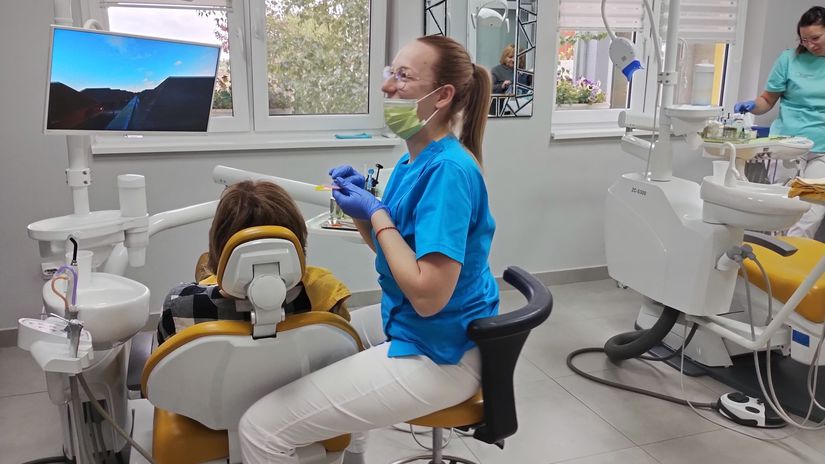 Photo: Henrieta Mihalková
Marina Francisti, dental tourism, Serbia Illustrative photo.
If we look at the specific items that dentists work with, the costs of disposable devices, dental materials, disinfection, sterilization and energy have grown the most. Don’t forget about staff wages either. Moravčík says that the prices of technology, software and the provision of legal obligations of ambulances have also become significantly more expensive.
“Dentistry is an extremely material and technologically demanding field. Every dental clinic must meet strict hygiene and safety rules. This is right, because it is about the patient’s health. At the same time, it must be said openly that these rules have their price,” he clarified.
The increase in costs has affected the whole of Slovakia, it does not only affect wealthier areas. Materials, energy or service of devices do not know the borders of cadastres. According to Moravčík, an ambulance in a smaller town buys material at the same prices as an ambulance in a larger one. However, there are regional differences, namely in the purchasing power of the population, in the costs of wages, rent and in the availability of materials.
“That’s why there may be differences between regions in the final prices, but the basic problem is the whole of Slovakia: the real costs of providing modern dental care are growing faster than public reimbursements,” Moravčík pointed out.
Procrastination never means saving
Sitting in the dentist’s chair is not a matter of course for everyone. The head of the dental chamber perceives that many patients consider their financial options and especially postpone treatments after detection of caries, inflammation, but also when they need a prosthesis.
The president of the Association for the Protection of Patients’ Rights, Mária Lévyová, confirmed to Pravda the concerns of patients about dental bills. “Preventive examination at the dentist is covered by public health insurance, but patients often do not think only about the preventive examination itself. They are afraid of what comes after it, the need to get fillings, dental hygiene, or perhaps a major procedure,” she told Pravda.
The cheapest form of dental care is prevention. “Delayed treatment is almost always more demanding in terms of health and finances. A small caries can be treated more easily than a tooth with a damaged nerve, and inflammation that is not resolved can end in the loss of the tooth,” pointed out Moravčík.
According to Lévyová, skipping the examination is the most dangerous moment from the patient’s point of view. In the case of teeth, postponement almost never means savings, but a more expensive procedure later. “However, another thing must be said. The preventive check-up itself should be available to the patient and paid for from health insurance sources. If patients postpone the preventive check-up due to fear of the prices, it is a signal that the system needs more affordable follow-up treatment,” she pointed out.
Even 50 euros can be an obstacle
Lévyová says that dentistry is the most affected by the fact that the availability of quality healthcare in dentistry has been tied to direct patient payments for years. And that with low reimbursements for services and materials from public health insurance.
“There are low-income households, seniors, single parents, families with several children, people with medical disabilities, chronically ill patients and people in regions where the availability of contracted dentists is worse, because for many it is not worth concluding contracts with insurance companies. For low-income patients, even an amount that seems manageable to a part of the public, whether 50 or 100 euros, can be a real obstacle,” she explained.
Although the patient is formally entitled to dental care within the scope of public insurance, the coverage is relatively low. In practice, therefore, according to her, it is not the case that everyone can easily afford to pay for everything they need at the dentist.
“Dental treatment often cannot be planned like a normal purchase. The pain comes all at once, the procedure must be paid for quickly, the dental emergency is not always the optimal solution, and the patient does not always have time to compare prices or wait. This is where the social dimension of dentistry is shown, teeth are not an aesthetic luxury, but part of health, dignity and the ability to function normally at work, at school and in everyday life,” she explained.
Moravčík says that he understands the financial limits of households. This is precisely why, according to him, it is essential that the system supports prevention and early treatment more. According to him, the stabilization of prices would be helped especially by “real payments” from health insurance, which would correspond to the actual costs of ambulances.
Will dentists be cheaper?
Lévyová thinks that it would not be accurate to describe the dentist as a luxury for everyone. However, for some patients, some interventions are already in the category of “I’m going to postpone it because I don’t have time for it now”. According to her, if prices will rise faster than the ability of households to pay them, the risk of worsening oral health is real. “Especially for people who already live paycheck to paycheck or have multiple health expenses at once,” he thinks.
INESS Institute analyst Martin Vlachynský does not foresee a drop in prices. “The number of dentists has been slowly growing for a long time (from 2,633 in 2009 to 2,966 in 2024), but at the same time, the demand of patients is increasing due to increasing age and increasing demands on the quality of teeth,” he concluded.
He does not consider an increase of 8.5 percent to be anything special. “I don’t know the detailed reasons, but just the general inflation in the economy was at the level of four percent in 2025 and the growth of nominal wages (not doctors, generally all wages) in the economy by 6.3 percent, so I don’t consider the figure of 8.5 percent to be some interesting anomaly,” he clarified.
Moravčík does not expect a drop in prices at dentists. They would only decrease if entry costs fell significantly or if insurance companies contributed more to them. “Dentists cannot provide quality health care at prices that do not cover costs. This would lead to reduced quality, delayed investment, understaffing and, ultimately, poorer access to care for the patient,” he concluded.
It can’t be on benefits
Lévyová sees the dental benefits of insurance companies as a good addition, but they should not be the pillars of the system. A grant for dental hygiene or part of a child’s treatment can help, but it does not replace affordable care covered by insurance.
“Today, the problem is mainly that the benefits vary by health insurance company, have different limits, conditions and often cover only a part of the real costs. The patient may have trouble getting their bearings. In addition, the patient in the healthcare sector should not be dependent on whether the benefit will be introduced, changed or limited in a given year,” she continued.
According to her, however, data from the World Health Organization show that the availability of dental care in Slovakia is not the worst in Europe. Despite this, the price of procedures is the main barrier to access, and dental expenses represent a significant burden for households. “According to the WHO, in 2023, approximately 4.4% of households in Slovakia experienced catastrophic health expenses, and for low-income households, dental care was among the main sources of this burden,” she added.