Streets, cities and maps go beyond their geographical place in the works of the Syrian artist, Khuzayma Al-Ayed, and take on an emotional space, as he re-imagines these places and shapes them according to the documentation of my life, so that memory precedes the idea of the city, and across the intersections of lines, and according to multiple layers, the artist designs cities and streets, introducing into the three-dimensional depth painting some details that give it its privacy, while employing many materials and techniques to break traditional boundaries in the complex compositions that he presents.
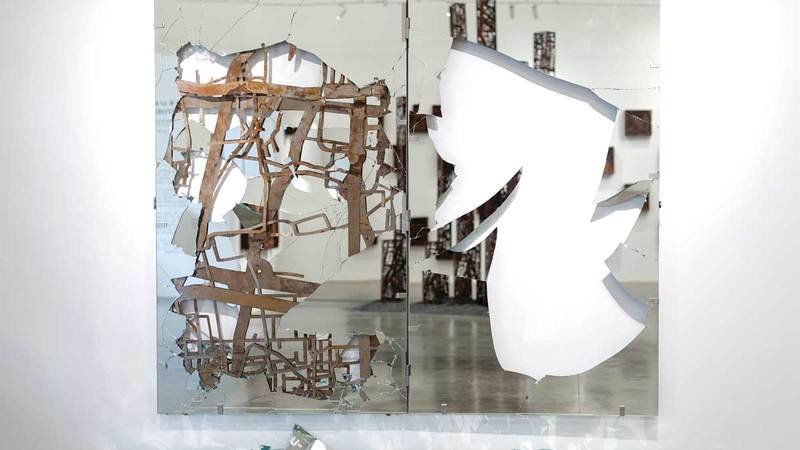
In his exhibition “We Walk on Stories,” hosted by Verity Gallery in Dubai, Al-Ayed presents an interactive work that formed a “trend” on social media platforms and sparked a lot of controversy, as he invoked through his work “You are deeper than you think,” the legacy of the mirror as a conceptual tool in contemporary art, especially the one used by Michelangelo, by presenting an artistic performance in which he breaks the mirror, behind which the lines and streets that he has always worked on are revealed, to pose a deeper question, which is: What happens when the mirror no longer exists? A surface for reflection, but a site for questioning?
A departure from the ordinary
Khuzayma Al-Ayed told Emirates Today about his exhibition in Dubai: “I work on the earth, with all the forms of life it carries, and I have tried to depart from the norm since I started this project, because we are accustomed to the stereotypical image of the basic arts, so I deliberately combined painting and sculpture, until I left traditional painting and replaced it with damaged artificial materials, including iron, wood, fiber, and some of the remains that I find in the streets.”
He added: “I presented the idea of Earth in more than one project, including works that dealt with Syria, as well as those in which I imagined a black hole falling to Earth. In general, they are works that express belonging, because in the Middle East we always feel the need to document our days.”
He pointed out that his origins go back to the occupied Syrian Golan, and he has always been far from the land to which he belongs. He grew up in the Levant, then immigrated to Germany, after which he settled in Dubai. He monitors this state of dispersion and belonging in his works, especially since he sees the land as a memory. The streets represent multiple moments, dreams, and ancient history, while the multiple layers in his works reflect time, starting from the present and going back to the past, as a kind of restructuring of memory.
Regarding the maps in his works, he pointed out that the streets always carry marks preserved by memory, and these marks are the real maps that he deliberately presents, noting the line of Nizar Qabbani: “I walk on the map paper in fear, because on the map we are all strangers,” which touches him very much, especially since he moved a lot, and in every place he goes, he seeks to work on building a new state of belonging to new places and different people, and this takes time and years, and it is what he tries to document through art.
Multiple layers
Al-Ayed’s installation works consist of multiple layers, and these layers and symbols he started with from a question he asked people about the first memory that comes to their mind when mentioning places. The answers were very diverse, and through them he worked to document people’s memories, not just his own. He considered this to be a documentation of the memory of the cities, and within the buildings that are placed in his works, especially since he created a fabric of ancient towers and streets, which were a mixture of the present and the past, and this makes the documentation consistent with people’s memory.
Al-Ayed – who combines different materials – saw that his works are a series in which the materials are varied. He learned how to use iron until he understood the mechanism of working on iron, how its thickness can be, and what is compatible with it, in addition to integrating the cumulative memory, and trying to collect it in this way, while the color of rust was intended to express the effect and the passage of time.
Following in Angelo’s footsteps
Al-Ayed also presented a work that belongs to performance art, through which he embodied the breaking of the mirror in a new conceptual formulation, which caused controversy on social media platforms, explaining that the interactive work is an experience, and that he sought to present it as part of a complete project. He pointed out that he sought to provide quick work and an interactive experience. He pointed out that Michelangelo worked on the subject of mirrors and breaking, and he was very attracted to his works, as Angelo asked the question about how a person can see in the reflection of a mirror, but in return he developed this, and sought to present a vision of what is behind the mirror, considering that what is behind the mirror is the same concept of maps, streets, memory, and some small pieces of the broken mirror, and how we see ourselves in it. He stressed that there was great interaction with the work and he did not expect it, stressing our need in Arab societies to understand art in general, and performance art in particular, about which there is division even in Western countries, as it is new, and in the audience’s vision it may be unclear.
He added: “When the idea is illuminated, it chooses the artistic medium in which it will be presented. Performing art requires explanation, and whoever watches it needs to read what is written about the work to understand it,” calling for more work on shaping the culture around arts, music, and sculpture from a young age.
Two special works
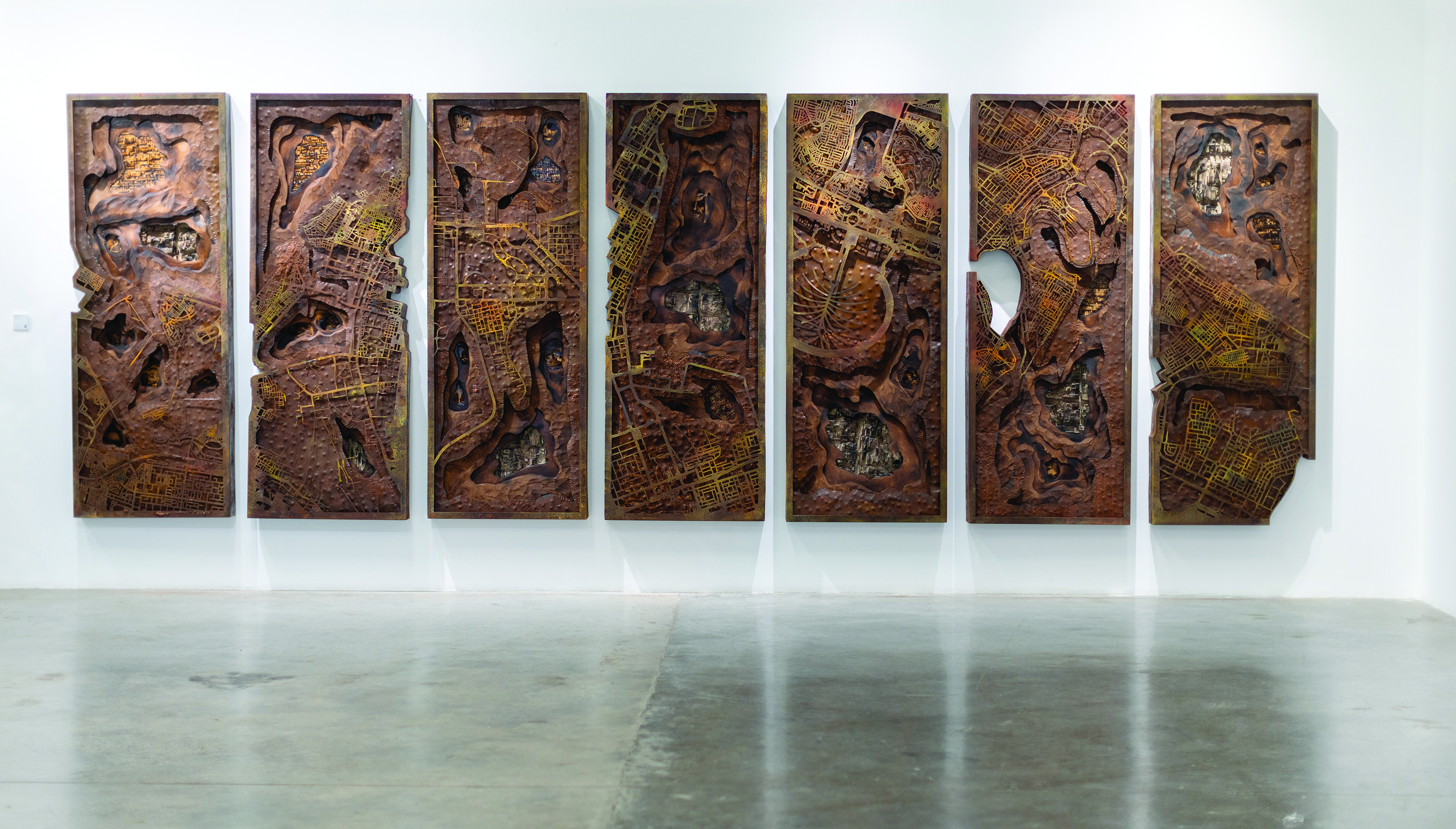
Khozaima Al-Ayed presents two special works in the exhibition, the first of which is paintings depicting the Emirates, and the second monitors the urban face and towers in Dubai. Through the seven paintings, he presented the history of the country, the sea and pearls, the woman who weaves with a hook, children running, wooden doors, building drawings, and many other details, noting that the painting of the towers is one of the works that most expresses Dubai, as it symbolizes the city and the state of continuous rise it is experiencing.
Khuzayma Al-Eid:
• I moved a lot, and everywhere I went, I sought to work on building a new state of belonging.
• They abandoned traditional painting and replaced it with damaged synthetic materials, including iron.