Should Cork’s Patrick Collins have won man of the match?
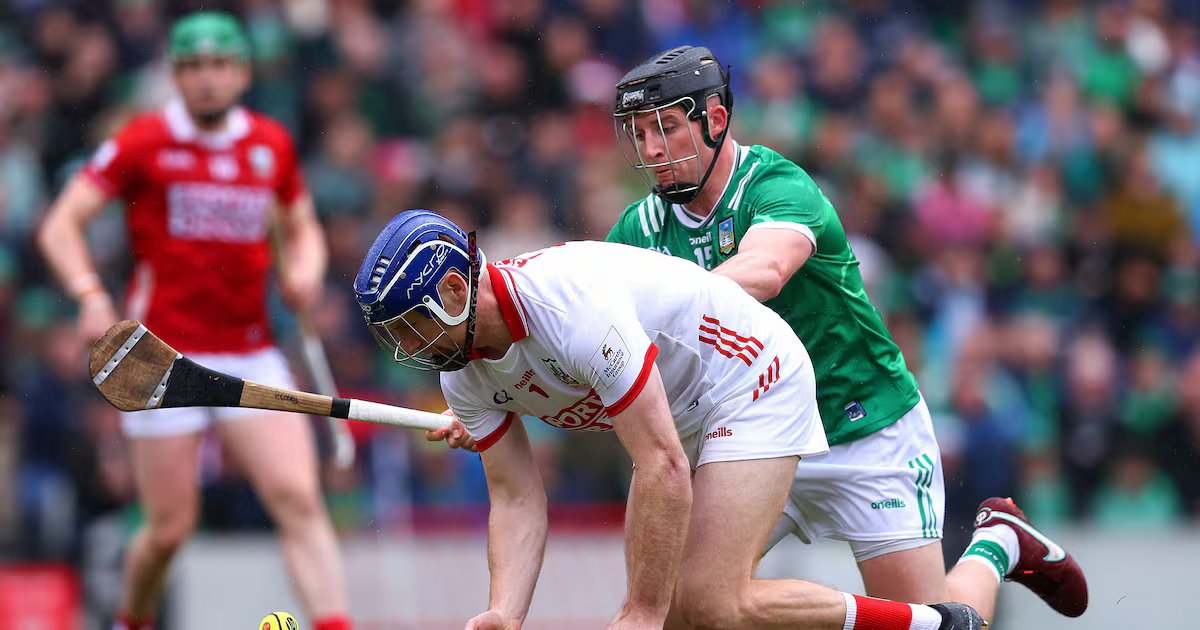
On a day when conditions were a handicap for everyone, it was probably only right that RTÉ’s Munster final man of the match award went to a goalkeeper. Says you, with Brendan Cummins on co-commentary and Donal Óg Cusack in the studio, the rest of them would have done well to even get mentioned. Question is, did the right goalie get it in the end?
Quaid’s save from Diarmuid Healy in the first half was astonishing. The velocity of the strike, the fact that Quaid’s view of it was obscured until the very last split second by the frame of Diarmaid Byrnes in front of him, the wind and rain coming into his face – all of them combined to make saving it impossible, yet he managed it anyway.
But in the final analysis, Patrick Collins made more saves than Quaid on the day. They were maybe not as eye-catching but they had to be made and they kept Cork in the game. Limerick had five goal chances, Collins saved four of them. Cork had also had five, of which Quaid saved two and Brian Hayes flashed one over the bar.
True, Limerick’s puckout retention was higher across the day – they retained 75 per cent of Quaid’s restarts as opposed to 58 per cent of Collins’s for Cork. But it’s also true that Collins had to do it far more often than Quaid – he pucked the ball out 31 times, compared to Quaid’s 18. It’s only natural that his retention rate would be lower.
Sometimes man of the match goes to the winning team and sometimes it goes to the player with the big reputation. Quaid is an all-timer and we’re blessed to be living in his era. But Collins can count himself unlucky yesterday. Malachy Clerkin
Hurling’s black card rule still providing some difficulties

No one is saying the black card in hurling isn’t a good idea, if only to act as a basic deterrent to any player intentionally fouling to deny a goalscoring opportunity (the rules say nothing about a ‘clear’ goalscoring opportunity). But twice during Saturday’s Leinster hurling final between Galway and Dublin it became a talking point for the wrong reasons.
Afterwards, Galway manager Micheál Donoghue didn’t make a big deal about the first black card for Conor Whelan, which came in the 56th minute, when Galway were up 1-23 to 1-14. Eoghan O’Donnell was charging towards the 20-metre line when Whelan pulled him down, but there were several other Galway bodies in front of O’Donnell. There was nothing whatsoever clear about the goalscoring opportunity.
Still, Tipperary referee Michael Kennedy consulted with his umpires and awarded the penalty (questionable) and issued the black card to Whelan (similarly questionable). Dónal Burke converted the penalty, meaning Dublin were back to six points, and Galway were down to 14 men.
Moments later, Kennedy awarded a yellow card to Dublin’s Conor McHugh, who had just committed a clearly recklessly high tackle on Joshua Ryan. Donoghue could certainly have made a big deal about that, had the game been in any way closer.
Then in the 64th minute, Kennedy called another penalty and black card, after Conor Cooney was dragged down by Andrew Dunphy, and with that the Dublin player spent the rest of the game in the sin bin. Again, the goalscoring opportunity was somewhat questionable. Aaron Niland converted the penalty, but the problem here was Cooney had pulled back Eoghan O’Donnell in the build-up, and no foul was called.
Galway’s 4-29 to 4-15 victory meant none of these decisions had any telling impact on the result, Donoghue did point to the first incident nonetheless: “It’s a big punishment for the crime when maybe where there are bodies back … thankfully, it hadn’t too much of a detrimental effect on us.”
Now, imagine if any of those calls had been made in the Munster hurling final between Limerick and Cork. Ian O’Riordan
Galway’s overhaul pays dividends with Leinster title

Just 12 months ago Galway trudged off the Croke Park pitch after suffering an eight-point defeat to Kilkenny in the Leinster final. Only five of that team started Saturday’s provincial decider victory over Dublin at the same venue – Daithí Burke, Padraic Mannion, Conor Whelan, Tom Monaghan and Cathal Mannion.
Overhauling two thirds of your team is quite the makeover in such a short space of time but Micheál Donoghue’s belief in the emerging talent reaped its rewards at Croke Park over the weekend. Darragh Neary hit 1-1, Aaron Niland was superb from placed balls while Cillian Trayers and Cian Daniels all made significant contributions to the 14-point victory over Dublin.
The more experienced players also made telling plays – not least the leadership of Cathal Mannion throughout, Burke’s man-marking job on John Hetherton and the scoring returns of Monaghan (0-7) and Whelan (0-5).
“My view on that is that in some performances we were getting criticised but in our world we were still in transition and there’s a lot of young fellas there and they’re learning their trade,” said Donoghue afterwards when asked about Galway’s inconsistent league form.
“In Galway when you have a few decent performances the expectation levels go through the roof and then if you have mediocre performances it’s the end of the world.
“For us in the group we kept that balance and just trying to be getting better every single day. I’m not saying it’s the finished article by any stretch, we still have a lot of work to do but there’s some really good talented young fellas there and they have a great opportunity now over the next few years to push on.” Gordon Manning
Settled Limerick have a clear focus on winning
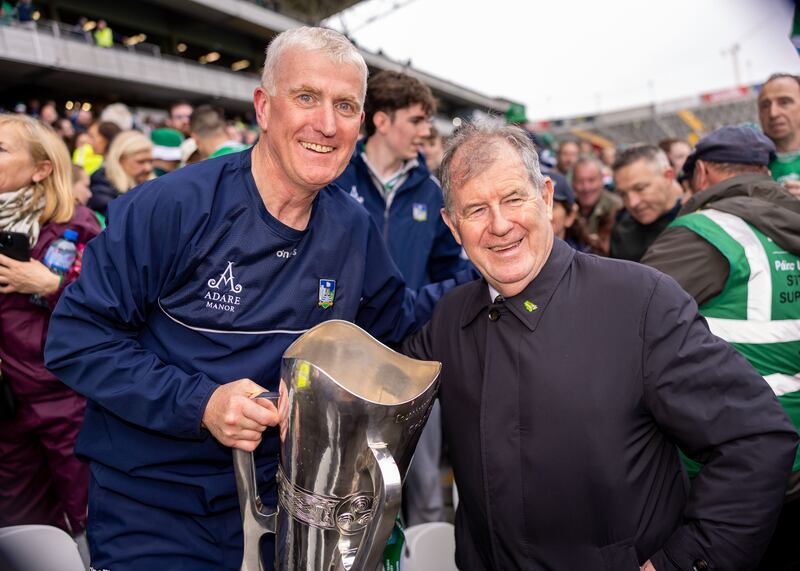
The perception with Limerick over the years was that very little changed. In their All-Ireland winning pomp, they were very clear about their best 18 or 19 players and their starting 15s were consistently permed from that group.
John Kiely’s greatest achievement over the last 10 years has been to change the skin of the team without impacting its bone structure or muscle mass. Of the 18 players who saw action in Páirc Uí Chaoimh on Sunday, 13 of them played a part in the first Munster final that Limerick won under Kiely in 2019.
And yet it didn’t feel like the same team. Seven years later, how could it be? Nickie Quaid, Seán Finn, Diarmaid Byrnes, Cian Lynch, Gearóid Hegarty and Aaron Gillane were the only players to have started in the same positions in 2019 and yesterday.
Less than a handful of players, though, have started all seven winning finals: Quaid, Byrnes, Kyle Hayes and Hegarty. For Aidan O’Connor it was his first Munster medal as a starter and for Shane O’Brien it was just his second.
Limerick, though, are still picking their championship 15s from an elite crew, it’s just that the cast has changed. In the Munster championship they used only 19 different starters and just 23 players overall, which as Denis Hurley pointed out in the Evening Echo, was the lowest number of any Munster team. Four of those players saw less than 15 minutes of game time.
It was clear during the National League that Limerick were more interested in winning than finding new talent. They used just 29 players in that competition compared to 39 last year, a staggering fall off in rotation.
Their clear purpose this year was to win everything. Limerick have the players who know how that’s done. Denis Walsh
Winning Leinster a positive omen for Galway’s Liam MacCarthy chances

Galway’s fourth Leinster title was won at a canter on Saturday evening. It’s now 17 years since the county was switched into the provincial championship and a strike rate of over 20 per cent has been quite encouraging especially as in the early years, it overlapped with peak Kilkenny, who over the same period have made off with two thirds of the titles on offer.
In fact, Saturday was only the fourth time this century that the Leinster final didn’t feature Kilkenny and out of the 23 contested, they won 20.
Providing competition was one plank of the platform on which Galway were transplanted across the country. The other was to provide a better model for the county to succeed.
It was an interesting move. Back in 1959, Galway was switched to Munster for similar developmental reasons in preference to the brief arrangement that saw the county given a bye to the 1955 and 1958 All-Ireland finals.
That earlier relocation was not a success and over the 11 years until 1969 when it was abandoned, the county won just one match, against Clare in 1961.
The current arrangement brings further encouragement in Galway’s subsequent record after winning Leinster. The county has won all three All-Ireland semi-finals in those years, 2012, 2017 and 2018 and landed the MacCarthy Cup in the middle year.
No wonder that manager Micheál Donoghue, who has now been in charge for three of those O’Keeffe Cup victories, said on Saturday that winning Leinster was a primary target for the team this year.
As is his wont, he was not getting carried away.
“In Galway when you have a few decent performances the expectation levels go through the roof and then if you have mediocre performances it’s the end of the world. For us in the group we kept that balance and just trying to be getting better every single day.”
For opponents Dublin, with one title this century in 2013, it was the familiar routine of two steps forward, one step back, as manager Niall Ó Ceallacháin acknowledged.
“It’s a killer to be honest, it’s an absolute killer. We are well aware that we in Dublin have to take this step – have to take this step and haven’t there today.” Seán Moran