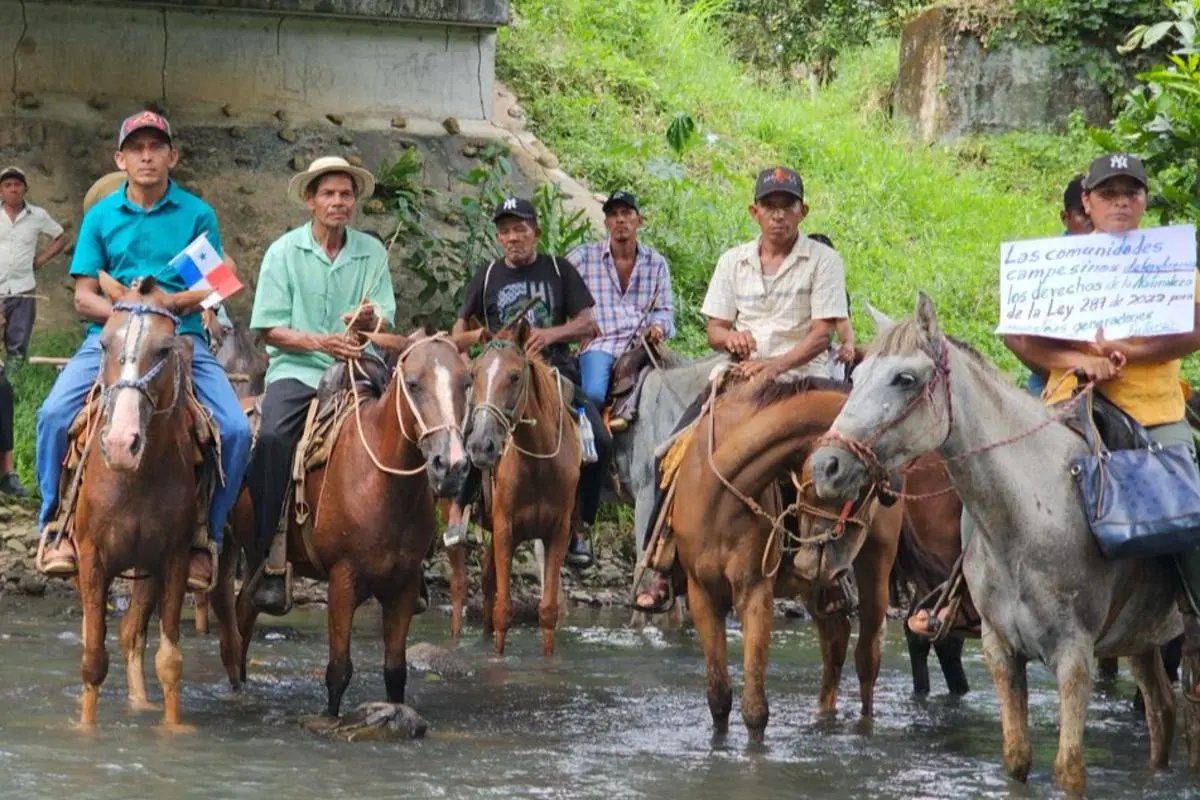
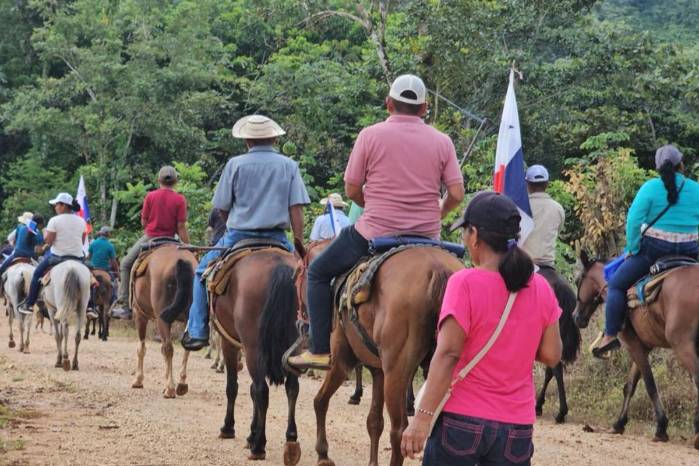
Hundreds of farmers marched this weekend on foot and on horseback through the communities of Los Uveros, La Mina, San Cristóbal and Tres Hermanas, all under the threat of disappearing flooded by the Río Indio reservoir project, promoted by the Panama Canal Authority (ACP).
The mobilization concluded at the Tres Hermanas bridge, over the river of the same name, where the participants rejected the recent statements by President José Raúl Mulino before the United Nations General Assembly and made complaints against the Ministry of Public Security and the ACP.
The statement questions the deputies for approving ACP projects without listening to the farmers
During the closing ceremony, the Peasant Coordinator for Life against Reservoirs read a statement in which it directly questioned the Executive, the ACP, the Minister of Security, Frank Ábrego, and the National Assembly of Deputies.
In the document, the farmers reproach President Mulino for having described them as “extortionists” at the UN, which they consider a sign of “incapacity, disrespect and deafness” towards those who defend sovereignty, nature and democracy in Panama.
The Coordinator denounced that the ACP acts with “opacity, lies and deception” to hide the threat that the Río Indio reservoir represents for the communities and the country.
He also accused Minister Ábrego of allowing the illegal infiltration of undercover agents into peasant meetings and homes, calling this practice an “intolerable abuse of power.”
The statement questions the deputies for approving ACP projects without listening to the farmers or the Panamanian people, which they consider an “open betrayal” of the electorate.
The Coordinator asked citizens and the international community to audit the supposed 70% approval of the project in the affected territories, a figure that they reject because they consider that their communities have historically been abandoned and ignored by the Canal.
Due to the flooding of the reservoir area, some 2,500 people (around 500 families) from local communities will have to be gradually relocated.
To ensure fair treatment, the ACP implements the Water of the Future strategy, carrying out population and infrastructure censuses along with extensive citizen consultation processes and the creation of participatory platforms.
ACP reports indicate that close to 80% of census residents are satisfied with the conditions set out in the Resettlement Plan, which includes improvements in housing, allocation of suitable land and support in economic activities.
The Río Indio Lake project is the most important strategic work of the ACP to confront the climate crisis and ensure the sustainability of the interoceanic waterway for the next 50 years. Following severe droughts, the project has been established as an absolute national priority under the administration of Ilya Espino de Marotta.
What does the project consist of?
The Reservoir: Will create a new artificial lake of approximately 4,600 hectares, which is equivalent to about 8% of the total surface area of the Río Indio basin (58,000 hectares).
Gravity Transfer: Being a basin contiguous to Gatun Lake, the water will be transferred very simply through a tunnel or connection by gravity, which means that it will not require pumping or consumption of electrical energy. It will be enough to open a valve to supply the Canal’s water system