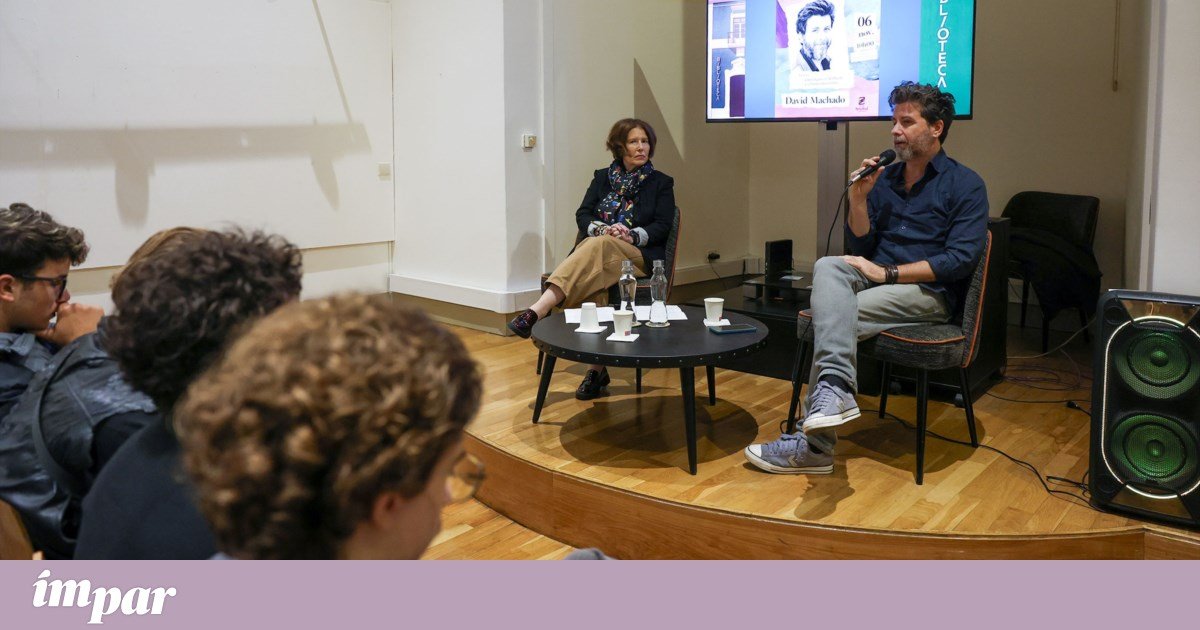
Invited to debate Artificial intelligence and the future of writing, David Machadoin front of around 60 students from Professional School of Setúbal and some non-school audiences, explained how they use AI in their work and daily lives and alerted young people to the necessary precautions when using it.
For him, “artificial intelligence (AI) robs us of purpose and process”.
Starting by remembering that “human beings are useless in the universe” and that they “work well without us”, the writer of books for all audiences — children, young people and adults — argued that, therefore, “there is an instinct to give meaning to our lives”. His is writing. If you use AI to replace it, it loses its “purpose” for existence.
David Machado says he likes “difficult things” and does not want the help of AI to shorten the path to his literary creation. “When I’m writing, the end result ‘book’ is not important. The process is what interests me.”
If you “press a button” that causes the AI to write instead of you, you lose the pleasure of the journey, “the process”. Like when you “make a puzzle”, he compared, to add, “sometimes it is easy, sometimes it is difficult, but being difficult is not bad”.
However, he continues to make paid use of artificial intelligence and admire it: “It’s an incredible thing. I use it as a tool to solve more pragmatic issues and to ask for help when it comes to more factual topics.” It is capable of taking advice from AI to “fix a lamp”, he exemplified. “But sometimes YouTube does the trick too.”
DR/Literary Festival of Azeitão and Setúbal
THE author of books like Average Happiness Index, A Real Story or The Girl Who Spoke to the Mountain warned the audience to always review the content that AI provides with critical thinking, as “it makes a lot of mistakes and invents”.
Write less, read more
Remembered the National Reading Plan Conference 2025, in which Daniel Cassany, professor and researcher in Barcelona, specialist in AI, said, at the Calouste Gulbenkian Foundation, in Lisbon: “Artificial intelligence may lead us to write less, but it forces us to read much more.”
Also Lígia Águas, head of Library Service from Setúbal City Council, who shared the stage with David Machado, on Friday, told how he uses AI to make slides from your own text for public presentations, but revises, cuts, adds and adapts them until the final version. He told the students that this is also a legal practice for them to use AI in their work and studies.
Some questions about copyright were problematized, but remained unanswered because the Portuguese legal framework predates the popularization of generative AI and there were no people present who claimed to have legal knowledge.
One of the young people wanted to know if the AI was asked to create a song based on an existing one, who would be “to blame” for the theft of rights. “The person who made the order or the AI, who executed it?”
Azeitão and Setúbal paid tribute to Lobo Antunes
THE Azeitão and Setúbal Literary Festival took place from the 4th to the 7th of November, in the first edition dedicated to the writer António Lobo Antunes.
Under the theme “Literature, memory and future”, names such as Ana Margarida de Carvalho, Marisa Mourinha, Rui Cardoso Martins, Manuel Seatra (Literature that lives and clicks), Pedro Chagas Freitas (Why do we continue reading?), Pedro Lamares (Poetry is a weapon loaded with the future), The City Poet (Pedro Freitas, Poetic dialects) and Rita Redshoes (In conversation with…), between others.
DR/Literary Festival of Azeitão and Setúbal
Over four days, there were more than 30 initiatives in ten spaces in the municipality between Setúbal and Azeitão, with book launches, theater, workshops, debates on libraries and reading mediation, with the participation of the school community, a book fair and also cinema (War Lettersdirected by Ivo Ferreira based on letters by António Lobo Antunes; Albert Camus, A Tragedy of Happinessdocumentary by Joël Calmettes).
The exhibition Poetic Cartography of the Citybuilt from the Literary and Photographic Creation Laboratory sessions, curated by Vitorino Coragem, opened in Setúbal during the festival, can be seen at Casa da Cultura — Espaço João Paulo Cotrim until November 29th.