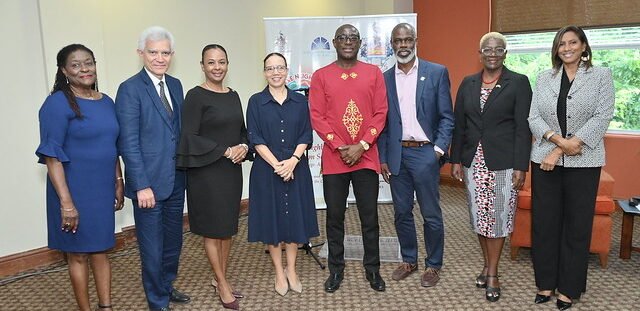

A recent forum hosted by The University of the West Indies (The UWI) explored the growing crisis in Cuba, with regional experts warning that the country’s challenges are not only reshaping its future but also testing Caribbean unity and the wider international order.
According to a UWI press release, the June 25 Vice-Chancellor’s Forum, titled “Perspectives on the Current Cuban Crisis: Issues, Impact, and Imperatives,” brought together diplomats, academics and policy experts to discuss Cuba’s economic situation, ongoing reforms, and the implications for the Caribbean.
The virtual event was chaired by Ambassador Gillian Bristol, Director of The UWI’s Latin American-Caribbean Centre (LACC), and co-moderated by Professor Canute S. Thompson and Professor Don D. Marshall.
Opening the discussion, Cuba’s Ambassador to Jamaica, Her Excellency Tania López Larroque, argued that the country’s current difficulties cannot be separated from more than six decades of United States economic, commercial and financial sanctions, which she said were intensified earlier this year. She rejected claims that the sanctions benefit the Cuban people, saying they instead restrict access to food, fuel, medicine and investment. The ambassador also called for stronger multilateral cooperation and respect for national sovereignty.

Delivering remarks on behalf of Vice-Chancellor Professor Sir Hilary Beckles, Professor Thompson said the University remains committed to confronting major regional and global issues. “We are not passive observers; we are activists,” he emphasised.
International relations expert Professor Andy Knight of the University of Alberta described the current global landscape as an “interregnum” in which international norms are increasingly being challenged. He cautioned that weakening the principles of sovereignty and non-intervention in Cuba could have wider consequences for small nations.
“If the principles of sovereignty and non-intervention are compromised… no small state can presume it will remain protected,” he said.
Providing a perspective from within Cuba, Dr. Miriam Nicado, Rector of the University of Havana, described the country’s situation as “a strangling.” She highlighted the impact of electricity shortages on higher education, particularly online learning, while pointing to the UWI-Havana Centre for Sustainable Development as an example of productive regional collaboration.
The UWI said that Professor Emerita Jessica Byron-Reid reflected on more than 50 years of cooperation between CARICOM and Cuba, noting the country’s longstanding contributions to regional education and healthcare. She said the Caribbean’s debt to Cuba could never truly be repaid and suggested the current situation offers an opportunity for the region to return that support.
Meanwhile, Dr. Indira Rampersad of The UWI St. Augustine examined Cuba’s package of 176 economic reforms, describing them as an effort to introduce greater market-oriented policies while maintaining the country’s socialist political system. She compared the approach to development models adopted by China and Vietnam.
Professor Bert Hoffmann of the German Institute for Global and Area Studies (GIGA) described the reforms as the most far-reaching Cuba has attempted. However, he said meaningful recovery would remain difficult without improved access to international banking systems and relief from sanctions, which continue to discourage foreign investment.
During the discussion, Professor Byron-Reid encouraged CARICOM to focus on maintaining the Caribbean as a zone of peace, protecting Caribbean nationals living in Cuba, providing humanitarian assistance and supporting the country’s economic recovery. Professor Knight also urged regional leaders to speak with greater clarity and confidence, arguing that the way the Caribbean responds to Cuba will shape the region’s future.
The release shared that the forum concluded with a call for greater regional engagement rather than indifference. In support of that message, The UWI announced its One-UWI Humanitarian Effort, led by the School of Graduate Studies and Research, which is encouraging staff, students, alumni and partners across its five campuses to contribute financially toward essential supplies for the Cuban people through September 30. Donations can be made through the initiative’s online fundraising platform, according to the University.