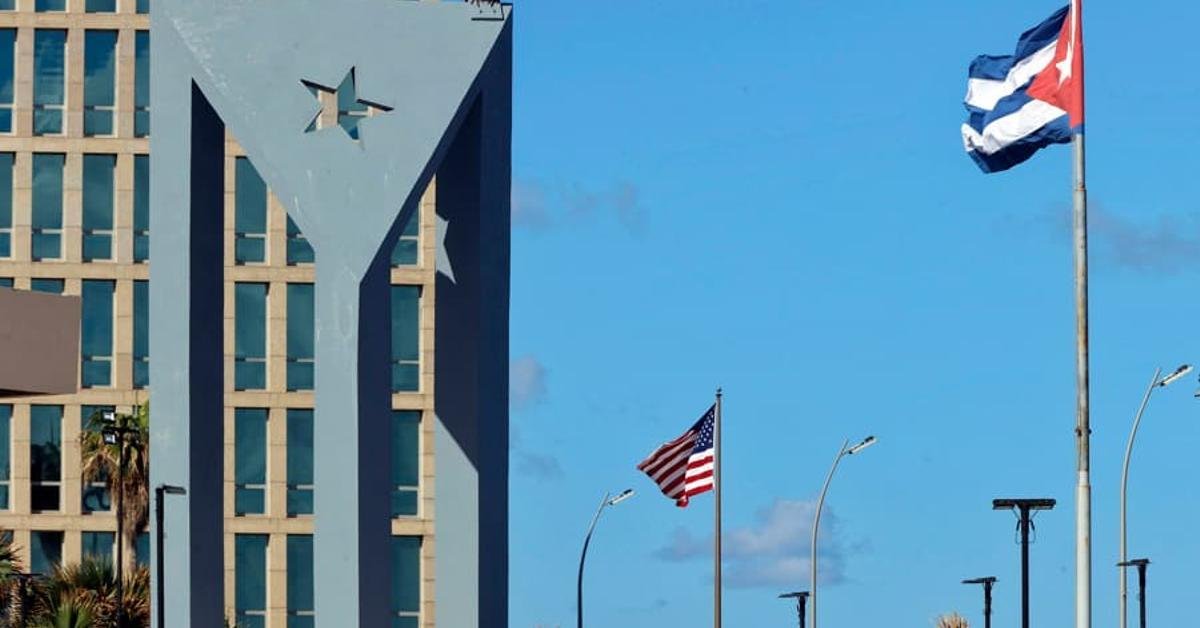
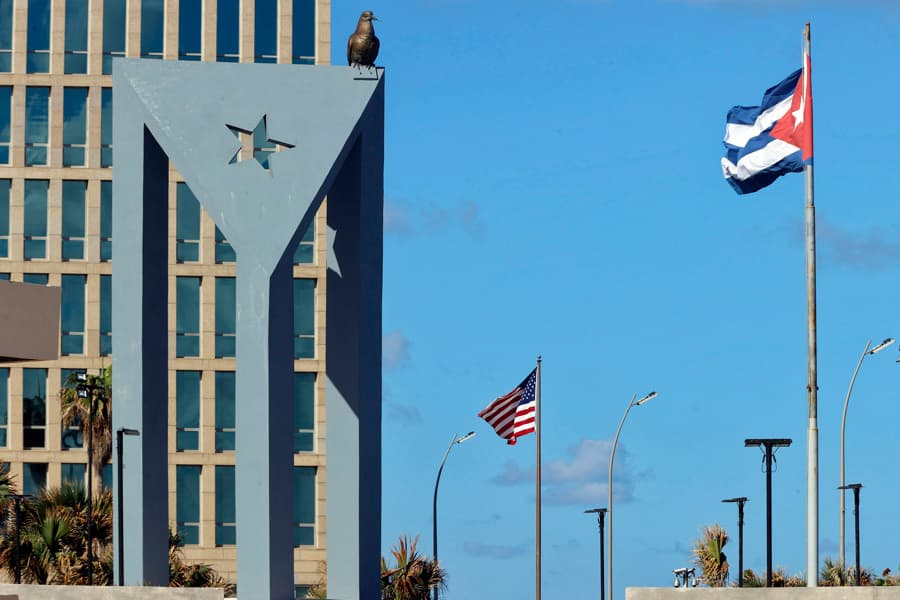
Madrid/The Pentagon has slightly cooled the speculation arising from the publication of USA Today according to which the organization “is discreetly intensifying its military plans for a possible operation in Cuba in case President Donald Trump gives the order to intervene.”
“We will not speculate on hypothetical scenarios. The Department plans various contingency scenarios and remains prepared to execute the president’s orders as indicated,” he responded to questions from the agency Russian Ria Novosti. The statement is more cautious than the one offered USA Today when he requested clarifications about that alleged plan revealed by two sources to the media, although there was an addition.
The Pentagon added that there is a chain of command that keeps it “isolated” from the president, a phrase that has been interpreted as a call to separate political statements from technical and operational decisions. Although the final decision rests with President Donald Trump, the department ultimately confirms that all options are on the table.
“Right now, it’s more of a communication strategy”
The idea is basically the same as that presented in the note USA Today Brian Fonseca, director of the Jack D. Gordon Institute of Public Policy at Florida International University, interviewed for the occasion as an expert on the Cuban Army. Fonseca opined, requested by the media, that talking about preparing military plans could only be a threat: “At this moment, it is more of a communication strategy.”
The specialist highlighted something already known: that the material resources of the Cuban Army are very limited and its human resources are not very motivated. However, he believes that the consequences of the intervention would not be very promising. “This would be a very easy military victory, but a much more difficult political victory,” he says. In his opinion, “recovering the rule of law and supporting opposition leaders would be a much more complex task.”
The note of USA Today It does not reveal anything new, since since the United States intervened in Venezuela on January 3, 2026 to capture Nicolás Maduro, it is contemplated that the technique will be repeated in Cuba, due to Trump’s own constant statements. However, the diplomatic route remains on the table and talks between the State Department and Raúl Castro’s grandson, Raúl Guillermo Rodríguez Castro, known as The Crabrevealed by the American press, are taken for granted.
What is not known is whether or not they will prosper, since in recent weeks Miguel Díaz-Canel himself, who in mid-March confirmed talks with the US Government, has fueled military rhetoric. In two interviews with American media, the Cuban president has insisted that he is not going to resign – one of the most widely discussed options, to make way for a successor more to Washington’s liking, such as Óscar Pérez-Oliva himself, current deputy prime minister and member of the Castro family – and that the regime will resist until, if necessary, death.
This Wednesday, Beijing and Moscow once again provided their verbal support to Havana, although materially it is unthinkable that the material would go from solar panels and oil to the military.
Chinese Foreign Ministry spokesperson Guo Jiakun said at a press conference that Beijing “firmly opposes” Washington’s coercive practices and reiterated that China “will firmly support Cuba in safeguarding its national sovereignty and opposing external interference,” a message that is repeated almost identically daily.
This Wednesday, Beijing and Moscow once again provided their verbal support to Havana, although materially it is unthinkable that the material would go from solar panels and oil to the military.
As for Moscow, Kremlin spokesman Dimitri Peskov said in an interview with the media India Today that Russia “would not want any country to invade Cuba.” “Cuba is an exceptional partner of Russia, our good friend. And we would not like to see any country invading Cuba, or putting pressure on Cuba, or isolating it from abroad, preventing medicines from reaching Cuban children,” he said.
“Children in hospitals die without electricity or medicine. This is not right,” he insisted. The spokesperson, however, downplayed Trump’s statements about Cuba and considered that the president “is extremely open with the press and very detailed in his explanations.”
Foreign Minister Sergei Lavrov also maintained this line, asked about the same situation. “I am not going to be a fortune teller because many times we have heard statements from Washington, and many of these later did not take the form of practical actions,” he said.
The Foreign Minister recalled that Russia has ratified on numerous occasions its “firm support for the sovereignty and independence of Cuban friends, who are willing to defend their freedom to the end, with all the resources at their disposal.”
“Russia and China provide Cuba with political support, in the United Nations and other economic and humanitarian forums, and I have no doubt that we will continue to provide that support,” he added, without mentioning at any time the possibility that the aid could go further, a possibility ruled out after its lack of military cooperation with Venezuela and Iran.
Lavrov also said he hopes that “the United States will not return to the times of direct colonial wars or of subjugating free peoples.”