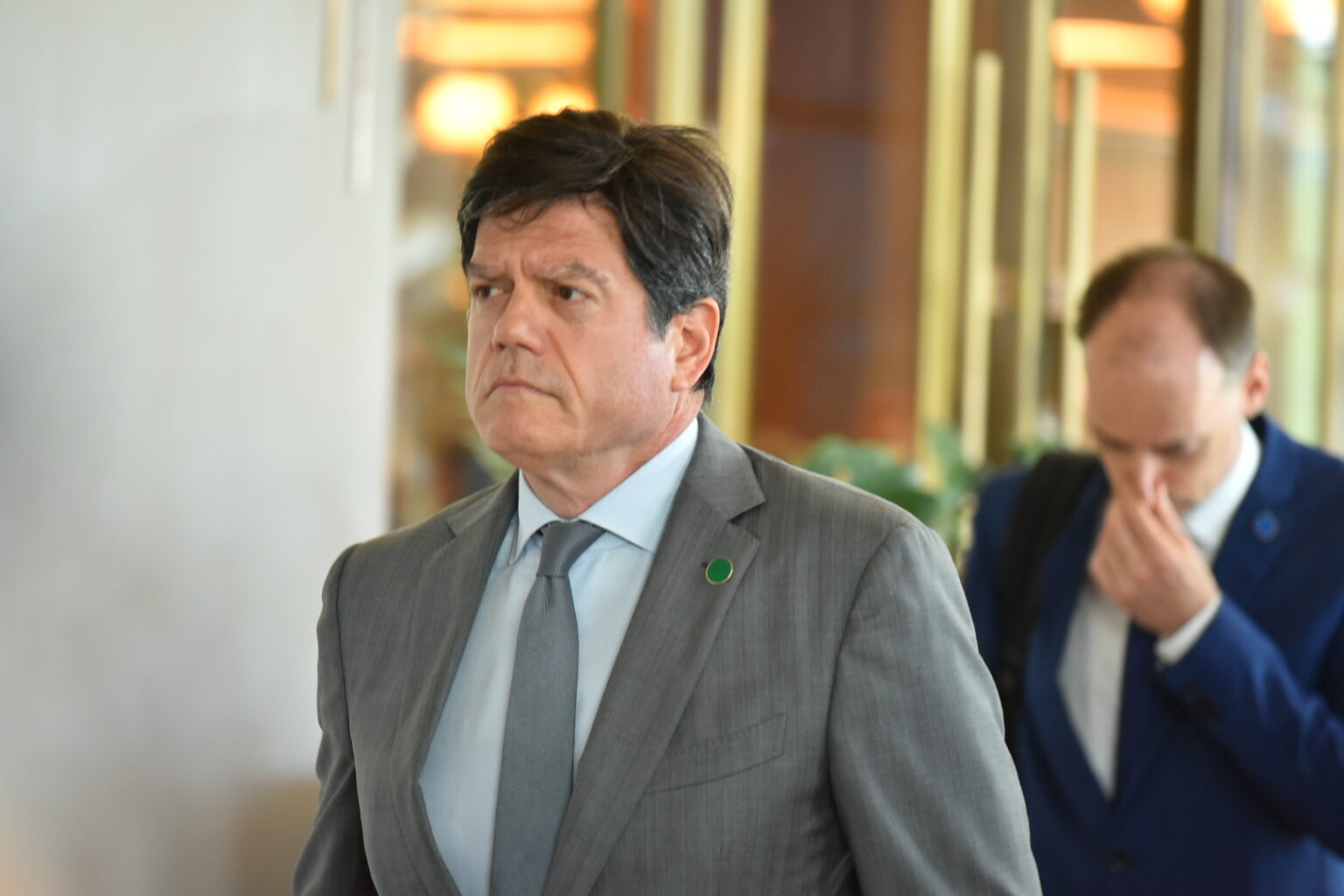
Valuable political message and call of European ambassador Rokas for “stopping the disunity of the political spectrum”!
- Greater pragmatism, determination and unification of the political spectrum are needed. With this sentence, Michalis Rokas practically delivered the most accurate diagnosis of the situation in our country, as well as “political therapy” for growth and development. Few would dare to dispute that the country lacks just that: a minimum of political cohesion on key state issues.
- But exactly where Roxas’s message sounds the strongest, it fundamentally fails. Because if “unification” again means the same thing it has meant in the past two decades – with an external force to group and harmonize the political spectrum in the country around pre-defined and imposed ultimate obligations, then it is not a vision, but an already seen model. In the message sent by Roxas, the right intention is recognizable, but unfortunately, in its well-packaged form, the content and substance are deeply problematic for us…
Right at the beginning of this editorial observation, it would not be politically fair, if we did not express words of praise for the ambassador of the European Union, Michalis Rokas, who emphasized that “greater pragmatism, determination and unification of the political spectrum are needed”, addressing the conference organized on the occasion of the 30th anniversary of the establishment of diplomatic relations between Macedonia and the EU and the 25th anniversary of the Stabilization and Association Agreement. The form of his message is impeccable. Even encouraging. Who would be against unification for the future?
– But there really remains one big but, because exactly where Roxas’s message sounds the strongest, it essentially fails. Because if “unification” again means the same thing as it has meant in the past two decades, which is that “with force from the outside to group the political spectrum around pre-defined and imposed ultimate obligations”, then it is not a vision, but an already seen model – the drunk interlocutors, professors and analysts who actively participate in the editorial debates and extended collegiums begin their explanation.
– The EU will not allow black holes to exist on the European continent – Roxas said.
But from our discussions and analyses, the question that remains open is – should Macedonia be integrated as a stable and clearly defined unitary state, or as a constantly changing construction and amorphous mass that adapts and remodels on the move, on the way to the EU?
Because if unification comes down to the political elites re-aligning around something that the citizens don’t feel is their consensus, then the problem is not the lack of unity, but its content covered in Roxas’ message! And right there, Roxas’ call that at first glance sounds like statesmanship, risks turning into another well-packaged, but essentially (substantially) missed message.
When the “call for unity” comes with “footnotes”
Michalis Rokas’ call for political unification in our country seems at first glance like a banal truth. That “without consensus there is no progress”. But the problem is that in Macedonian conditions, such calls rarely come “clean”, say our interlocutors, intellectuals and university professors.
– What does it mean that such calls rarely come “clean”? This means that they mostly carry an invisible agenda. Not uniting around a vision, but around already defined obligations! And this is where the irony begins. Unity is required, but not to establish a national position, but to accept someone else’s pace and framework – warn our colleagues.
They refer to another noticeable phenomenon in Macedonian politics, in making major decisions without social consensus.
– If there is something in which the Macedonian political elites really unite, it is the ability to make major decisions without a real social consensus… The Ohrid Framework Agreement, the Prespa Agreement, the Good Neighbor Agreement with Bulgaria… each of these was followed by the same argument: this is necessary for the future. But the future is constantly being postponed, and the state is constantly being rewritten – the interlocutors point out.
Macedonia needs political unification, but not as an automatic response to external expectations
Roxas’ call hits the form but misses the point.
– Yes, Macedonia has a problem with political disunity. But an even bigger problem is that when it unites, it often does so without a clearly defined national platform. Unification without principles is not a display of strength. It is an empty form that is easily filled with other people’s content – say the interlocutors.
They add that Macedonia needs political unification, but not as an automatic response to external expectations!
– Unification is needed around clearly defined state positions, then around principles that will not be opened during every new crisis and around the idea that the European path must not mean constant institutional uncertainty! Otherwise, every next call for a “last step” will sound the same as the previous ones – like something we’ve already heard, accepted and… we’re starting again from the beginning – the interlocutors claim.
What kind of unification do we need?
The real question is not whether we need unification, but what should unification be? If by unification Roxas and Europe mean quick alignment without broad citizen consent, if by that they mean party discipline instead of institutional dialogue or they mean consensus created under pressure, then it is not unification, but temporary political coordination.
And it is precisely such “unifications” that brought the state to the point where every new decision looks like a new beginning, instead of a logical continuation. In such a context, Roxas should be more precise and explain clearly, not about the form of unification as a necessity, but about the content and essence of unification. This is the only way to recognize whether his messages to the public are well-intentioned and visionary, or they are a function of another unprincipled pressure on the country that would be “already seen” (deja vi) and “already experienced” (deja veku). PR
_______________________________________________________________________
The Constitution as a “variable category”?!
In stable democracies, the constitution is the foundation. It rarely changes and is carefully built. In Macedonia, it increasingly resembles a variable document, rather than a monolithic document.
That is why the debate on new constitutional amendments cannot be reduced to a technical issue. That is why the interlocutors ask the question, does the state want to have continuity or is it living in constant transition?
– Political, frequent and deep constitutional interventions create a perception of instability and openness to fundamental issues. And in politics, perception often has as much power as the norm – claim our interlocutors. PR
The European agenda and the domestic reality
The European Union remains the most important strategic partner – economic, political and security. That is not in dispute. But something else is disputed. Should European integration be conducted as a process of internal strengthening or as a series of conditional adjustments? When reforms are perceived as externally imposed, they lose legitimacy, regardless of their essence, our interlocutors concluded. PR