April 13, 2026 – 01:00
The 2025 balance sheet of Ueno Bank—an entity linked to former associates of President Santiago Peña—reveals that its greatest profits do not come from the financial business, but from areas outside of traditional banking activity. While it raised state funds for G. 4.7 billion in just over two years, its accounting notes detail that its fundamental profitability comes from the concepts of “rents” and “projects.”
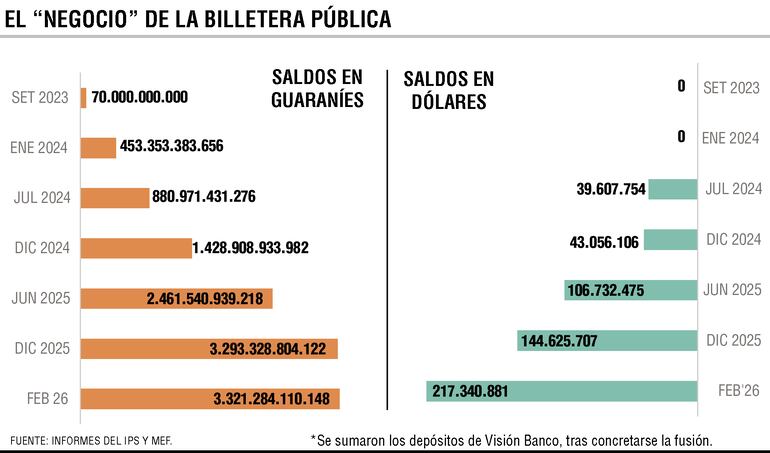
Coinciding with the beginning of the mandate of Santiago Pena, Ueno Bank experienced a dizzying rise to become one of the main custodians of the “public wallet.” According to official records, the entity went from managing zero state resources in August 2023 – when it was still operating as a financial institution – to concentrating some G. 4.7 billion (distributed into G. 3.3 billion and US$ 217 million) at the end of February of this year.
Read more: Public funds in ueno skyrocketed 4,600% in 28 months of Peña’s administration
However, the entity’s 2025 balance sheet—belonging to the Vázquez Group SAEchaired by Federico Miguel Vazquez— reveals a distortion in the origin of its profitability: its main profits do not come from the banking business (the collection of interest on loans and others), but from “miscellaneous earnings”where the items of “rentals” and “projects””.
The documents published at the end of March detail that the bank—almost directly linked to the president Santiago Pena until April of last year through the Vázquez Group company and the company’s representative Ueno Holding Saeca— obtained a net profit of G. 313,857 million. However, the genuine financial profit (the net result of own banking activity before forecasts) was only G. 243,693 millionwhich represents a drop of 24% compared to the G. 318,624 million registered in fiscal year 2024. This is a striking decrease considering the significant growth in the collection of public funds.
The technical anomaly arises when contrasting this result with the so-called “other miscellaneous gains”, which added G. 497,944 million. In comparative terms, the profits from these activities non-traditional banking entities are a 104% higher than the profit generated by the traditional core financial business of a bank.
Opacity in key areas
The breakdown of these “miscellaneous earnings” exposes figures that defy the logic of the conventional banking market. Among the seven concepts that make up this category, only two registered explosive growth close to 100% in just 12 months.
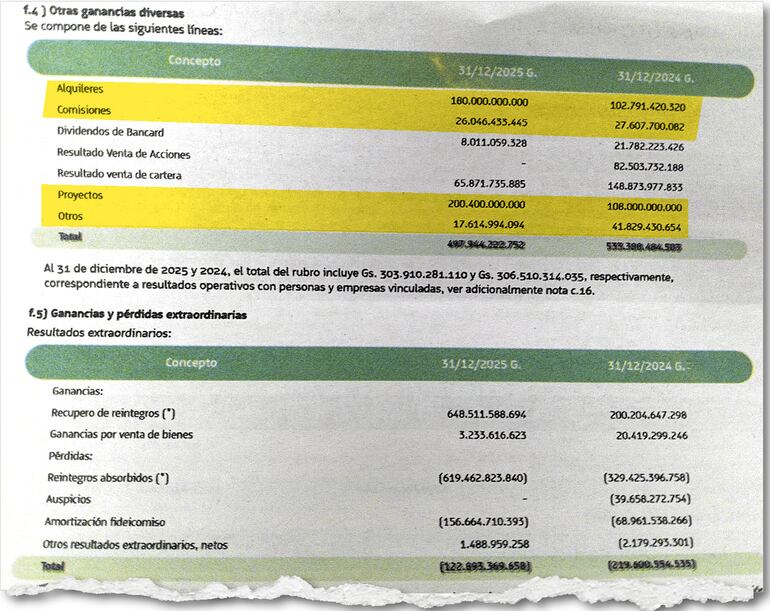
According to the accounting notes, rental income – without precise and clear detail about this concept – grew G. 77,208 million in one year: G. 102,791 million in 2024 they jumped to G. 180,000 million in 2025. For its part, the “projects” item—without specifically knowing what it refers to—recorded an increase of G. 92.4 billiongoing from G. 108,000 million to G. 200,400 million.
Read more: “Bancada ueno Honor Colorado” shields former business partners of Santi Peña
Despite the magnitude of these figures, which together add up G. 380,400 million, The bank does not detail in its balance sheet the nature of said rentals or the specificity of the projects. This lack of transparency is critical, considering that the entity has come to lead the management of public resources while its solvency seems to depend less and less of its capacity as a bank and more of items that escape traditional analysis of the Paraguayan financial system.
ABC tried to obtain Federico Miguel Vázquez’s version, but he did not respond to messages sent to his cell phone.
Under the magnifying glass of Congress
This financial structure had previously set off alarms. An analysis of official reports from the Central Bank of Paraguay (BCP) showed that, as of June of last year, the financial margin of Ueno Bank (net profit from money intermediation) It was barely 15%, positioning itself as the lowest in the entire national banking system.
Read more: IPS’s favorite bank has the lowest financial margin in the entire system
Given the speed with which the entity accumulated public deposits despite these indicators, last December the Chamber of Deputies sent a request for reports to the BCP to know its technical position on the data it collected. suspicions about the sustainability of the bank linked to Peña’s former partners.