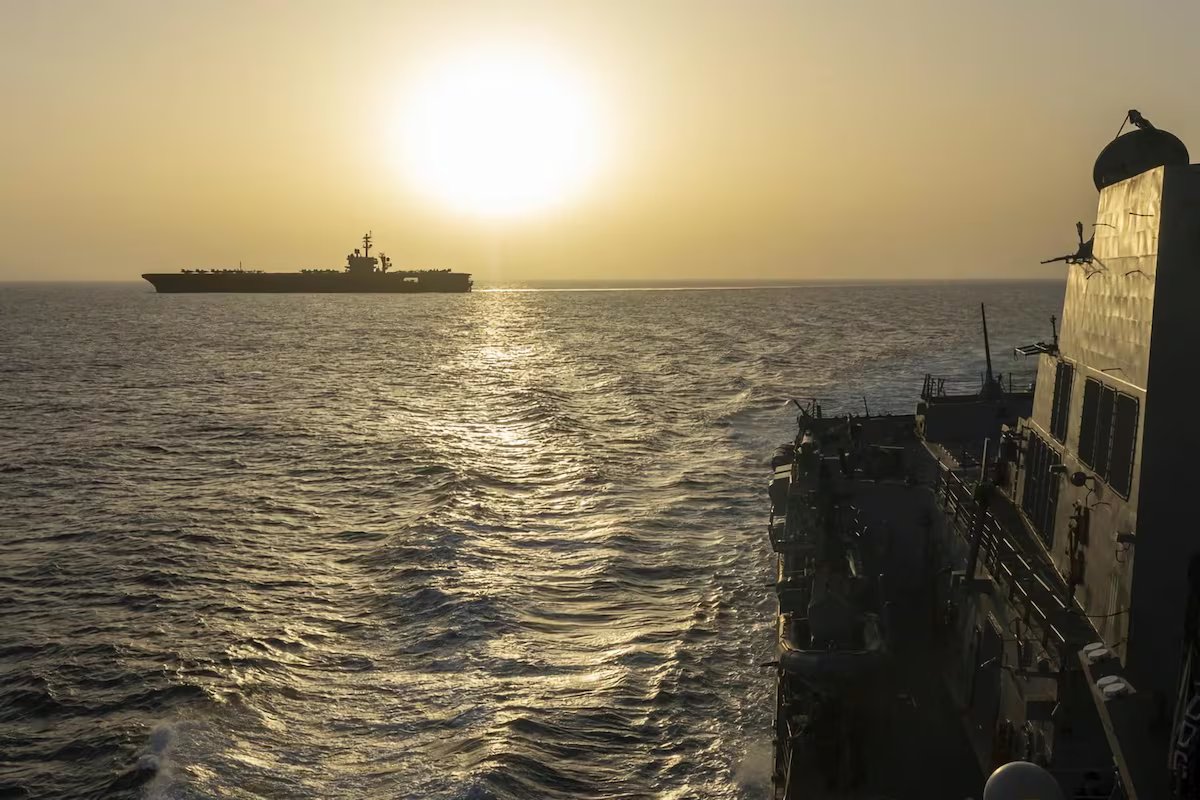
The US Navy’s blockade of the Iranian coast remains in force until both countries reach an agreement to end the conflict, initiated by the United States and Israel on February 28.
The president of the United States, Donald Trump, assured this Friday, April 17, that Iran has agreed to never again close the Strait of Hormuz, the strategic route for crude oil and goods at the center of the tensions of the war against Tehran, while celebrating that this is a “great day for the world.”
But while the president assures that Iran promised not to close the Strait of Hormuz again – a route through which nearly a third of the world’s oil circulates – the Iranian government confirmed the reopening of the passage after the start of a truce linked to Lebanon, but made it clear that the measure is not definitive: transit will remain free only as long as the ceasefire lasts and as long as the United States does not intensify its naval pressure in the area.
Foreign Minister Abás Araqchí’s statement thus introduces a crucial nuance to Washington’s triumphalist tone.
The head of Iranian diplomacy clarified that the transit must be carried out along the previously announced route that passes through the island of Larak.
Araqchí, however, did not explain whether he was referring to the ceasefire agreed with the United States and which ends this Wednesday or the one closed yesterday between Lebanon and Israel and which will last for 10 days after negotiations mediated by Washington.
The end of hostilities in Lebanon was one of the 10 Iranian conditions of the ceasefire reached by Iran and the United States on the 8th, but Israel continued to attack Lebanese territory despite this, in bombings in which more than 2,200 people have died, according to Lebanese authorities.
Trump, for his part, said that “Iran has agreed to never close the Strait of Hormuz again. It will no longer be used as a weapon against the world!” Trump wrote on his Truth Social network.
According to the American, this is “a great and bright day for the world.”
Trump had already celebrated on the social network the Iranian Government’s announcement about the complete reopening of the maritime passage, although he warned that the US Navy’s blockade of the Iranian coast remains in force until both countries reach an agreement to end the conflict, initiated by the United States and Israel on February 28.
The Republican leader predicted that “this process should be very fast, since most of the points have already been negotiated.”
The president ordered a naval blockade on ships entering or leaving Iranian ports after the failure of last weekend’s talks in Islamabad, where negotiations are expected to resume soon, with the mediation of Pakistan.
Iran announced this Friday that the Strait of Hormuz, through which 20% of the world’s oil passes, will remain “fully open” until the end of the ceasefire with the United States next Wednesday, as a result of the beginning of the truce in Lebanon announced on Thursday.
The open route, according to Tehran, consists of an entry route and an exit route: the first will go from the Sea of Oman to the north, to the island of Larak, and from there to the Persian Gulf, while the second will follow the reverse route.
The interruption of passage through the strait in retaliation by Iran for the American and Israeli attacks has caused uncertainty in the markets, skyrocketed the price of crude oil and affected the world economy, while contributing to the destabilization of the Middle East.