Trip to the Moon; the solar eclipse, “terrestrial sunset” and other photos from the Artemis II mission
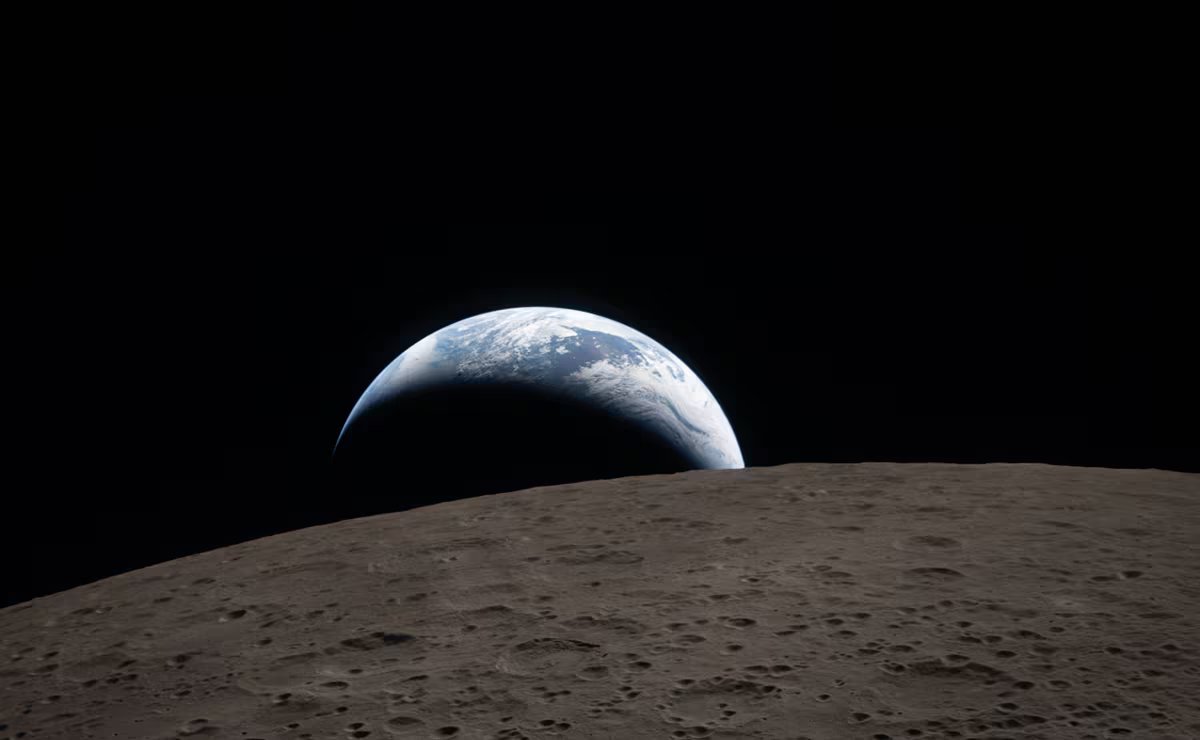
From the far side of the Moon, the Artemis II mission captured a historic “terrestrial sunset”: the Earth is hidden behind the lunar horizon in an unprecedented image that evokes the iconic record of Apollo 8.
The photographs, taken during the flyby, document a solar eclipse seen from space, with the Moon completely covering the Sun, and reveal deep details of craters, basins and the far side surface.
Earth sunset captured through the window of the Orion spacecraft at 6:41 pm EDT, April 6, 2026, during the lunar flyby of the Artemis II crew. A faint blue Earth with bright white clouds hides behind the cratered lunar surface. The dark part of the Earth is experiencing night. On the dayside, swirling clouds are observed over the Australia and Oceania region. In the foreground, Ohm Crater features terraced rims and a flat bottom interrupted by central peaks. These spikes form in complex craters when the lunar surface, liquefied by the impact, splashes upward during crater formation.
Earth sets at 6:41 pm EDT, April 6, 2026, over the curved edge of the Moon in this image captured by the Artemis II crew during their orbit around the far side. The Orientale basin is located at the edge of the visible lunar surface. The Hertzsprung basin appears as two subtle concentric rings, interrupted by Vavilov, a younger crater superimposed on the older structure. The rift lines are chains of secondary craters formed by material ejected from the massive impact that created Orientale. The dark side of the Earth is at night, while the illuminated side sees swirling clouds over Australia and Oceania.
Captured by the crew of Artemis II during its lunar flyby on April 6, 2026, this image shows the Moon completely eclipsing the Sun. From the crew’s perspective, the Moon appears large enough to completely block the Sun, creating nearly 54 minutes of totality and extending the view far beyond what is possible from Earth. The solar corona forms a bright halo around the dark disk of the Moon, revealing details of the Sun’s outer atmosphere that normally remain hidden by its brightness. Stars are also visible, which are usually too faint to be observed when photographing the Moon, but which become evident when it is in the dark. This unique vantage point offers both a striking image and a valuable opportunity for astronauts to document and describe the corona during humanity’s return to deep space. The faint glow of the Moon’s near side is also visible, illuminated by light reflected from Earth.
The Moon, seen here backlit by the Sun during a solar eclipse on April 6, 2026, is photographed by one of the cameras on the wings of the Orion spacecraft’s solar panels. Orion is visible in the foreground on the left. The Earth reflects sunlight off the Moon’s left edge, making it slightly brighter than the rest of the disk. The bright spot just below the lower right edge of the Moon is Saturn. Beyond, the bright spot on the far right of the image is Mars.
The Earth appears tiny as the Moon looms large in this image taken by the Artemis II crew during its flyby on April 6, 2026. Taken 36 minutes before Earth’s sunset, our planet is visible in the blackness of space, next to the edge of the illuminated Moon. The Earth is in a crescent phase, with sunlight arriving from the right. The Orientale Sea basin, with its dark solidified lava floor and mountainous outer rings, covers almost the lower third of the imaged lunar surface. The different colors in the lunar sea suggest its mineral composition. The lines of small indentations above Orientale are chains of secondary craters formed by material ejected during a violent impact. Both new craters that the Artemis II crew has proposed naming—Integrity and Carroll—are clearly visible. The edge of the visible surface of the Moon is called the “lunar limb.” Seen from a distance, it looks almost like a circular arc, except when backlit, as in other images captured by the crew.
A close view taken by the Artemis II crew of the Vavilov crater, located on the edge of the oldest and most extensive Hertzsprung basin. The right side of the image shows the transition from smooth material within an inner ring of mountains to more rugged terrain around the edge. Vavilov and other craters, along with their ejecta, are highlighted by long shadows on the terminator, the boundary between day and night on the Moon. The image was captured with a portable camera with a focal length of 400 mm, while the crew flew over the lunar far side.
Edition: Daniela Elim Simón
Photos: NASA