Government negotiations longest in Danish history, sirens to be tested at noon and man-made chemicals and PFAS widespread in Danish soil samples. Here’s Denmark’s news on Wednesday.
Government negotiations now longest in Danish history
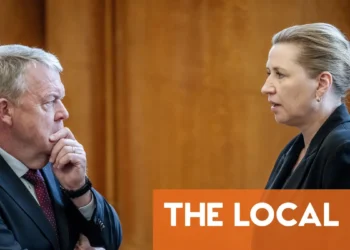
Negotiations to form Denmark’s new government have now been going on for 43 days, one day longer than the 42-day record set after the 2022 election.
Social Democrat leader Mette Frederiksen, who was also leading negotiations in 2022, announced a new government 42 days after the election on November 1st, which took office two days later, 44 days after the election had taken place.
On Monday and Tuesday this week the Moderate Party visited Frederiksen for negotiations at the Prime Minister’s official residence, Marienborg. Frederiksen is also negotiating with the parties in the left-wing ‘red bloc’, with the aim of forming a government made up of the Social Democrats, Green Left, Moderates and the Social Liberals, with the support of the Alternative and the Red-Green Alliance.
The Moderates left negotiations on Tuesday after more than seven hours of negotiations. Moderate leader Lars Løkke Rasmussen has made no comments to press on his way in or out of recent negotiations.
Danish vocabulary: to beat the record ‒ to break the record
Unicef calls for a ban on gambling in children’s games
A new study by child rights organization Unicef has shown that gambling via so-called loot boxes is widespread among Danish children, with more than half of the 1,785 children answering the organization’s survey answering that they had used real-life money to buy them.
Loot boxes promise a small chance for players to win rare items, although the chance of this actually happening is low.
Now, Unicef are calling for a ban on purchasing loot boxes for under-18s.
“We see clearly that loot boxes and other functions which encourage addiction have become a large part of children’s digital lives,” Unicef Denmark’s secretary-general Susanne Dahl said in a statement. “There’s a need for clear rules which put children’s rights and well-being first.”
Around a third of those answering the same study reported bad experiences on the social media Discord, which is often used when gaming with friends.
This includes unpleasant messages, unwanted contact, violent images or scam attempts.
Danish vocabulary: it is gambling for money prohibited ‒ playing for money (gambling) is banned
Denmark set to test emergency sirens at noon
Denmark’s emergency siren system will be tested at noon today ‒ it’s always tested on the first Wednesday in May.
A test of a digital warning system, first introduced in 2023, will also take place. The digital system allows authorities to send siren sounds and warning messages to smartphones.
Anyone with a smartphone connected to the Danish network can expect to receive the test siren and message on their devices on May 6th at noon.
Around 50 sirens across the country are out of service, public broadcaster DR reportsand will not go off today, according to the Danish Emergency Management Agency, The National Emergency Management Agency.
There are around 1,000 sirens in Denmark, which are most often used to warn residents in the area of emergency situations such as fires, poisonous smoke or chemical spills.
The first siren will go off between 12:00 and 12:04, with four signals, rising quickly in pitch before falling slowly, sounding for a combined 45 seconds.
At 12:08 a second signal will go off to signal that danger is over. This is one constant signal lasting 45 seconds.
Danish vocabulary: to warn ‒ two warnings
Soil samples from all over Denmark contain man-made chemicals
More than 30,000 schoolchildren from all over Denmark collected soil samples last year which were sent off for analysis to national science center Astra.
The experiment, which was given the name Mass Experiment, took place in September last year. Samples were taken from areas close to towns and cities and sent to researchers from Aarhus University, Aalborg University and DTU.
Lene Christensen, project lead for the study, said that work was carried out systematically to avoid mistakes.
“Schoolchildren do not work in labs and are not trained researchers, but our experience proves that these students are good,” Christensen said. “You can see that clearly in the quality of the data.”
The samples, which were taken from 97 of Denmark’s 98 municipalities, all included man-made chemicals. Læsø municipality, the smallest municipality in the country, was the only one where samples were not collected.
All samples included industrial chemicals and other chemicals, while 80 percent of samples included so-called ‘forever chemicals’, PFAS.
Mogens Humlekrog Greve, lead researcher in the study, called it a “wake up call”.
“I think it’s definitely a wake up call to have it confirmed that the situation is just as bad, or even worse, than we feared.”
Danish vocabulary: man-made chemicals ‒ man-made chemicals