It’s hard to imagine a Danish lunch without ‘pålæg’ and rye bread. But what is toppings exactly, and why does it get a whole supermarket section to itself?
What is toppings?
Toppings is a concept as synonymous with Scandinavian snacks as the open-topped sandwich because, well, it is part of that sandwich. Hence pious on, ‘on’ and the verb to lay ‘to lay something (on something)’, toppings is the food you put on top of your slice of bread.
A topping, if you will.
Unlike in countries like for example the UK or Italy, where a sandwich or a tramezzino consist of at least two slices of bread with a filling, a Danish food (literally ‘food’ but the equivalent of a snack or sandwich) is usually an open slice of bread with some sort of toppings. If two slices of bread are used, you will hear the term clapping, meaning ‘fold together meal’.
Many Danes eat at least one food a day as a snack (snack – literally “between meal”).
This could be a slice of cheese on rye bread (cheese food) or the sliced processed pork known as sausage roll (‘rolled sausage’), sausage, a type of salami that comes in many variations, or even, if you’re feeling adventurous, some hummus or cottage cheese.
How do I prepare and eat it?
With about half the work of a normal sandwich, but twice the risk of making a mess.
As a general rule, toppings is something cold placed on a piece of bread or toast, normally rye bread, which you should then be able to lift up and eat with your hands – so scrambled eggs are not considered toppings and beans on toast (the British staple) is generally considered an affront to culinary decency.
Cold, sliced boiled eggs are, however, toppingsas are prawns. Danish style sandwich stand out from the types seen in other Nordic countries because they are so piled high with toppings that eating them with cutlery is acceptable.
A note of caution here, though: there’s a complicated and arcane system for the order in which various toppings should be placed in different types of sandwichand some things are not compatible with others ‒ for example, curry dressing is okay with herring but definitely not with roast beef (I believe this is the case and am happy to be corrected on this specific example!).
Having an unconventional combination could be frowned upon, but you’ll be safe with a more simple one food which only has one or maybe two types of toppings on it.
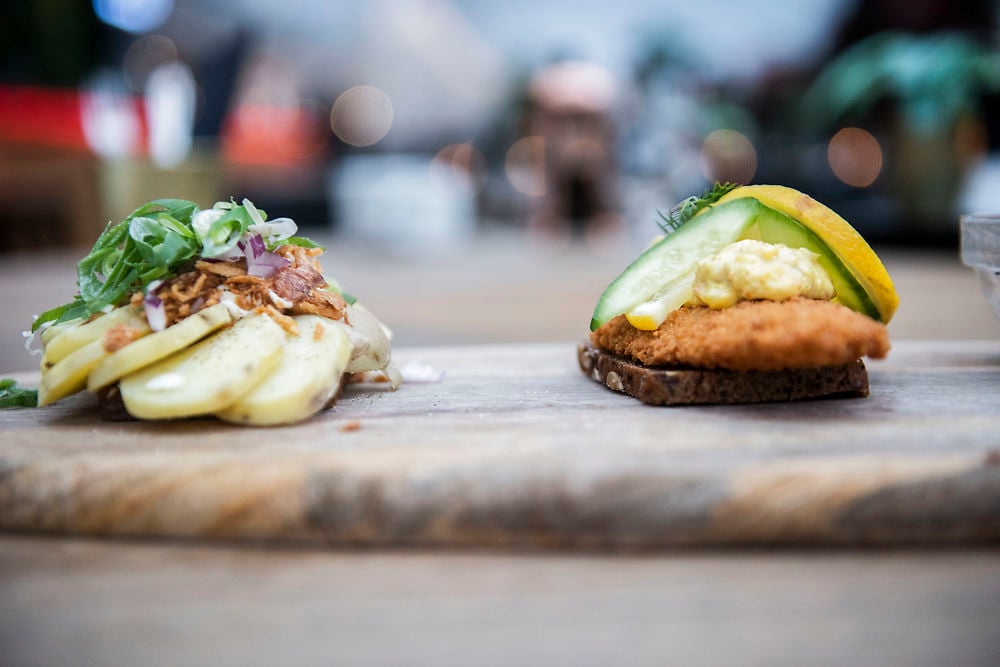
Carefully constructed sandwiches. File photo: Maria Albrechtsen Mortensen/Ritzau Scanpix
What’s this about supermarkets?
There are so many different types of toppings and eating them on rye bread is so ubiquitous, it’s hardly surprising they get sections in supermarkets to themselves.
An alternative translation of toppings is “spread”, which is partly correct – it can be used to mean spreads such as cream cheese or the no-frills Danish take on liver pâté, liver pâté.
The word toppings also encapsulates cold cuts such as salami or ham, as well as sliced cheese or even tinned mackerel in tomato sauce.
An incongruous addition to this range of rye bread toppings is the popular one spread chocolate – thin slices of milk or dark chocolate eaten on top of rye bread, often with toothpaste, literally ‘tooth butter’, a layer of butter so thick that you can see the markings left by your teeth in it once you take a bite. Perhaps unsurprisingly, this form of toppings is quite popular with children.
Did we miss anything? Do you disagree with any of the above? Do you have a suggestion for a future word of the day? Let us know.